Wisconsin Plumbing Code and Homeowner Work
Who may do plumbing in Wisconsin: a licensed plumber with a master plumber in charge, except an owner working in the one-family home they own and live in (or a farm building), unless a local ordinance says otherwise, plus anyone making minor repairs. The code applies either way (SPS 381-387). Frost depth for buried lines from the code's zone map and soil table (2.5 to 10 feet), foam insulation for shallow sewers, and how the pieces of this course fit the code.
- 4 min
- 4 steps
- 3 questions
- Lesson 44 of 111
In this lesson
- Who may do plumbing
- Frost depth for buried lines
- Code pieces from this course
- What to take from this
Picking up where you left off.
Who may do plumbing
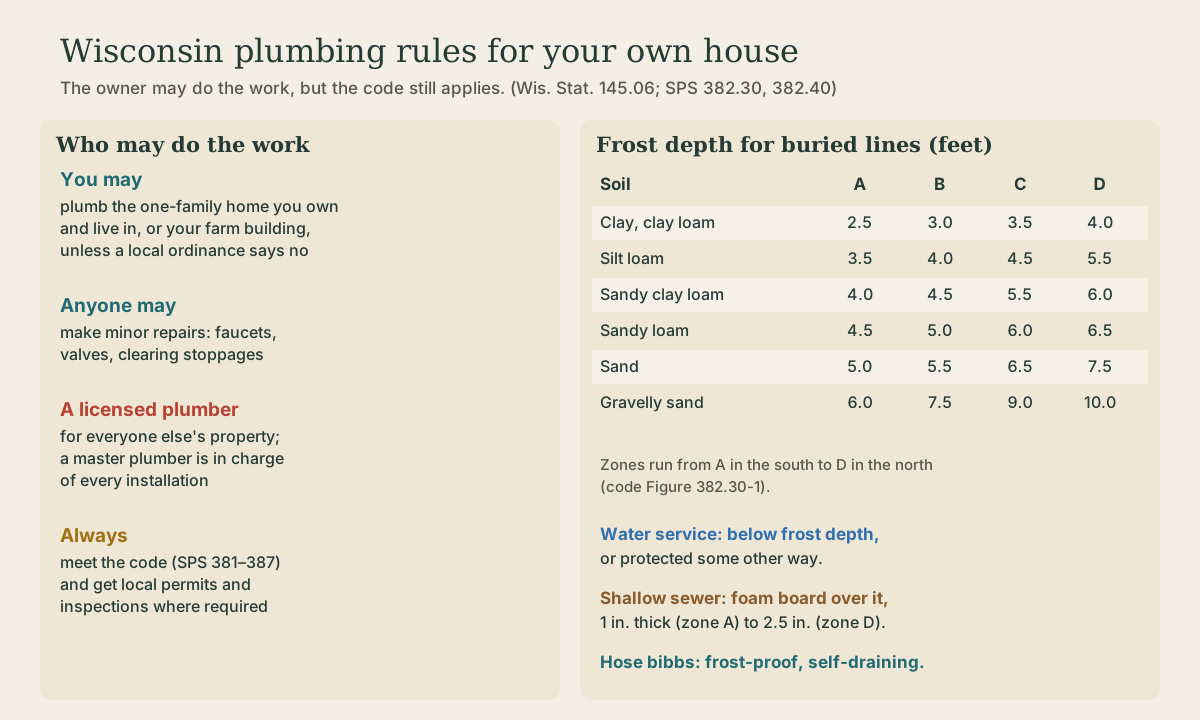
Wisconsin licenses plumbers. Under Wis. Stat. § 145.06, no one may do plumbing work without a license, and every installation needs a licensed master plumber in charge, responsible for it 1. The exemptions that matter at home 1:
- The owner-occupant: plumbing work done by a property owner in a one-family building he or she owns and occupies as a home, or in a farm building, unless a local ordinance requires a license.
- Minor repairs: fixing faucets and valves and clearing stoppages.
So you can plumb your own house, but not a rental, a two-family building, or a friend’s place. And the exemption is from licensing, not from the code: the work must still meet Wisconsin’s plumbing code, SPS 381 to 387, and local permits and inspections apply where the municipality requires them. Plumbing plans for new homes are signed by a master plumber (or a registered architect, engineer, or plumbing designer) 2, and the Uniform Dwelling Code permit lists the master plumber responsible.
Quick check
Wis. Stat. 145.06(4)(a); check for local permits and inspections.
Quick check
Installations on property you don’t own and occupy need a licensed plumber.
Frost depth for buried lines
Water services and sewers have to stay below frost. The code’s Figure 382.30-1 divides the state into frost protection zones A through D, running from the south (A) to the far north (D), and Table 382.30-6 gives the predicted frost depth by zone and backfill soil 2:
| Backfill soil | A | B | C | D |
|---|---|---|---|---|
| Clay, clay loam | 2.5 ft | 3.0 | 3.5 | 4.0 |
| Silt loam, silty clay loam | 3.5 | 4.0 | 4.5 | 5.5 |
| Sandy clay loam | 4.0 | 4.5 | 5.5 | 6.0 |
| Sandy loam, loamy sand | 4.5 | 5.0 | 6.0 | 6.5 |
| Sand | 5.0 | 5.5 | 6.5 | 7.5 |
| Gravelly sand | 6.0 | 7.5 | 9.0 | 10.0 |
Coarse, dry soils let frost go deepest; clay holds water and heat and freezes shallower. Water services must be below the predicted depth or otherwise protected 2. A building sewer that has to run shallower than frost (where snow won’t be cleared over it) gets extruded polystyrene foam over it, from 1 inch thick in zone A to 2.5 inches in zone D, sized by the code’s tables 2. Driveways and paths that are plowed bare freeze deepest of all.
Quick check
Sandy loam: 4.5 (A), 5.0 (B), 6.0 (C), 6.5 (D) feet.
Code pieces from this course
| Topic | Where in the code |
|---|---|
| Traps, vents, drain sizing and slope | SPS 382.30 to 382.31 |
| Water supply sizing, pressure, valves | SPS 382.40 |
| Cross connections and backflow | SPS 382.41 |
| Materials and joints | SPS 384.30 to 384.40 |
| Fixture flow limits and placement | SPS 384.20 |
| Wells (DNR) | NR 812 |
| Septic systems | SPS 383 |
For any project, look up the section before you buy materials, and ask the municipality whether a permit and inspection are required.
What to take from this
Wisconsin requires licensed plumbers with a master plumber in charge, except an owner working in the one-family home they own and occupy (or a farm building), unless local ordinance says otherwise, and anyone doing minor repairs. The code applies regardless. Bury water services below the predicted frost depth from the zone map and soil table (2.5 to 10 feet, deeper in sand and in the north), and insulate shallow sewers with foam board.
Lesson complete
Nice work.
Sources for this lesson
- 1Wis. Stat. § 145.06, Plumbing licenses and exemptions. Wisconsin Legislature. verifiedNo one may do plumbing work in Wisconsin unless licensed, and plumbing installations need a licensed master plumber in charge; exemptions include plumbing work done by a property owner in a one-family building he or she owns and occupies as a home, or a farm building, unless local ordinance requires a license; minor repairs such as faucets, valves, and stoppages are also exempt.
- 2Wis. Admin. Code ch. SPS 382, Design, Construction, Installation, Supervision, Maintenance and Inspection of Plumbing. Wisconsin Legislature. 2026. verifiedRegister August 2026. SPS 382.10: plumbing protects health and the waters of the state; fixtures need adequate water volume and pressure; drains must carry waste efficiently with cleanouts and enough air circulation that trap seals are never siphoned, aspirated, or forced; every dwelling on a sewer or POWTS needs at least one water closet, wash basin, kitchen sink, and tub or shower. SPS 382.30: horizontal branch drains 2 inches or less slope at least 1/4 inch per foot, larger ones 1/8 inch per foot; drainage fixture units, e.g. residential water closet 4, bathroom group 6, residential kitchen sink 2, lavatory 1, residential shower 2, residential clothes washer 4. SPS 382.31: each gravity building sewer served by at least one 3-inch stack to a vent terminal; vent terminals at least 2 inches for frost; trap-to-vent maximum developed lengths (1/4 inch per foot, sanitary tee: 1-1/4 in. 5 ft, 1-1/2 in. 6 ft, 2 in. 8 ft, 3 in. 12 ft, 4 in. 16 ft); vents not within two diameters of the weir; air admittance valves allowed with limits. SPS 382.32: trap seals 2 to 4 inches; trap primers for evaporation; prohibited traps include bell, drum, non-integral S-traps, partition, and moving-part traps. SPS 382.40: minimum flow pressure 8 psig at fixtures, 15 for washdown and siphonic water closets, 20 for one-piece tank toilets and pressure-balance or thermostatic mixing valves, 25 for blowout fixtures; over 80 psig requires a pressure reducing valve and strainer downstream of the meter and upstream of fixtures; sizing accounts for fixture load, minimum supply pressure, elevation, device losses, minimum fixture pressure, and friction.
Further reading
- Wis. Admin. Code ch. SPS 384, Plumbing Products. Wisconsin Department of Safety and Professional Services. verifiedSPS 384.40 joints: copper soldered joints per ASTM B828 with NSF-approved flux and ASTM B32 solder, lead-free for water supply (solders and fluxes over 0.2 percent lead not allowed for brass); flared joints only on annealed tube with a flaring tool; PEX joints per the manufacturer's instructions; PVC solvent joints per ASTM D2855 with F656 primer and D2564 cement; ABS solvent joints with D2235 cement; ABS-to-PVC solvent joints only in non-pressurized systems, with F656 primer on the PVC and D3138 transition cement; threaded joints get compound or tape on male threads only, and plastic may be threaded only at schedule 80 or heavier; cast iron by caulked (oakum and poured lead) or mechanical sleeve joints with C564 rubber and CISPI 310 bands; different materials joined by mechanical compression joints, with dielectric fittings to prevent galvanic corrosion.