Breakers, GFCI, and AFCI
Three protective devices with three different jobs. Breakers and fuses protect wire from overloads and short circuits; GFCIs protect people by tripping when 5 milliamps goes missing; AFCIs protect the house from arcing. How a GFCI senses a leak, why it works without a ground wire, where Wisconsin requires GFCI protection under the 2023 NEC and SPS 316, and testing them.
- 4 min
- 6 steps
- 3 questions
- Lesson 50 of 111
In this lesson
- Breakers: protecting the wire
- How a GFCI works
- Where Wisconsin requires GFCIs
- AFCI: protecting the house
- Testing
- What to take from this
Picking up where you left off.
Breakers: protecting the wire
Fuses and circuit breakers open a circuit when too much current flows. Fuses melt, breakers trip. They exist to protect conductors and equipment from overheating 1.

They handle two kinds of trouble:
- Overloads: too much connected load, a little over the rating for a long time. The breaker waits a while, then trips.
- Short circuits and ground faults on the hot: a hot wire touching neutral, ground, or grounded metal. Current jumps far past the rating and the breaker trips almost instantly 2.
A breaker never notices the 30 or 100 milliamps that can kill a person 1. That’s the GFCI’s job.
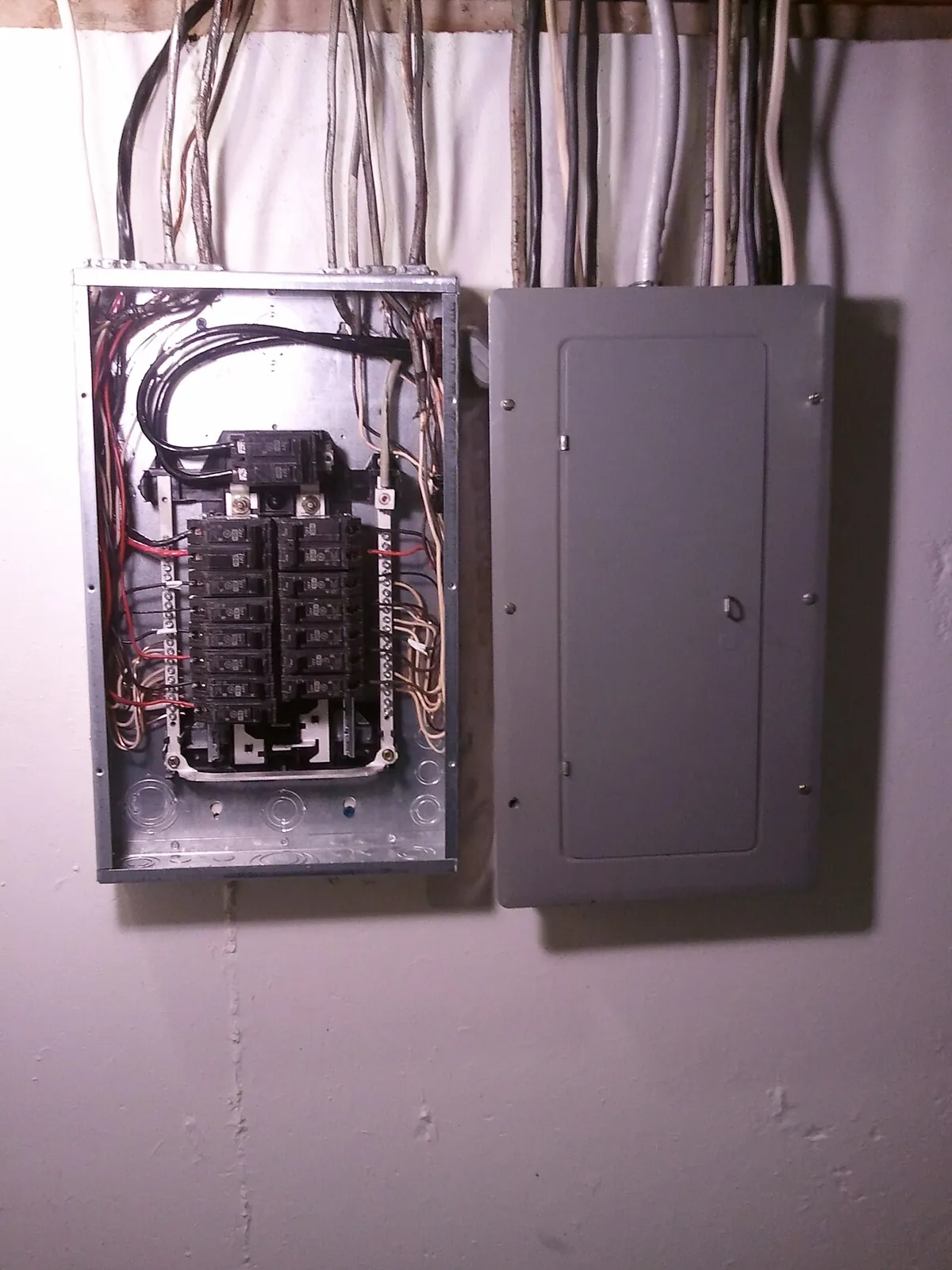
In the panel, single-pole breakers sit on one hot bus for 120-volt circuits and two-pole breakers span both for 240 volts 3.
How a GFCI works
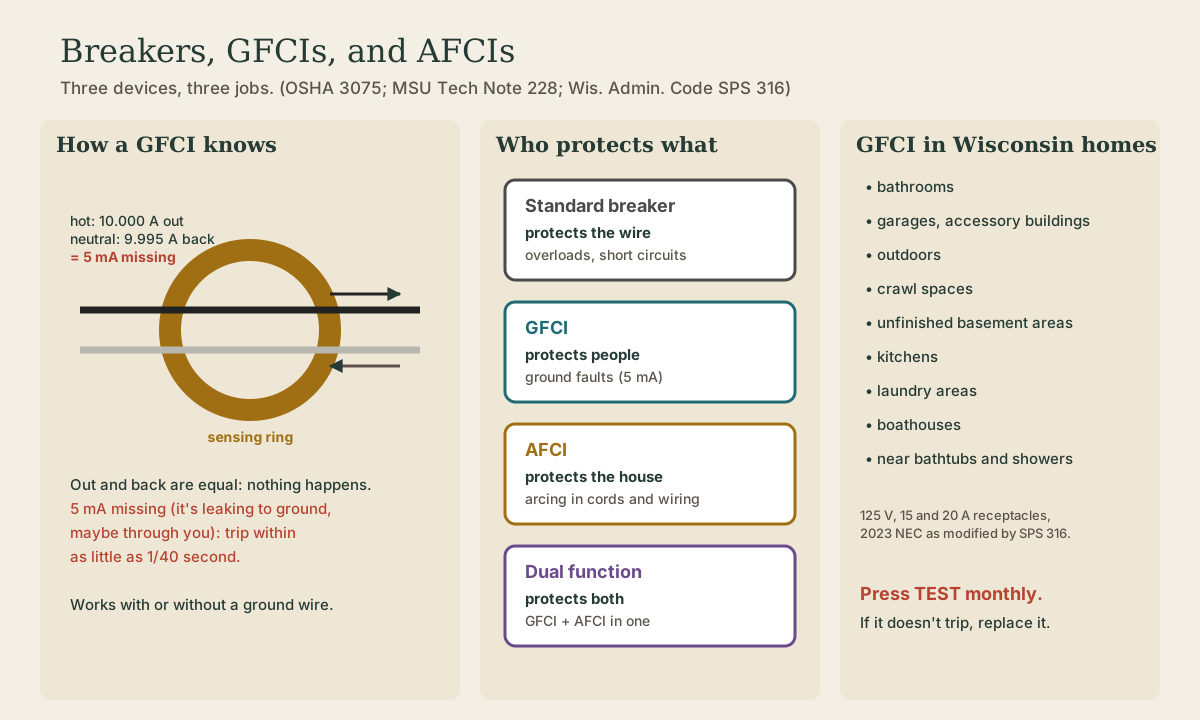
A ground-fault circuit interrupter compares the current going out on the hot with the current coming back on the neutral. Normally they’re equal. If the difference exceeds 5 milliamps, some current is leaking out of the circuit, perhaps through you to the ground, and the GFCI shuts off the power within as little as 1/40 of a second 1.
Inside, both wires pass through a small sensing coil. Equal and opposite currents cancel; an imbalance doesn’t, and the coil trips the device.
Two consequences:
- A GFCI doesn’t need a ground wire. It can protect people on an old two-wire circuit, though such outlets should be labeled “No equipment ground.”
- A GFCI doesn’t limit the shock you feel. You’ll still feel a jolt; it just ends before it can stop your heart.
GFCIs come as receptacles, which can also protect outlets downstream on the same circuit, and as breakers, which protect the whole circuit.
Quick check
If about 5 milliamps is missing, it’s leaking somewhere, maybe through a person, and the GFCI trips.
Quick check
It should be labeled ‘No equipment ground’, since it doesn’t provide a ground for three-prong plugs.
Where Wisconsin requires GFCIs
Wisconsin’s electrical code, SPS 316, adopts the 2023 National Electrical Code with state modifications 4. For dwellings, GFCI protection is required for 125-volt, single-phase, 15- and 20-amp receptacles in locations including 4:
- bathrooms,
- garages and accessory buildings,
- outdoors,
- crawl spaces,
- unfinished basement areas not intended as habitable rooms (Wisconsin’s wording),
- kitchens,
- laundry areas,
- boathouses,
- and near bathtubs and shower stalls.
Wisconsin narrows some of the 2023 NEC’s additions. It leaves out the NEC’s general within-6-feet-of-any-sink rule, some appliance outlets, and the outdoor equipment outlets requirement 4. Check SPS 316.210 and your inspector for the current details before wiring.
Every outdoor 120-volt receptacle must be GFCI protected 2.
AFCI: protecting the house
An arc-fault circuit interrupter watches for the electrical signature of arcing: a loose terminal, a cord crushed under furniture, a nail or screw through a cable. Those sparks can start fires without ever drawing enough current to trip a regular breaker. The AFCI recognizes them and de-energizes the circuit 1. The NEC requires AFCI protection for most 15- and 20-amp circuits feeding living areas in new homes, with Wisconsin modifications in SPS 316 4.
Dual-function breakers combine GFCI and AFCI protection in one device.
Quick check
AFCIs recognize the electrical signature of arcing and shut the circuit off.
Testing
Press TEST on every GFCI and AFCI monthly. The device should trip; press RESET to restore power. If it doesn’t trip, or won’t reset, replace it. A plug-in tester with a GFCI button confirms downstream outlets are protected.
Playback is optional. If the player is unavailable, open the video at its source.
What to take from this
Breakers and fuses protect wire: they trip on overloads and, almost instantly, on short circuits, but never notice the milliamps that kill. A GFCI compares hot and neutral current and trips at a 5-milliamp difference within about 1/40 second, works without a ground wire, and is required in Wisconsin homes for 125-volt receptacles in bathrooms, garages, outdoors, crawl spaces, unfinished basements, kitchens, laundry areas, boathouses, and near tubs and showers. AFCIs catch arcing that starts fires. Test them all monthly.
Lesson complete
Nice work.
Sources for this lesson
- 1Controlling Electrical Hazards (OSHA 3075). Occupational Safety and Health Administration. 2002. verifiedConductors and insulators; impurities make water conduct, and wet skin conducts; shocks happen when the body completes a path between both wires, a wire and ground, or an energized metal part and ground; effects of current hand to foot for one second: under 1 mA not felt, 1 mA faint tingle, 5 mA slight shock, 6-30 mA painful and the let-go range, 50-150 mA respiratory arrest and possible death, 1,000-4,300 mA the heart stops pumping, 10,000 mA cardiac arrest and burns; fuses and breakers protect conductors and equipment; GFCIs compare outgoing and returning current and trip at a 5 mA difference within as little as 1/40 s; AFCIs detect arcing.
- 2Electrical Tech Note 228: Grounding, Bonding, and Equipotential Grids. Michigan State University, Biosystems & Agricultural Engineering. verifiedSystem grounding ties the neutral to earth at the service to limit voltage from lightning, surges, or contact with higher-voltage lines and to stabilize voltage to earth; the equipment grounding conductor (bare or green) carries fault current back so the breaker trips and limits touch voltage; the neutral is the grounded conductor and carries current; the equipment grounding wire and neutral terminate together in the service panel; bonding joins metal parts into one continuous path; current returns to its source, not into the earth for its own sake; electrodes should be under 25 ohms if possible; 0.14 A into a 25-ohm rod gives about 3.5 V neutral-to-earth voltage; GFCI receptacles trip at 5 mA; equipotential grids in livestock and pool areas.
- 3Electrical Tech Note 219: Single-Phase, 120/240 Volt, 3-Wire Electrical System. Michigan State University, Biosystems & Agricultural Engineering. verifiedA center-tapped transformer secondary gives 120 V from the center (neutral) to either end and 240 V end to end; codes require the neutral to be grounded, at the transformer and again at the service (water pipe or ground rod at least 8 ft); balanced 120 V loads leave the neutral carrying only the difference; the panel has two bus bars; single-pole breakers make 120 V circuits (black to breaker, white to neutral bar), two-pole breakers make 240 V circuits; ranges and dryers also use the neutral.
- 4Wis. Admin. Code ch. SPS 316, Electrical. Wisconsin Legislature. verifiedSPS 316.007 adopts NFPA 70, the National Electrical Code, 2023 edition, with Wisconsin modifications; SPS 316.210 limits dwelling GFCI requirements under NEC 210.8(A) to 125-volt, single-phase, 15- and 20-ampere receptacles, applies the basement requirement to unfinished areas not intended as habitable rooms, and omits NEC 210.8(A)(7), parts of 210.8(D), 210.8(F), and 210.12(E).