Switches and Three-Way Circuits
A switch always interrupts the hot, never the neutral, so off means no power at the light. How a 3-way switch's common and two travelers work, why two of them control one light from two places, how 4-way switches add more locations, and MSU's step-by-step order for wiring a switched circuit: grounds first, then neutrals, then travelers, then hots.
- 4 min
- 5 steps
- 3 questions
- Lesson 55 of 111
In this lesson
- Switch the hot
- How 3-way switches work
- Four-ways for more locations
- A wiring order that works
- What to take from this
Picking up where you left off.
Switch the hot
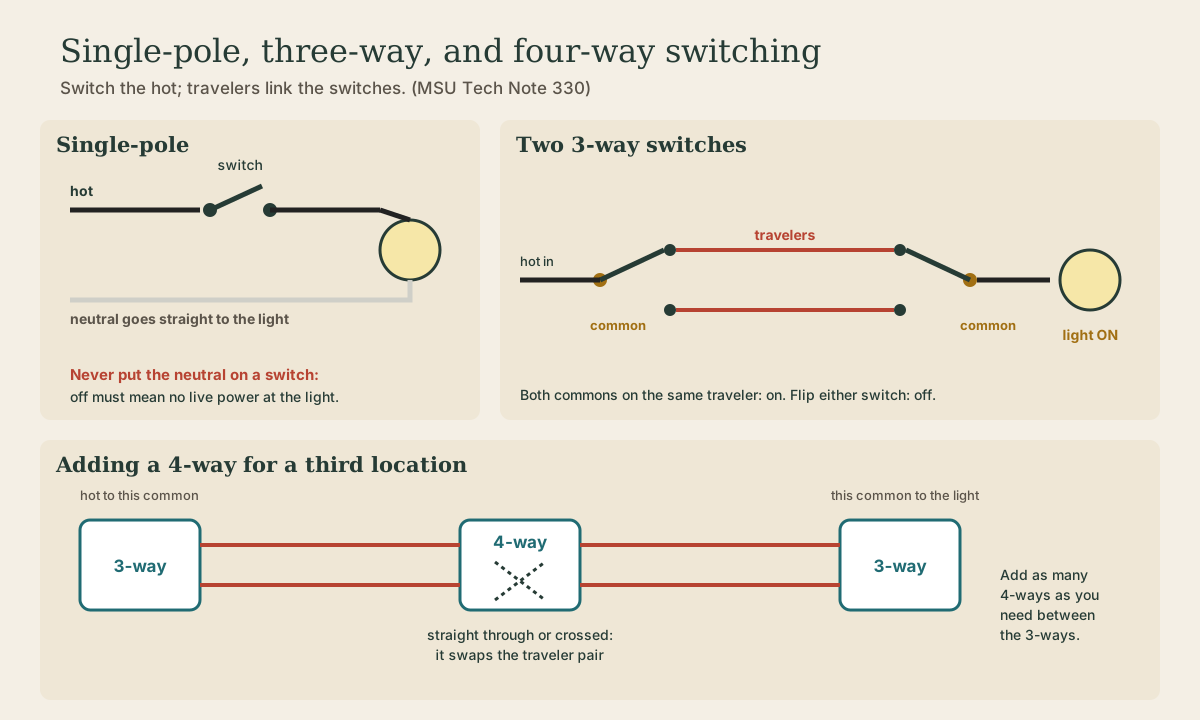
A wall switch controls a light by interrupting power on its way there. The code rule is that the neutral connects directly to the light and only the hot is interrupted by the switch. When the switch is off, nothing at the light should be live. A neutral wire should never connect to a switch controlling a light 1.
At a switch box fed with power, that means the white neutrals are spliced together and continue on to the light, untouched by the switch 1. Many switches also have a green grounding screw; if there is one, ground the switch 1.
One wrinkle: when power comes to the light first and a two-wire cable drops to the switch, the cable’s white wire has to serve as a hot. It must be re-identified (marked with black tape) at both ends, because white otherwise always means neutral.
Quick check
With the hot switched, off means nothing at the light is live.
How 3-way switches work
To control a light from two places, you use two 3-way switches. Each has three terminals 1:
- one common, usually a darker or differently colored screw,
- two travelers.
Inside, the common connects to one traveler or the other, depending on the toggle. That’s why a 3-way has no ON or OFF marked on it 1.
Wire the travelers of one switch to the travelers of the other. Bring the hot to one switch’s common, and run the other switch’s common to the light. Now the light is on whenever both commons are connected to the same traveler, and either switch can break or complete the path 1. Identify the common on each switch before wiring; manufacturers place it differently, and older switches differ from new ones 1.
Quick check
That’s why 3-way toggles aren’t marked ON and OFF.
Four-ways for more locations
For three or more locations, put a 4-way switch between the two 3-ways. All four of its terminals are travelers, in two pairs. One 3-way’s travelers go to one pair; the other pair continues to the other 3-way. The 4-way either passes the travelers straight through or crosses them. You can install as many 4-ways in a row as you need 1.
Quick check
Each 4-way swaps or straightens the traveler pair.
A wiring order that works
MSU recommends wiring a switched circuit systematically, one kind of wire at a time, rather than all at once 1:
- Grounds: connect all the equipment grounds at every box, then push them back out of the way. Metal boxes, receptacles, and switches with grounding screws all get grounded.
- Neutrals: run the white neutrals to every place power is used, the receptacles and lights. Never to a switch.
- Travelers: connect the traveler terminals of one 3-way to the other’s, usually with the red and black of a 3-wire cable.
- Hots: bring the hot to the first common, and run the second common to the light.
Done in that order, you can check each step on its own, and the circuit works the first time.
Playback is optional. If the player is unavailable, open the video at its source.
What to take from this
Switches interrupt only the hot; neutrals run straight to the light and never touch a switch. A 3-way switch has a common and two travelers, and the common connects to one traveler or the other. Link the travelers of two 3-ways, feed one common, and run the other to the light. 4-way switches between them add more locations. Wire grounds, then neutrals, then travelers, then hots.
Lesson complete
Nice work.
Sources for this lesson
- 1Electrical Tech Note 330: Wiring Circuits, Basic Rules. Michigan State University, Biosystems & Agricultural Engineering. verifiedEach hot wire is about 120 V to earth and 240 V hot to hot; voltages above about 15 V can be dangerous; NM-B cable for dwellings is commonly 14 AWG for 15 A circuits (white jacket), 12 AWG for 20 A (yellow), and 10 AWG for 30 A (orange); NM cable is for dry locations only; keep the equipment grounding conductor continuous; one wire per device screw terminal.