Working Safely: Shutoff and Testing
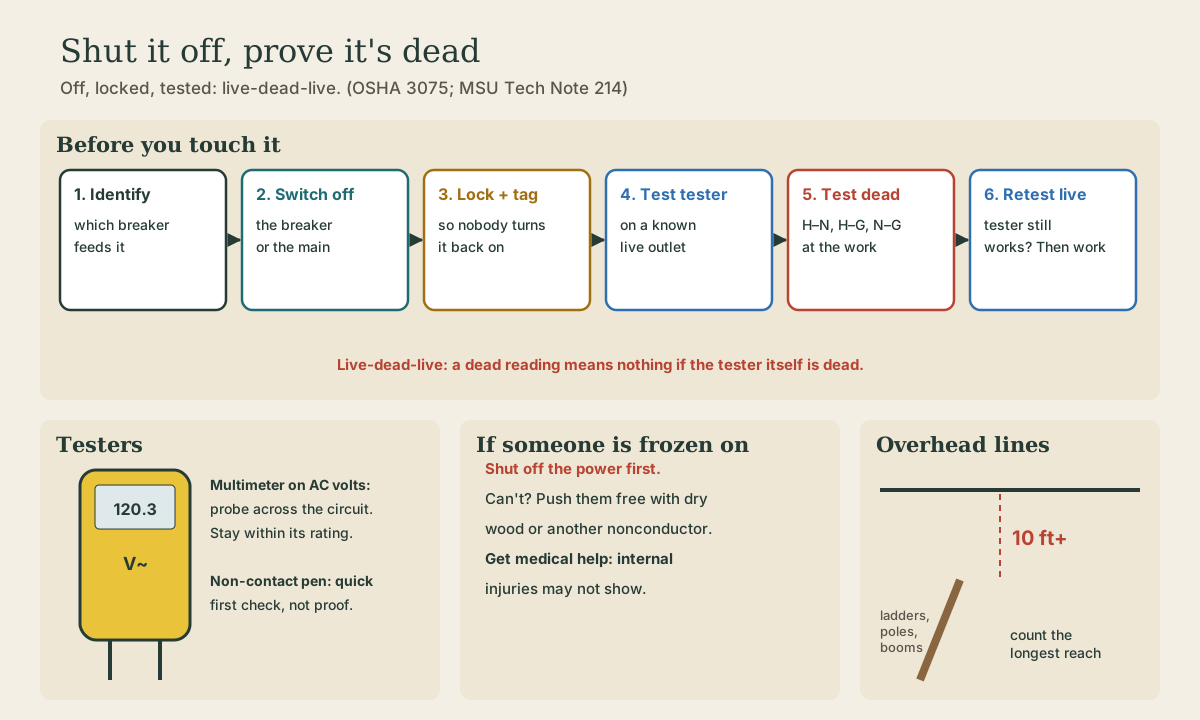
The routine that prevents almost every home-wiring injury: identify the circuit, switch off and lock or tag the breaker, prove your tester on a known live circuit, test dead at the work (hot to neutral, hot to ground, neutral to ground), and prove the tester again. Using a multimeter versus a non-contact pen, what to do if someone is frozen to a live wire, and the 10-foot rule for overhead lines.
- 4 min
- 6 steps
- 3 questions
- Lesson 57 of 111
In this lesson
- Off and locked
- Prove it dead
- Why so careful
- If someone is shocked
- Overhead lines
- What to take from this
Picking up where you left off.
Off and locked
OSHA’s first rule for any electrical repair is simple: turn the current off before inspecting or repairing, then lock the switch in the OFF position and tag it so everyone knows why, “even on so-called low-voltage circuits” 1.
At home that means:
- Identify the circuit. Plug a radio or lamp in, flip breakers until it goes off, and label the panel as you go. If you can’t be sure, turn off the main.
- Switch it off.
- Lock or tag it. A breaker lockout clip with a padlock costs a few dollars; at minimum, tape a note over the breaker. The danger is someone else “fixing” the dead circuit while your hands are in a box.
Remember that the main breaker doesn’t de-energize the service conductors ahead of it, and that multiwire circuits can share a neutral with another breaker.
Quick check
OSHA’s first step before any repair: turn the current off and lock the switch in the OFF position, even on low-voltage circuits.
Prove it dead
A switched-off breaker is a belief, not a fact. Prove it, and prove the tester too: live-dead-live.
- Test the tester on a known live outlet.
- Test the work dead: hot to neutral, hot to ground, and neutral to ground, on every conductor in the box. A box can hold more than one circuit.
- Test the tester on the live outlet again. If it died between tests, your “dead” reading meant nothing.
A digital multimeter set to AC volts (the V with a wavy line) gives a real reading when you touch the probes across two conductors; keep within the meter’s rated voltage 2. Resistance checks are only for circuits with the power off, because the meter supplies its own current 2.
A non-contact voltage tester (the pen that beeps) is a fast first check, but it can miss a live conductor or false-alarm on a dead one. Use it to find hot wires; use a two-probe tester to confirm dead.
Quick check
A dead battery or broken lead also reads zero.
If someone is shocked
If a person is frozen to a live contact, shut off the current immediately. If you can’t, push or pull them free with a dry board, pole, or other nonconductor, protecting yourself first. Then get emergency medical help: a severe shock can cause internal bleeding and tissue damage that doesn’t show on the surface 1.
Quick check
Protect yourself; severe shocks can cause internal injuries that don’t show.
Overhead lines
Unqualified people and their equipment stay at least 10 feet from overhead power lines, farther for very high voltages, and the distance counts the longest reach of a ladder, pole, or boom 1. Carrying an aluminum ladder or a pole saw under a service drop is how many rural electrocutions happen.
Playback is optional. If the player is unavailable, open the video at its source.
What to take from this
Identify the circuit, switch it off, and lock or tag it. Then prove it dead with live-dead-live: tester on a known live source, test every conductor at the work, tester on the live source again. Use a two-probe tester to confirm; a non-contact pen only screens. If someone is frozen to a live wire, kill the power or push them free with a nonconductor and get help. Keep yourself and anything you carry 10 feet from overhead lines.
Lesson complete
Nice work.
Sources for this lesson
- 1Controlling Electrical Hazards (OSHA 3075). Occupational Safety and Health Administration. 2002. verifiedConductors and insulators; impurities make water conduct, and wet skin conducts; shocks happen when the body completes a path between both wires, a wire and ground, or an energized metal part and ground; effects of current hand to foot for one second: under 1 mA not felt, 1 mA faint tingle, 5 mA slight shock, 6-30 mA painful and the let-go range, 50-150 mA respiratory arrest and possible death, 1,000-4,300 mA the heart stops pumping, 10,000 mA cardiac arrest and burns; fuses and breakers protect conductors and equipment; GFCIs compare outgoing and returning current and trip at a 5 mA difference within as little as 1/40 s; AFCIs detect arcing.
- 2Electrical Tech Note 214: Measuring Voltage, Resistance and Current. Michigan State University, Biosystems & Agricultural Engineering. verifiedUse the AC volts setting to measure voltage by touching both circuit conductors; keep measurements within the meter's withstand rating; resistance measurements require the power disconnected because the meter supplies its own current; a clamp-on ammeter measures AC current in the field.
- 3Electrical Tech Note 216: Electric Shock and Safety. Michigan State University, Biosystems & Agricultural Engineering. verifiedShock is current through the body; thousandths of an ampere can be felt; most shock fatalities are reported to come from contact with 120 V; an equipment grounding conductor keeps a faulted frame from reaching dangerous voltage.