Two-Prong Outlets and Ungrounded Circuits
Old houses are full of two-prong outlets on circuits with no ground wire. You can't just swap in a three-prong outlet and call it grounded, and you should never jumper the neutral to the ground screw. The code gives four honest choices: another two-prong outlet; a GFCI outlet marked "No Equipment Ground"; three-prong outlets downstream of a GFCI, each labeled; or running a real ground. Why a GFCI protects you even without a ground, and why a cheap plug-in tester can't catch the most dangerous mistake.
- 4 min
- 7 steps
- 2 questions
- Lesson 65 of 111
In this lesson
- The problem
- Four honest choices
- Why a GFCI works without a ground
- Never the bootleg ground
- Adding outlets is different
- Try it
Picking up where you left off.
Two-prong outlets are a hallmark of an old house, and so is the frustration of a three-prong plug with nowhere to go. The temptation is to buy a pack of three-prong outlets and swap them in. Don’t, at least not without one of the fixes below.
The problem
A three-prong outlet’s round hole connects to the equipment grounding conductor, a path that carries fault current back to the panel and trips the breaker if a hot wire touches a metal case. Old two-wire circuits, whether knob-and-tube or early cable, simply don’t have that wire. Wiring installed before about 1965 often didn’t require one 1. A three-prong outlet on such a circuit has a ground hole connected to nothing, which looks safe and isn’t.
Four honest choices
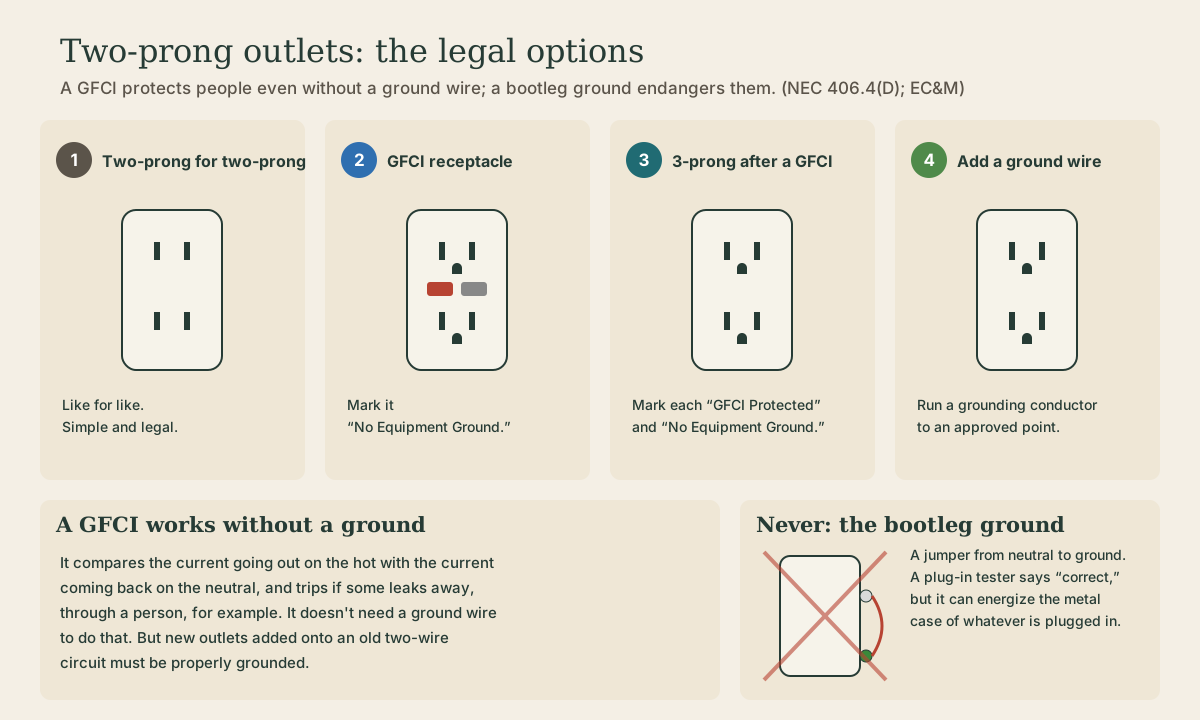
When the box has no grounding means, the code allows you to replace an outlet with 2:
- Another two-prong outlet. Like for like.
- A GFCI outlet, marked “No Equipment Ground.”
- Three-prong outlets supplied through a GFCI, either a GFCI outlet upstream on the same circuit or a GFCI breaker, with each outlet marked “GFCI Protected” and “No Equipment Ground.” (GFCI outlets come with these stickers.)
- A real ground: run an equipment grounding conductor to the box from an acceptable grounding point, and then install a normal grounded outlet 2.
One more rule: if you’re replacing an outlet in a place where GFCI protection is now required, like a kitchen counter, bathroom, or basement, the replacement must be GFCI protected regardless 2.
Why a GFCI works without a ground
A GFCI doesn’t need a ground wire to protect people. It constantly compares the current going out on the hot with the current coming back on the neutral. If some is missing, it’s leaking somewhere it shouldn’t, perhaps through you to the floor, and the GFCI shuts off in a fraction of a second. That’s why the code accepts it as the fix for two-wire circuits.
What a GFCI doesn’t provide is a grounding path for equipment that wants one, such as some electronics and surge protectors. Hence the “No Equipment Ground” label: it tells the next person the truth.
A practical trick: one GFCI outlet at the first outlet on the circuit can protect every outlet downstream if you connect them to its “load” terminals, so you can install ordinary three-prong outlets after it, each with the stickers.
Never the bootleg ground
The dangerous shortcut is the bootleg ground: installing a three-prong outlet and running a short jumper from the neutral screw to the ground screw. It’s a code violation that turns up more often than you’d think 1. And it’s sneaky: a cheap three-light plug-in tester, and even voltage readings between the slots, will often say the outlet is wired correctly 1. If the hot and neutral are also reversed somewhere upstream, the bootleg ground can energize the metal case of whatever’s plugged in 1.
If you buy an old house, look behind a few three-prong outlets on old circuits. A jumper from the silver screw to the green screw means that outlet needs to be fixed.
Quick check
That’s a bootleg ground: it fools testers and can put current on an appliance’s metal case.
Adding outlets is different
The GFCI option covers replacing existing outlets. If you extend an old two-wire circuit to add a new outlet, the new outlet must be the grounding type and actually grounded 2. The code’s logic is that it won’t make you rip out old wiring, but it won’t let you build onto it the old way either 2. In practice, a new outlet in an old house usually means a new circuit run in modern cable, which is the subject of the next lesson.
Playback is optional. If the player is unavailable, open the video at its source.
Quick check
The GFCI option is for replacing existing outlets, not for extending an old system.
Try it
Walk the house with a GFCI-equipped plug-in tester and a notepad. Note which outlets are two-prong, which are three-prong showing “open ground,” and which show correct. Then pick one circuit and plan the fix: a GFCI at the first outlet, with labels downstream, is often an afternoon’s work.
Lesson complete
Nice work.
Sources for this lesson
- 1Mike Sokol. Failures in Outlet Testing Exposed. EC&M (Electrical Construction & Maintenance). 2013. verifiedJuly 15, 2013. Pre-1965 wiring often has no equipment ground. A bootleg (false) ground is created when a grounded receptacle is installed on an ungrounded circuit and the ground screw is strapped to the neutral screw; a code violation that occurs more often than you'd think. A 3-light plug-in tester, and even voltage readings between hot, neutral, and ground, can show such outlets as correctly wired, especially the reverse-polarity bootleg ground, which can energize equipment chassis. Per NEC 250.130(C), add a proper equipment ground or use GFCI protection.
- 2Article 406: Receptacles. EC&M (Electrical Construction & Maintenance). verifiedReplacing a receptacle where the box has no grounding means (e.g., old 2-wire cable without a ground): use a nongrounding-type receptacle; or a GFCI receptacle marked 'No Equipment Ground'; or a grounding-type receptacle that is GFCI-protected and marked 'GFCI Protected' and 'No Equipment Ground.' A replacement in a location where GFCI protection is now required must be GFCI-protected (210.8). The GFCI option doesn't apply to new outlets extended from an existing ungrounded box: a branch-circuit extension must be grounding type and grounded per 250.130(C).