Water Pressure and Pipe Sizing
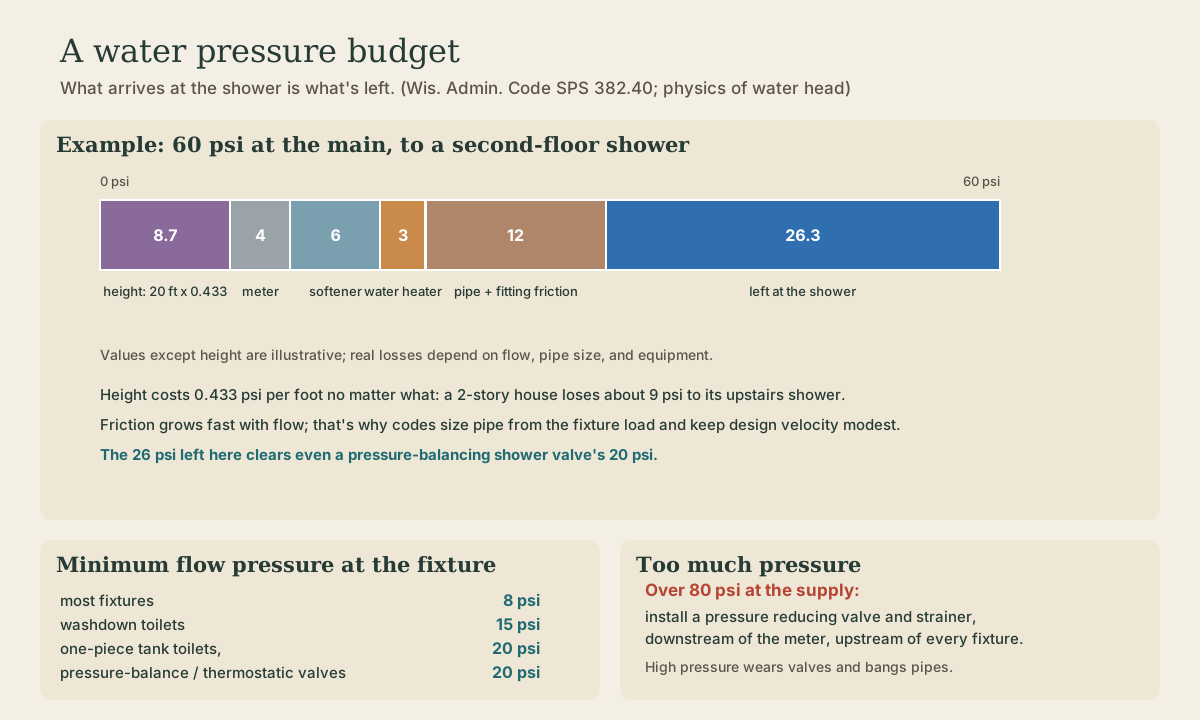
Pressure available at the main or pressure tank gets spent on height (0.433 psi per foot), the meter, softener, and water heater, and friction, and what's left must meet the code's minimum flow pressure at each fixture: 8 psi for most, 20 for one-piece toilets and pressure-balancing shower valves. Static versus flow pressure, why over 80 psi requires a pressure reducing valve, and how pipe sizing balances load, pressure, and friction.
- 4 min
- 7 steps
- 3 questions
- Lesson 30 of 111
In this lesson
- Static and flow pressure
- Height costs pressure
- Where the rest goes
- What the fixture needs
- Too much pressure
- Try it
- What to take from this
Picking up where you left off.
Static and flow pressure
Water pressure is measured in pounds per square inch (psi). Two numbers matter:
- Static pressure: with every tap closed. A gauge on an outdoor hose bibb with nothing running reads static.
- Flow pressure: what’s left at a fixture while water is running. It’s always lower, because moving water loses pressure to friction and equipment.
Fixtures care about flow pressure. Wisconsin’s plumbing code sets minimums at the fixture outlet, and every supply system has to be designed to deliver them 1.
Height costs pressure
Water has weight. A column of water one foot tall presses on its base with about 0.433 psi: pressure in a fluid rises with depth as density times gravity times height 2. Run that backward and every foot you lift water costs 0.433 psi.
So a second-floor shower 20 feet above the basement meter starts out about 8.7 psi behind before a drop flows. Flip it around and 2.31 feet of water makes one psi, which is why water towers are tall and why a well pump’s pressure switch has to account for the height of the house.
Quick check
A column of water one foot tall exerts 0.433 psi at its base, so every foot of rise costs that much.
Where the rest goes
Wisconsin’s code lists what a supply design has to account for 1:
- the fixture load on each pipe (in water supply fixture units or gallons per minute),
- the minimum pressure available at the main or pressure tank,
- pressure lost to elevation,
- pressure lost through the water heater, water treatment devices, meter, and backflow preventers,
- the minimum flow pressure the controlling fixture needs,
- pressure lost to friction in pipe, fittings, and valves.
Friction rises steeply with flow: double the flow through the same pipe and the friction loss roughly triples or quadruples. That’s what pipe sizing fights. Bigger pipe means slower water and less friction. The code’s tables give the maximum load each size of copper, PEX, CPVC, or steel pipe can carry, and larger-than-minimum piping must still flush effectively at 8 feet per second 1.
What the fixture needs
Wisconsin’s minimum flow pressures at the fixture supply outlet 1:
| Fixture | Minimum flow pressure |
|---|---|
| Most fixtures | 8 psi |
| Washdown and siphonic toilets, flushometer toilets | 15 psi |
| One-piece tank toilets, pressure-balance and thermostatic mixing valves, manufactured homes | 20 psi |
| Blowout toilets and urinals | 25 psi |
| Anything else | what the manufacturer specifies |
A shower that turns weak when someone flushes downstairs is a house running near those minimums.
Quick check
Most fixtures need 8 psi; one-piece tank toilets and pressure-balance or thermostatic valves need 20.
Too much pressure
High pressure is a problem too: it hammers valves, makes pipes bang when taps close, and wastes water. If the pressure from the main or a private supply exceeds 80 psi, Wisconsin requires a pressure reducing valve and strainer, installed downstream of the meter and upstream of every fixture 1. A screw-on gauge at a hose bibb tells you where you stand for a few dollars.
Quick check
Above 80 psig a PRV is required. High pressure wears valves, bangs pipes, and wastes water.
Try it
Thread a pressure gauge onto a basement hose bibb. Read it with everything off (static). Then open an upstairs shower and read again (flow, plus height). The difference shows what your pipes, meter, softener, and stairs cost you.
What to take from this
Fixtures need flow pressure: 8 psi for most, 20 for one-piece toilets and pressure-balance shower valves. Pressure from the main gets spent on height (0.433 psi per foot), the meter, softener, water heater, and friction, which grows fast with flow; pipe sizing balances these against the fixture load. Over 80 psi requires a pressure reducing valve. A $10 gauge tells you static and flow pressure.
Lesson complete
Nice work.
Sources for this lesson
- 1Wis. Admin. Code ch. SPS 382, Design, Construction, Installation, Supervision, Maintenance and Inspection of Plumbing. Wisconsin Legislature. 2026. verifiedRegister August 2026. SPS 382.10: plumbing protects health and the waters of the state; fixtures need adequate water volume and pressure; drains must carry waste efficiently with cleanouts and enough air circulation that trap seals are never siphoned, aspirated, or forced; every dwelling on a sewer or POWTS needs at least one water closet, wash basin, kitchen sink, and tub or shower. SPS 382.30: horizontal branch drains 2 inches or less slope at least 1/4 inch per foot, larger ones 1/8 inch per foot; drainage fixture units, e.g. residential water closet 4, bathroom group 6, residential kitchen sink 2, lavatory 1, residential shower 2, residential clothes washer 4. SPS 382.31: each gravity building sewer served by at least one 3-inch stack to a vent terminal; vent terminals at least 2 inches for frost; trap-to-vent maximum developed lengths (1/4 inch per foot, sanitary tee: 1-1/4 in. 5 ft, 1-1/2 in. 6 ft, 2 in. 8 ft, 3 in. 12 ft, 4 in. 16 ft); vents not within two diameters of the weir; air admittance valves allowed with limits. SPS 382.32: trap seals 2 to 4 inches; trap primers for evaporation; prohibited traps include bell, drum, non-integral S-traps, partition, and moving-part traps. SPS 382.40: minimum flow pressure 8 psig at fixtures, 15 for washdown and siphonic water closets, 20 for one-piece tank toilets and pressure-balance or thermostatic mixing valves, 25 for blowout fixtures; over 80 psig requires a pressure reducing valve and strainer downstream of the meter and upstream of fixtures; sizing accounts for fixture load, minimum supply pressure, elevation, device losses, minimum fixture pressure, and friction.
- 2University Physics, Volumes 1–3. OpenStax (Rice University). verifiedOpen calculus-based physics. Vol 1 mechanics; Vol 2 thermodynamics and electricity & magnetism; Vol 3 optics & modern physics. Cited at: Pressure.