Showers and Tubs
What a pressure-balancing shower valve does when a toilet flushes (keeps the temperature steady so nobody gets scalded), Wisconsin's shower rules: at least 900 square inches with a 30-inch circle (or 1,300 with a 25-inch circle), a 2-inch drain, showerheads limited to 2.5 gpm (WaterSense 2.0), and 20 psi flowing at balancing valves; plus 120 °F at the heater and the tub's trap and overflow.
- 4 min
- 5 steps
- 3 questions
- Lesson 38 of 111
In this lesson
- Steady temperature
- Room to shower
- Water use
- Tubs
- What to take from this
Picking up where you left off.
Steady temperature
A shower valve mixes hot and cold. The trouble comes when the pressure on one side changes suddenly: a toilet flushes, the cold-side pressure drops, and the shower turns scalding hot.
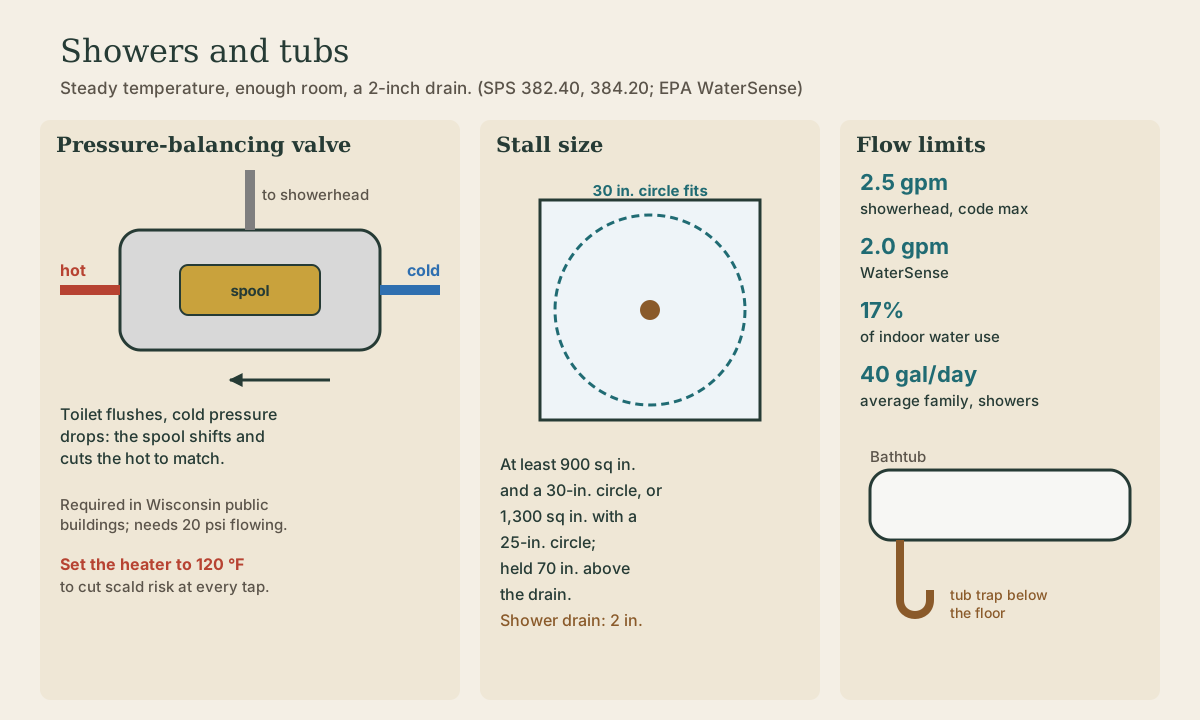
A pressure-balancing valve has a spool (or diaphragm) between the hot and cold inlets that senses both pressures. When cold pressure drops, the spool shifts and throttles the hot side to match, so the mix stays about the same temperature, just with less flow. A thermostatic valve goes further and holds a set outlet temperature directly.
Wisconsin requires thermostatic or pressure-balancing valves (to ASSE 1016) on showers in public buildings 1, and they’re the standard choice in homes too. Balancing and thermostatic valves need at least 20 psi of flowing pressure at their supply 1; on a well with a 30/50 switch, that’s another reason the cut-in pressure matters.
The other half of scald protection is the heater: set the water heater to about 120 °F, which saves energy and reduces scalding risk at every tap 2.
Quick check
Without it, the sudden loss of cold water can turn the shower scalding hot.
Room to shower
Wisconsin’s minimum shower size 3:
- At least 900 square inches of finished interior area, and able to hold a 30-inch circle; or
- if it can’t fit a 30-inch circle, at least 1,300 square inches and able to hold a 25-inch circle.
- Both measured 24 inches above the top of the threshold, and kept clear up to 70 inches above the drain, except for the valve, showerhead, soap dishes, seats, and grab bars.
A 30 by 30 inch stall is exactly 900 square inches and just fits the circle; a 32 by 32 is more comfortable.
Drains: shower waste outlets must be at least 2 inches in diameter with a removable strainer, except combination tub-showers 3. A shower that replaces a bathtub in an existing home may keep the tub’s 1 1/2-inch trap if it has one control valve, one showerhead at a time, and a head of no more than 2.5 gpm 1.
Quick check
Measured 24 inches above the threshold and held up to 70 inches above the drain.
Water use
Wisconsin limits showerheads to 2.5 gallons per minute at 80 psi 3. WaterSense showerheads use 2.0 gpm or less 4. Showers are nearly 17 percent of indoor water use, about 40 gallons a day for an average family, and a WaterSense head saves about 2,700 gallons and more than 330 kilowatt-hours of water-heating energy a year 4.
Quick check
Showers are about 17 percent of indoor water use.
Tubs
A bathtub drains through a trap below the floor, usually 1 1/2-inch, with an overflow near the rim that joins the drain above the trap so an unattended tub can’t run over. The waste-and-overflow assembly needs an access panel or careful sealing, because a leak there soaks the ceiling below. Whirlpool tubs must drain their piping and pump by gravity to the tub’s trap 3.
Tub and shower valves wear the same way faucets do (washers, cartridges, seals). Most single-handle valves have built-in stops behind the trim, so the cartridge can be changed without shutting off the whole house.
Playback is optional. If the player is unavailable, open the video at its source.
What to take from this
A pressure-balancing or thermostatic valve keeps shower temperature steady when another fixture draws water; Wisconsin requires them in public buildings, they need 20 psi flowing, and a 120 °F heater setting adds a second layer of scald protection. Showers need 900 square inches with a 30-inch circle (or 1,300 with a 25-inch circle) and a 2-inch drain. Showerheads are limited to 2.5 gpm; WaterSense heads use 2.0.
Lesson complete
Nice work.
Sources for this lesson
- 1Wis. Admin. Code ch. SPS 382, Design, Construction, Installation, Supervision, Maintenance and Inspection of Plumbing. Wisconsin Legislature. 2026. verifiedRegister August 2026. SPS 382.10: plumbing protects health and the waters of the state; fixtures need adequate water volume and pressure; drains must carry waste efficiently with cleanouts and enough air circulation that trap seals are never siphoned, aspirated, or forced; every dwelling on a sewer or POWTS needs at least one water closet, wash basin, kitchen sink, and tub or shower. SPS 382.30: horizontal branch drains 2 inches or less slope at least 1/4 inch per foot, larger ones 1/8 inch per foot; drainage fixture units, e.g. residential water closet 4, bathroom group 6, residential kitchen sink 2, lavatory 1, residential shower 2, residential clothes washer 4. SPS 382.31: each gravity building sewer served by at least one 3-inch stack to a vent terminal; vent terminals at least 2 inches for frost; trap-to-vent maximum developed lengths (1/4 inch per foot, sanitary tee: 1-1/4 in. 5 ft, 1-1/2 in. 6 ft, 2 in. 8 ft, 3 in. 12 ft, 4 in. 16 ft); vents not within two diameters of the weir; air admittance valves allowed with limits. SPS 382.32: trap seals 2 to 4 inches; trap primers for evaporation; prohibited traps include bell, drum, non-integral S-traps, partition, and moving-part traps. SPS 382.40: minimum flow pressure 8 psig at fixtures, 15 for washdown and siphonic water closets, 20 for one-piece tank toilets and pressure-balance or thermostatic mixing valves, 25 for blowout fixtures; over 80 psig requires a pressure reducing valve and strainer downstream of the meter and upstream of fixtures; sizing accounts for fixture load, minimum supply pressure, elevation, device losses, minimum fixture pressure, and friction.
- 2Wendell A. Porter, Kathleen C. Ruppert, Randall A. Cantrell. Energy Efficient Homes: Water Heaters (FY1025). University of Florida IFAS Extension. verifiedWater heating is the second-largest home energy expense, 14 to 18 percent of the utility bill; set the thermostat to 120 °F for efficiency and to reduce scalding (electric heaters have two thermostats, set them the same); drain about a quart every 3 to 6 months to remove sediment; tankless units heat on demand without storage; heat pump water heaters move heat rather than making it; the T&P valve releases excess heat and pressure; consider replacing a heater over 10 years old.
- 3Wis. Admin. Code ch. SPS 384, Plumbing Products. Wisconsin Department of Safety and Professional Services. verifiedSPS 384.40 joints: copper soldered joints per ASTM B828 with NSF-approved flux and ASTM B32 solder, lead-free for water supply (solders and fluxes over 0.2 percent lead not allowed for brass); flared joints only on annealed tube with a flaring tool; PEX joints per the manufacturer's instructions; PVC solvent joints per ASTM D2855 with F656 primer and D2564 cement; ABS solvent joints with D2235 cement; ABS-to-PVC solvent joints only in non-pressurized systems, with F656 primer on the PVC and D3138 transition cement; threaded joints get compound or tape on male threads only, and plastic may be threaded only at schedule 80 or heavier; cast iron by caulked (oakum and poured lead) or mechanical sleeve joints with C564 rubber and CISPI 310 bands; different materials joined by mechanical compression joints, with dielectric fittings to prevent galvanic corrosion.
- 4Showerheads. U.S. EPA WaterSense. verifiedStandard showerheads use 2.5 gallons per minute; WaterSense showerheads no more than 2.0; showering is nearly 17 percent of residential indoor water use, about 40 gallons a day for the average family; a WaterSense showerhead saves an average family 2,700 gallons and over 330 kWh a year.