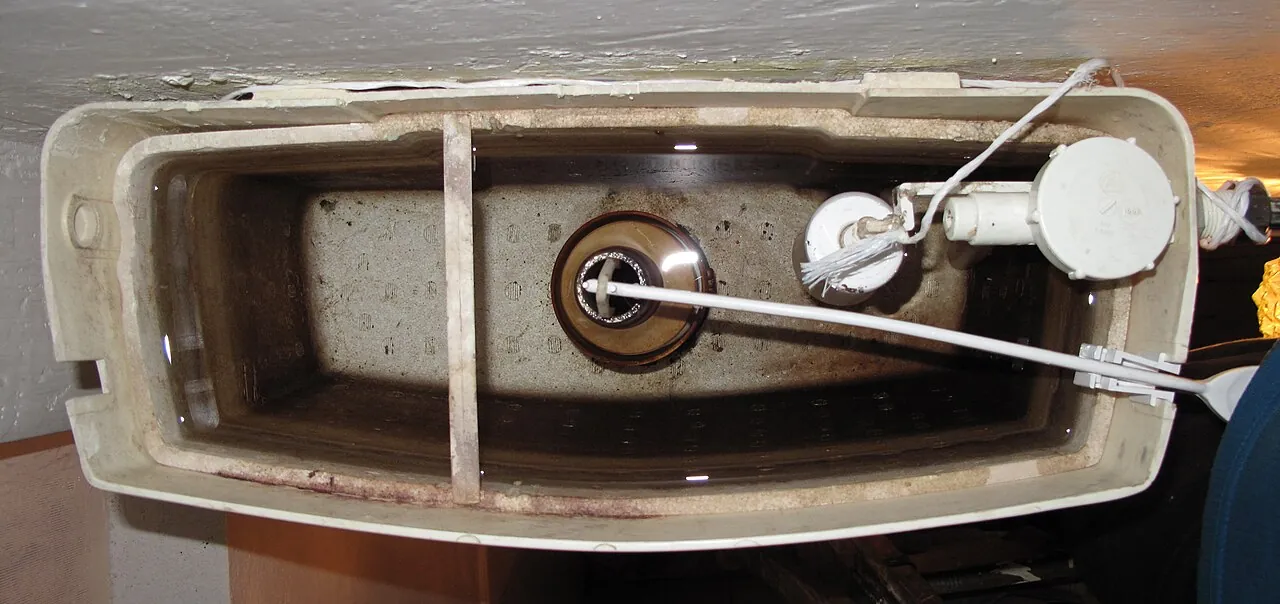
Toilets
How a gravity toilet flushes (the flapper drops the tank into the bowl and starts a siphon in the trapway) and refills (an anti-siphon fill valve whose critical level sits an inch above the overflow), Wisconsin's limits (1.6 gallons per flush; 15 inches from the center to a side wall, 24 inches clear in front), WaterSense toilets at 1.28 gpf, and finding a silent flapper leak with the dye test.
- 5 min
- 5 steps
- 3 questions
- Lesson 36 of 111
In this lesson
- One flush
- How much water
- Finding a leak
- Setting a toilet
- What to take from this
Picking up where you left off.
One flush
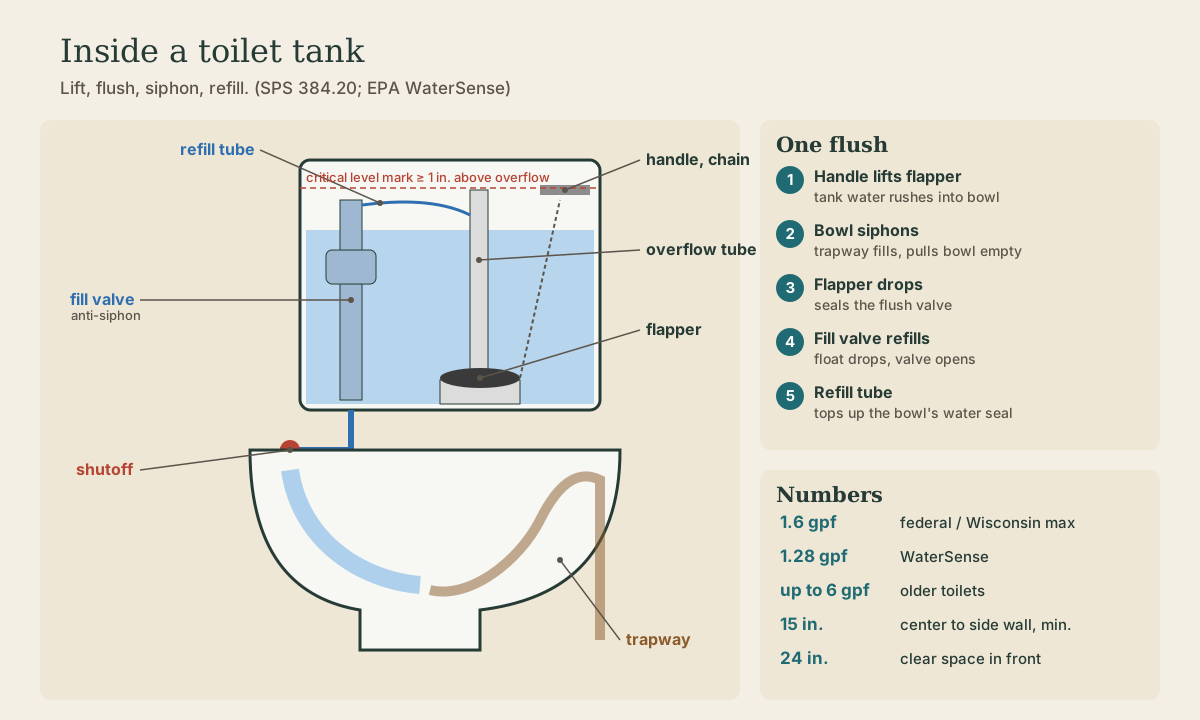
A gravity toilet stores a few gallons in its tank. Push the handle and 1:

- The handle’s chain lifts the flapper, a rubber seal over the flush valve at the bottom of the tank.
- Tank water rushes into the bowl, through holes under the rim and often a jet at the bottom.
- The surge fills the curved trapway in the base of the bowl enough to start a siphon, which pulls the bowl empty until air gets in and breaks it with the familiar gurgle.
- The flapper drops back onto the flush valve once the tank drains.
- The float drops with the water, opening the fill valve, which refills the tank. A small refill tube sends some water down the overflow tube to refill the bowl, restoring the water that seals sewer gas out.
The fill valve must be the anti-siphon type, with its critical level mark at least 1 inch above the top of the overflow tube, so tank water can never be siphoned back into the supply 1. Each toilet gets its own shutoff valve on the supply.
Quick check
Tank water fills the trapway enough to start the siphon, which pulls the bowl down until air breaks it.
How much water
Wisconsin’s code limits toilets to 1.6 gallons per flush, the same as the federal standard 1 2. Older toilets used as much as 6 gallons. EPA’s WaterSense label goes to toilets using 1.28 gallons or less that also pass independent flushing tests; replacing older toilets can cut toilet water use 20 to 60 percent, nearly 13,000 gallons a year for a home 2. Toilets are nearly 30 percent of a home’s indoor water use 2, so on a private well and septic system, that’s also water the pump and drainfield don’t have to handle.
Finding a leak
A toilet that runs on its own, or hisses now and then, is usually leaking past the flapper; the fill valve tops the tank back up. EPA’s dye test 3:
- Put a few drops of food coloring in the tank.
- Don’t flush for 10 minutes.
- Color in the bowl means the flapper (or flush valve seat) leaks. Flush afterward so the dye doesn’t stain.
A worn flapper can silently leak thousands of gallons a year 3, and it’s a few dollars to replace: shut off the supply, flush to empty the tank, unhook the old flapper from the overflow tube’s ears, and match the new one to the flush valve size (2 or 3 inches).
If water runs into the overflow tube instead, the fill valve is shutting off too high; adjust the float down until the water stops about an inch below the top of the overflow. If the fill valve won’t stop or hisses constantly, replace it.
Quick check
A worn flapper can leak thousands of gallons a year without a sound. Flush afterward so the dye doesn’t stain.
Setting a toilet
Placement rules for any toilet in Wisconsin 1:
- At least 15 inches from the toilet’s center to any side wall, partition, or vanity.
- At least 30 inches center to center between toilets.
- At least 24 inches of clear space in front.
Toilets are sold by rough-in, the distance from the finished wall behind it to the center of the floor drain: usually 12 inches, sometimes 10 or 14 in older houses. Measure before you buy.
The toilet bolts to a closet flange on the drain and seals with a wax ring or a foam gasket. The bowl should sit flat; if it rocks, shim it, because a rocking toilet breaks the seal and leaks onto the subfloor.
Playback is optional. If the player is unavailable, open the video at its source.
Quick check
The usual 12-inch rough-in is the distance from the finished wall behind to the drain center, a separate measurement.
What to take from this
A flush lifts the flapper, the tank’s surge starts a siphon in the trapway that empties the bowl, and an anti-siphon fill valve (critical level an inch above the overflow) refills the tank and tops up the bowl’s seal. Wisconsin allows 1.6 gallons per flush; WaterSense toilets use 1.28. Find a silent flapper leak with food coloring and a 10-minute wait. Set toilets at least 15 inches from side walls with 24 inches clear in front, and buy by rough-in.
Lesson complete
Nice work.
Sources for this lesson
- 1Wis. Admin. Code ch. SPS 384, Plumbing Products. Wisconsin Department of Safety and Professional Services. verifiedSPS 384.40 joints: copper soldered joints per ASTM B828 with NSF-approved flux and ASTM B32 solder, lead-free for water supply (solders and fluxes over 0.2 percent lead not allowed for brass); flared joints only on annealed tube with a flaring tool; PEX joints per the manufacturer's instructions; PVC solvent joints per ASTM D2855 with F656 primer and D2564 cement; ABS solvent joints with D2235 cement; ABS-to-PVC solvent joints only in non-pressurized systems, with F656 primer on the PVC and D3138 transition cement; threaded joints get compound or tape on male threads only, and plastic may be threaded only at schedule 80 or heavier; cast iron by caulked (oakum and poured lead) or mechanical sleeve joints with C564 rubber and CISPI 310 bands; different materials joined by mechanical compression joints, with dielectric fittings to prevent galvanic corrosion.
- 2Residential Toilets. U.S. EPA WaterSense. verifiedToilets use nearly 30 percent of a home's indoor water; older toilets use as much as 6 gallons per flush; the federal standard is 1.6 gallons per flush and WaterSense toilets use 1.28 or less, 20 percent less; replacing old toilets cuts toilet water use 20 to 60 percent, nearly 13,000 gallons a year for a home.
- 3Fix a Leak Week. U.S. EPA WaterSense. verifiedToilet dye test: put food coloring in the tank; color in the bowl after 10 minutes means a leak (flush afterward to avoid staining); a worn flapper can make a toilet run on its own or silently leak thousands of gallons a year; a faucet dripping once a second wastes more than 3,000 gallons a year; a showerhead leaking 10 drips a minute wastes over 500; check the water meter before and after two hours with no water use.