GFCI and AFCI When You Touch Old Circuits
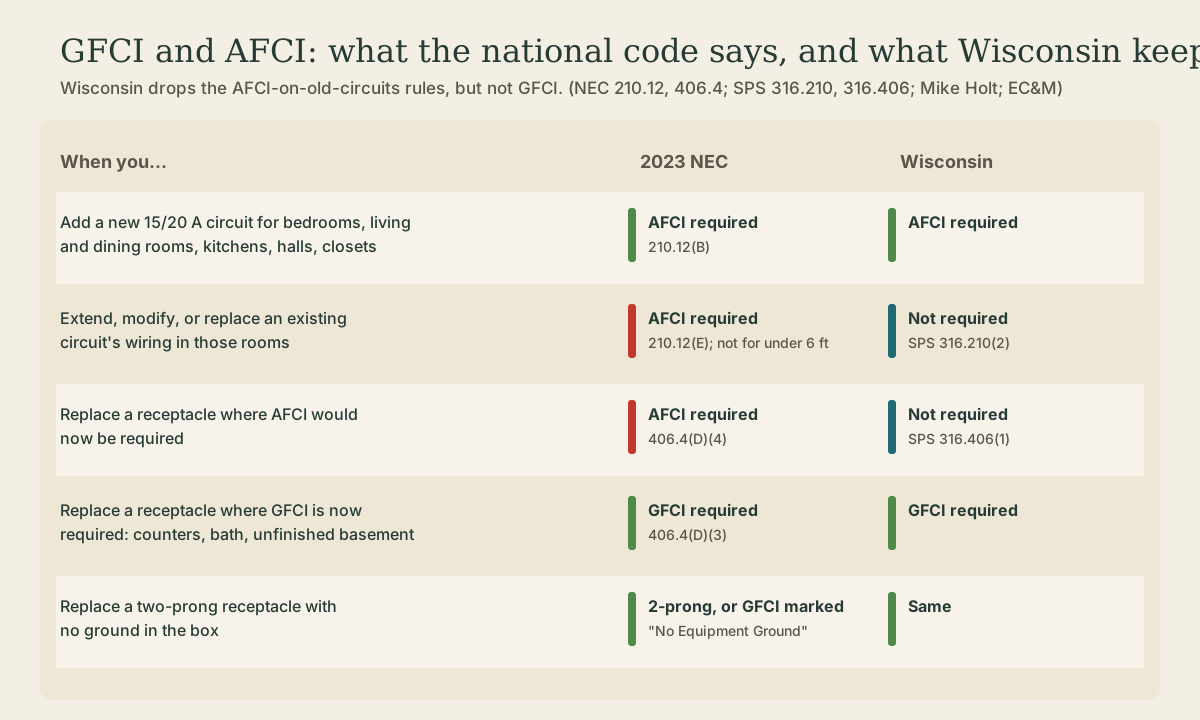
The national code requires arc-fault protection whenever you extend, modify, or replace wiring on an old bedroom or living-room circuit, and when you replace a receptacle there. Wisconsin dropped both rules, which matters a great deal in a house full of old circuits. It kept the ground-fault rules: a receptacle replaced where GFCI is now required must be GFCI-protected. New circuits for living spaces still need AFCI, and old two-prong outlets have three legal fixes.
- 4 min
- 6 steps
- 3 questions
- Lesson 79 of 111
In this lesson
- AFCI: the national rules
- AFCI: where Wisconsin differs
- GFCI: Wisconsin keeps it
- Two-prong outlets: three legal fixes
- Try it
Picking up where you left off.
Two kinds of protective device show up in every conversation about old wiring. A GFCI (ground-fault circuit interrupter) trips when current leaks to ground, as through a person, and protects against shock. An AFCI (arc-fault circuit interrupter) trips when it detects the electrical signature of arcing, such as a loose connection or damaged cord, and protects against fire 1. The question for an old house is when touching a circuit makes them required, and here Wisconsin’s code differs from the national one.
AFCI: the national rules
The 2023 NEC requires AFCI protection for 15- and 20-amp, 120-volt branch circuits serving outlets in a dwelling’s kitchens, family rooms, dining rooms, living rooms, parlors, libraries, dens, bedrooms, sunrooms, recreation rooms, closets, hallways, laundry areas, and similar areas, but not bathrooms, garages, or outdoors 1. That’s 210.12(B).
It also says, in 210.12(E), that if wiring on such a circuit is extended, modified, or replaced, it must be protected by an AFCI breaker or an AFCI receptacle at the first outlet of the existing circuit, except for extensions under 6 feet that add no outlets 1. And 406.4(D)(4) requires a receptacle replaced where AFCI protection is now required to be AFCI-protected.
AFCI: where Wisconsin differs
Wisconsin adopts the 2023 NEC with changes 2, and two of them matter here. SPS 316.210(2) says the requirements of NEC 210.12(E) are not included, and SPS 316.406(1) says NEC 406.4(D)(4) is not included 3.
In a Wisconsin house, then:
- Extending or modifying an old circuit in a bedroom or living room doesn’t, by itself, require you to add AFCI protection to that circuit.
- Replacing a receptacle on an old circuit doesn’t require an AFCI.
- A brand-new branch circuit for those rooms still needs AFCI under 210.12(B), which Wisconsin keeps 3.
“Not required” isn’t “not useful.” An AFCI breaker on an old circuit is still a fire-safety upgrade you can choose to make.
Quick check
A brand-new branch circuit for a bedroom still needs AFCI under 210.12(B).
GFCI: Wisconsin keeps it
Wisconsin did not drop the GFCI replacement rule. A receptacle replaced where GFCI protection is now required must be GFCI-protected 4. Wisconsin’s version of the dwelling GFCI list covers 125-volt, 15- and 20-amp receptacles, and applies the basement requirement to unfinished areas not intended as habitable rooms 2. The places you’ll meet it most in an old house: bathrooms, kitchen counters, the laundry, the unfinished basement, the garage, and outdoors.
Quick check
Wisconsin keeps the GFCI replacement rule.
Two-prong outlets: three legal fixes
Replacing an old two-prong receptacle where the box has no ground, you have three choices 4:
- Another two-prong (nongrounding) receptacle.
- A GFCI receptacle, marked “No Equipment Ground.”
- A three-prong receptacle protected by a GFCI upstream, marked “GFCI Protected” and “No Equipment Ground.”
What you can’t do is install a three-prong receptacle and jumper its ground screw to the neutral. That bootleg ground is a code violation that a plug-in tester can’t detect, and it can energize the metal case of whatever you plug in 5. The GFCI option also doesn’t extend to new outlets: a new receptacle added from an ungrounded box must be grounded 4.
Quick check
It’s a code violation; use one of the three legal two-prong fixes instead.
Try it
Walk the house with a plug-in tester and a notepad. List every receptacle in a GFCI location (bath, kitchen counter, laundry, unfinished basement, garage, outside) and whether it’s protected; push the test button on each GFCI you find. Mark every three-prong outlet that tests “correct” on an old two-wire circuit as a possible bootleg ground to open and check.
Lesson complete
Nice work.
Sources for this lesson
- 1Changes to the National Electrical Code 2023: 210.12 Arc-Fault Circuit-Interrupter Protection. Mike Holt Enterprises. 2023. verified2023 NEC reorganized 210.12: dwelling units moved to (B), extensions and modifications to (E). 210.12(B): AFCI required for 15A or 20A, 120V branch circuits supplying outlets or devices in dwelling kitchens, family rooms, dining rooms, living rooms, parlors, libraries, dens, bedrooms, sunrooms, recreation rooms, closets, hallways, laundry areas, and similar areas; not bathrooms, garages, or outdoors. 210.12(E): if such branch-circuit wiring is extended, modified, or replaced in those areas, protect it by an AFCI breaker or an AFCI receptacle at the first outlet of the existing circuit; exception for extensions under 6 feet with no added outlets or devices.
- 2Wis. Admin. Code ch. SPS 316, Electrical. Wisconsin Legislature. verifiedSPS 316.007 adopts NFPA 70, the National Electrical Code, 2023 edition, with Wisconsin modifications; SPS 316.210 limits dwelling GFCI requirements under NEC 210.8(A) to 125-volt, single-phase, 15- and 20-ampere receptacles, applies the basement requirement to unfinished areas not intended as habitable rooms, and omits NEC 210.8(A)(7), parts of 210.8(D), 210.8(F), and 210.12(E).
- 3Wis. Admin. Code SPS 316.003, 316.021, 316.210, and 316.406. Wisconsin Legislature. 2026. verifiedRegister September 2026. SPS 316.003(1): the chapter applies to all new installations, reconstructions, alterations, and extensions. (3) Existing installations shall conform to the electrical code that applied when they were installed; where a hazard exists or is created, the authority having jurisdiction may require compliance with current code. (4) Repairs conform to the code that applied when installed, with the same hazard provision. (6) Additions and alterations comply with the chapter at the time of permit application or, with no permit, the beginning of the project. SPS 316.021: installations known to be defective so as to endanger life or property shall be promptly repaired, disconnected, or isolated. SPS 316.210(2): NEC 210.12(E) (AFCI for branch-circuit extensions, modifications, or replacements) is not included. SPS 316.406(1): NEC 406.4(D)(4) (AFCI for replacement receptacles) is not included.
- 4Article 406: Receptacles. EC&M (Electrical Construction & Maintenance). verifiedReplacing a receptacle where the box has no grounding means (e.g., old 2-wire cable without a ground): use a nongrounding-type receptacle; or a GFCI receptacle marked 'No Equipment Ground'; or a grounding-type receptacle that is GFCI-protected and marked 'GFCI Protected' and 'No Equipment Ground.' A replacement in a location where GFCI protection is now required must be GFCI-protected (210.8). The GFCI option doesn't apply to new outlets extended from an existing ungrounded box: a branch-circuit extension must be grounding type and grounded per 250.130(C).
- 5Mike Sokol. Failures in Outlet Testing Exposed. EC&M (Electrical Construction & Maintenance). 2013. verifiedJuly 15, 2013. Pre-1965 wiring often has no equipment ground. A bootleg (false) ground is created when a grounded receptacle is installed on an ungrounded circuit and the ground screw is strapped to the neutral screw; a code violation that occurs more often than you'd think. A 3-light plug-in tester, and even voltage readings between hot, neutral, and ground, can show such outlets as correctly wired, especially the reverse-polarity bootleg ground, which can energize equipment chassis. Per NEC 250.130(C), add a proper equipment ground or use GFCI protection.