Threaded and Cast Iron Pipe
Older houses run on iron. Galvanized steel water pipe (gray, threaded, magnetic) was standard until about 1950 and lasts 40 to 60 years before rust chokes it and the threads leak; its zinc coating can also hold and release lead. Cast iron drains last far longer, joined by oakum and poured lead in old hub-and-spigot pipe or by rubber-sleeve no-hub couplings now. Threaded joints get dope or tape on the male threads only, and copper meets steel through a dielectric fitting.
- 4 min
- 5 steps
- 3 questions
- Lesson 34 of 111
In this lesson
- Galvanized steel water pipe
- Threaded joints
- Cast iron drains
- Joining different pipes
- What to take from this
Picking up where you left off.
Galvanized steel water pipe
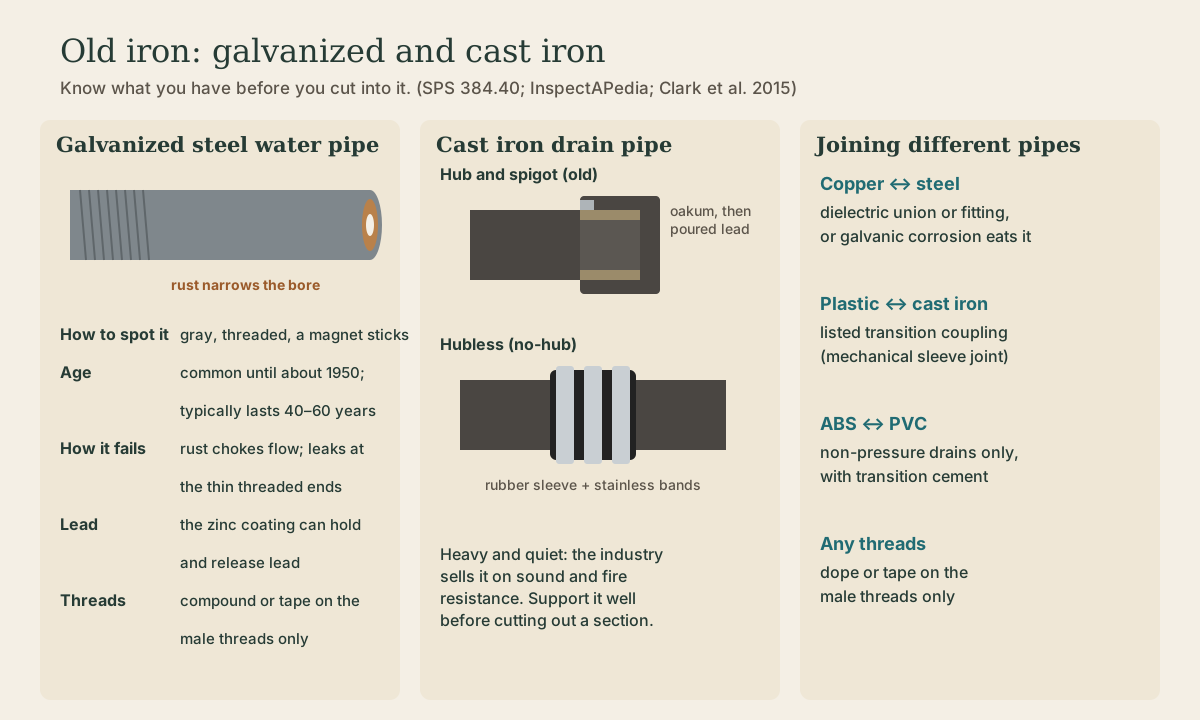
Before copper, water lines were galvanized steel: steel pipe coated with zinc to slow rust, joined with threaded fittings. It’s gray, threaded, and a magnet sticks to it (brass, also threaded, isn’t magnetic). It was common until about 1950 and typically lasts 40 to 60 years 1, so whatever is left is past its life.
How it fails 1:
- Rust builds up inside and narrows the bore until pressure drops.
- Leaks start at the threads, where cutting the threads left the wall thinnest.
There’s also lead. The zinc used for galvanizing contained lead, up to nearly 2 percent in pipe made between 1950 and 2008, and galvanized pipe downstream of an old lead service line collects lead and releases it later 2. If a house still has galvanized supply pipe, test the water for lead and plan to replace the pipe with copper or PEX.
Quick check
Galvanized pipe typically lasts 40 to 60 years; replacement is the fix.
Threaded joints
Threaded pipe is cut, threaded with a die, and screwed into fittings. Thread sealant goes on the male threads only, whether pipe joint compound or tape, for every threaded joint in Wisconsin’s code 3. Plastic pipe may be threaded only if it’s schedule 80 or heavier 3.
Taking apart old galvanized usually means cutting it: a run of threaded pipe can only be unscrewed from the end, and old joints rust solid. Repairs go back together with a union or a mechanical coupling.
Quick check
Wisconsin’s code says so for every threaded joint.
Cast iron drains
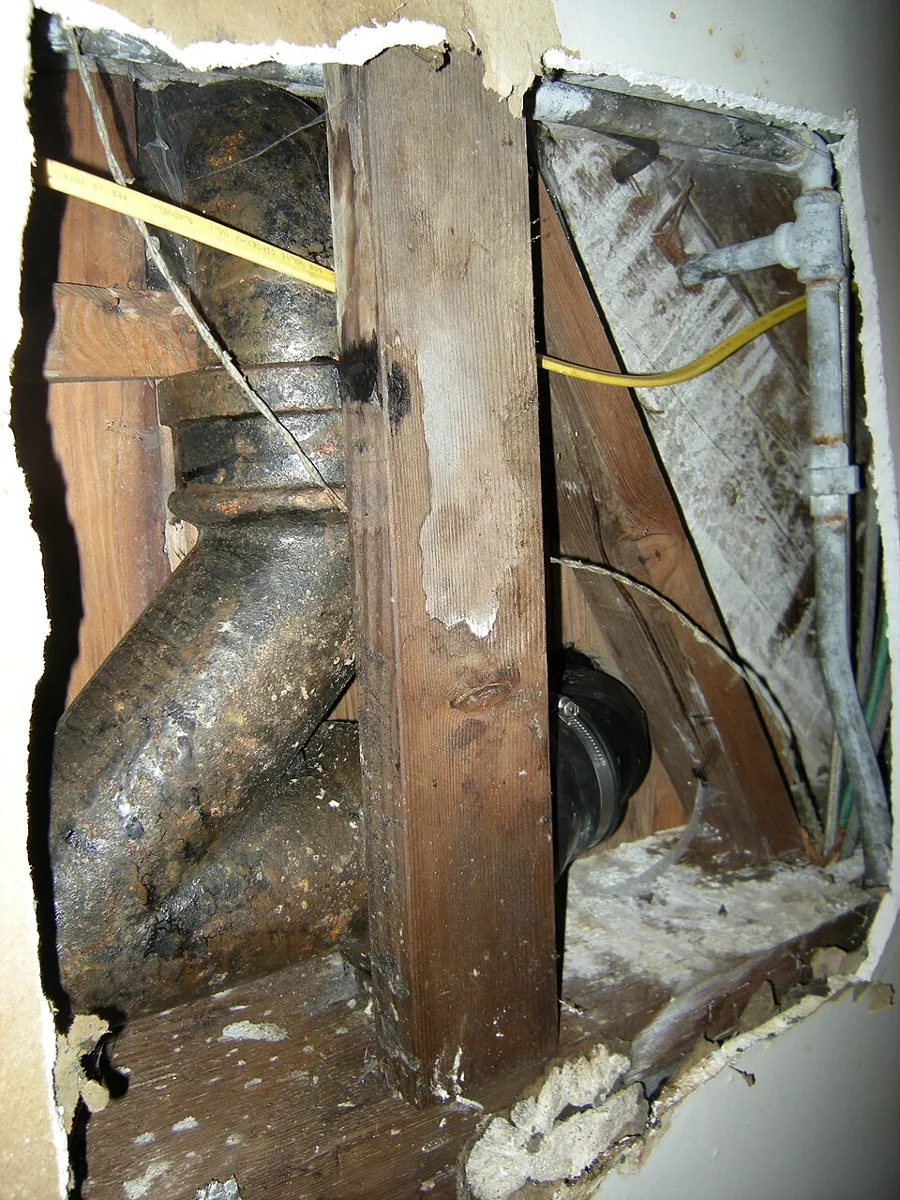
Cast iron soil pipe was the standard drain, waste, and vent pipe for most of the twentieth century, and much of it is still working. The industry markets it on sound attenuation (heavy pipe doesn’t drum the way plastic does) and fire resistance 4.
Two kinds of joints 3:
- Hub and spigot (old): the plain end sits in the bell (hub) of the next pipe; the gap is packed with oakum (tarred hemp) and sealed with at least an inch of molten lead, caulked tight.
- Hubless (no-hub): plain ends butt together inside a rubber sleeve (ASTM C564) clamped by a stainless steel band (CISPI 310). This is also how plastic is spliced into old cast iron, with a listed transition coupling 3 4.
Cast iron is heavy. Before cutting out a section of a vertical stack, support the pipe above with riser clamps so it can’t drop.

Joining different pipes
Wisconsin requires connections between different materials to use mechanical compression joints or the specific methods in the code, and dissimilar metals must be protected against galvanic corrosion 3:
- Copper to steel: a dielectric union, nipple, or transition fitting keeps the two metals from forming a battery in the water, which eats the steel.
- Copper or steel to cast iron: a caulked joint or threaded fitting.
- Plastic to cast iron: a caulked joint, threaded fitting, or mechanical coupling.
- ABS to PVC: only in drains, with transition cement (previous lesson).
Playback is optional. If the player is unavailable, open the video at its source.
Quick check
Dissimilar metals in water corrode the less noble one quickly.
What to take from this
Gray, threaded, magnetic supply pipe is galvanized steel, likely past its 40 to 60 year life; it rusts shut from inside, leaks at the threads, and can release lead, so test and replace it. Put thread sealant on male threads only. Cast iron drains have oakum-and-lead hub joints or rubber-sleeve no-hub couplings, and plastic splices in with a transition coupling. Join copper to steel through a dielectric fitting.
Lesson complete
Nice work.
Sources for this lesson
- 1Galvanized Iron Water Supply Piping & Galvanized Drain Piping. InspectAPedia. verifiedGalvanized steel water pipe was common until about 1950 and typically lasts 40 to 60 years; rust building up inside chokes the bore and lowers water pressure; leaks start at the threaded ends, where the wall is thinnest; it is gray, threaded, and magnetic.
- 2Brandi N. Clark, Sheldon V. Masters, Marc A. Edwards. Lead Release to Drinking Water from Galvanized Steel Pipe Coatings. Environmental Engineering Science 32(8). 2015. verifiedThe zinc used to galvanize steel pipe historically contained lead (nondetect to nearly 2 percent in pipe made 1950-2008), and galvanized pipe can also collect lead from upstream lead service lines; both can release lead into tap water.
- 3Wis. Admin. Code ch. SPS 384, Plumbing Products. Wisconsin Department of Safety and Professional Services. verifiedSPS 384.40 joints: copper soldered joints per ASTM B828 with NSF-approved flux and ASTM B32 solder, lead-free for water supply (solders and fluxes over 0.2 percent lead not allowed for brass); flared joints only on annealed tube with a flaring tool; PEX joints per the manufacturer's instructions; PVC solvent joints per ASTM D2855 with F656 primer and D2564 cement; ABS solvent joints with D2235 cement; ABS-to-PVC solvent joints only in non-pressurized systems, with F656 primer on the PVC and D3138 transition cement; threaded joints get compound or tape on male threads only, and plastic may be threaded only at schedule 80 or heavier; cast iron by caulked (oakum and poured lead) or mechanical sleeve joints with C564 rubber and CISPI 310 bands; different materials joined by mechanical compression joints, with dielectric fittings to prevent galvanic corrosion.
- 4Planning & Design. Cast Iron Soil Pipe Institute. verifiedThe cast iron soil pipe industry's design page lists sound attenuation and fire-resistive construction as benefits and specifies that hubless coupling gaskets conform to ASTM C564 (couplings to CISPI 310).