What 'Up to Code' Means for a 1905 House
No law makes you rewire a whole 1905 house to today's code. Wisconsin's electrical code lets existing work stand under the rules it was installed under, as long as it isn't dangerous, and holds every new installation, alteration, and extension to the current code. The Uniform Dwelling Code doesn't cover a house this old at all, but city permits still do. Who may do the work, what Stoughton asks for, and why touching a circuit changes what you owe it.
- 4 min
- 6 steps
- 3 questions
- Lesson 77 of 111
In this lesson
- Existing work stays
- New work meets today’s code
- The house itself
- Who may do the work
- Try it
Picking up where you left off.
“Up to code” sounds like one standard. In a house built in 1905 and remodeled every few decades since, it’s really three questions: what rules the old work answers to, what rules your new work answers to, and who gets to check.
Existing work stays
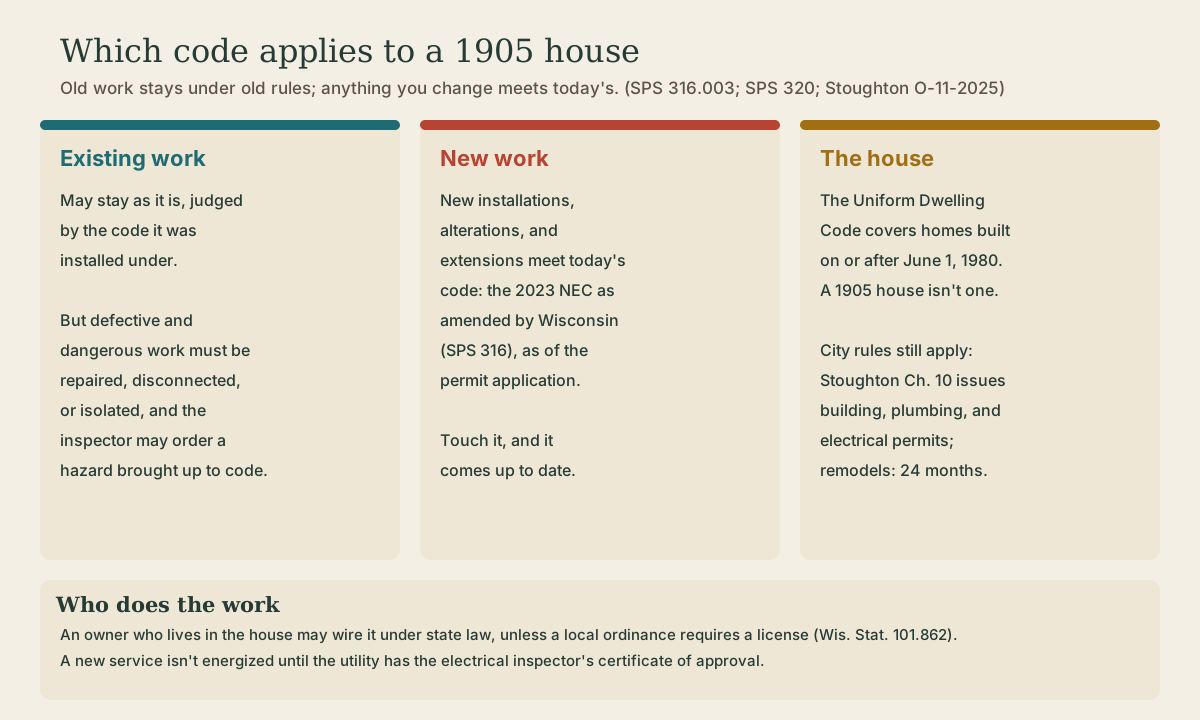
Wisconsin’s electrical code is direct about this. Existing electrical installations “shall conform to the electrical code that applied when the installations were installed,” and so do repairs to them 1. Your 1950s cloth-covered cable or a run of knob-and-tube isn’t illegal just because today’s code wouldn’t allow it in a new house.
There are two limits. First, anything “known to be defective so as to endanger life or property” must be promptly repaired, permanently disconnected, or isolated until it can be fixed 1. Second, when an existing installation is or creates a hazard, the authority having jurisdiction, in practice the electrical inspector, may require it to be brought up to the current code 1. Grandfathering protects old work that’s sound, not work that’s dangerous.
Quick check
SPS 316.003(3); the inspector can still order a hazard brought up to current code.
New work meets today’s code
The same chapter applies “to all new installations, reconstructions, alterations and extensions,” and additions and alterations must comply with the code in force at the time of permit application, or at the start of the project if no permit is required 1. That code is the 2023 National Electrical Code, adopted with Wisconsin’s own changes 2.
So the moment you touch a circuit, the part you touch is judged by today’s rules. Replace a switch and the replacement must follow current requirements for switches. Extend a circuit and the extension must follow current wiring rules. Add a bedroom circuit and it gets today’s protection. The next lessons go through the cases you’ll meet most: switch loops, AFCI and GFCI, alarms, and the service.
Quick check
New installations, alterations, and extensions follow the current code [SPS 316.003(1), (6)].
The house itself
Wisconsin’s Uniform Dwelling Code (SPS 320 to 325) covers one- and two-family dwellings built on or after June 1, 1980, and additions and alterations to those dwellings 3. A 1905 house is not a UDC house. That doesn’t mean anything goes: cities regulate building, plumbing, and electrical work by ordinance and permit.
In Stoughton, that’s Chapter 10 of the municipal code. Permit fees are paid to the Planning and Development Department before a permit issues; permits for one- and two-family remodeling and additions are good for 24 months; and the building inspector can suspend or revoke a building, plumbing, or electrical permit if the work doesn’t comply 4. Call the department before a project and ask what needs a permit; the answer is cheaper than a correction order.
Quick check
City ordinances and permits still apply, and the state electrical code covers all new electrical work.
Who may do the work
State law generally requires licensed electricians, but it exempts a residential owner who installs, repairs, or maintains wiring in a home the owner owns and occupies, unless a local ordinance requires a license 5. Doing your own work doesn’t excuse you from the code or from permits.
The one place you can’t go it alone is the service. The utility won’t energize a new or rebuilt service until it has an authorized electrical inspector’s certificate of approval 6.
Try it
Make a list of every change you’ve seen evidence of in your house: a newer panel, Romex in the basement, a remodeled kitchen, three-prong outlets on old wiring. For each one, ask: is it old work that’s sound, old work that’s a hazard, or new work that should meet today’s code? That list is your upgrade plan.
Lesson complete
Nice work.
Sources for this lesson
- 1Wis. Admin. Code SPS 316.003, 316.021, 316.210, and 316.406. Wisconsin Legislature. 2026. verifiedRegister September 2026. SPS 316.003(1): the chapter applies to all new installations, reconstructions, alterations, and extensions. (3) Existing installations shall conform to the electrical code that applied when they were installed; where a hazard exists or is created, the authority having jurisdiction may require compliance with current code. (4) Repairs conform to the code that applied when installed, with the same hazard provision. (6) Additions and alterations comply with the chapter at the time of permit application or, with no permit, the beginning of the project. SPS 316.021: installations known to be defective so as to endanger life or property shall be promptly repaired, disconnected, or isolated. SPS 316.210(2): NEC 210.12(E) (AFCI for branch-circuit extensions, modifications, or replacements) is not included. SPS 316.406(1): NEC 406.4(D)(4) (AFCI for replacement receptacles) is not included.
- 2Wis. Admin. Code ch. SPS 316, Electrical. Wisconsin Legislature. verifiedSPS 316.007 adopts NFPA 70, the National Electrical Code, 2023 edition, with Wisconsin modifications; SPS 316.210 limits dwelling GFCI requirements under NEC 210.8(A) to 125-volt, single-phase, 15- and 20-ampere receptacles, applies the basement requirement to unfinished areas not intended as habitable rooms, and omits NEC 210.8(A)(7), parts of 210.8(D), 210.8(F), and 210.12(E).
- 3Wis. Admin. Code SPS 320.02-320.04, Uniform Dwelling Code scope and application. Wisconsin Legislature. verifiedThe UDC applies to one- and two-family dwellings built on or after its effective dates: June 1, 1980 for chs. SPS 320, 321, 323, 324, and 325 (December 1, 1978 for SPS 322, energy). SPS 320.04(1): applies to dwellings for which the permit application was made or construction began on or after the effective date; installation of heating, plumbing, or electrical systems isn't required, but if installed must comply. (2): additions and alterations to dwellings covered by this code comply with the code at the time of permit application or the start of the project.
- 4Ordinance O-11-2025: Building permit fees, permit lapses, and revocation (Stoughton Municipal Code Ch. 10). City of Stoughton, Wisconsin. 2025. verifiedAdopted April 8, 2025. Permit fees paid to the Planning and Development Department before a permit issues. Permits for one- and two-family dwelling construction, remodeling, and additions are valid 24 months; other permits lapse after one year. The building inspector may revoke or suspend building, plumbing, or electrical permits for noncompliance, danger, or misrepresentation.
- 5Wis. Stat. 101.862, Electrician licensing. Wisconsin Legislature. verifiedElectrical wiring generally requires licensed or registered electricians under a master electrician; subsection (4)(a) exempts a residential property owner who installs, repairs, or maintains wiring on premises the owner owns and occupies as a residence, unless a local ordinance requires a license or registration; (4)(d) exempts systems of 100 volts or less.
- 6Electric Service Rules and Information. Stoughton Utilities. 2023. verifiedFebruary 3, 2023. State law requires the utility to receive an authorized electrical inspector's certificate of approval, or where there is no local inspector the wireman's affidavit, before furnishing electric service. Meters and meter equipment are sealed by the utility; only utility employees may remove or relocate meters. Customers must give reasonable notice of a substantial load increase that requires a larger transformer, service, or meter. The utility makes all connections to its distribution system. Contact (608) 873-3379.