Old Switches and Switch Loops
Pull an old switch out of the wall and you may find just two wires, one of them white, and no neutral. That's a switch loop: power runs to the ceiling light first and a two-wire cable drops to the switch, with the white wire carrying the hot. How to recognize one, why the white wire should be taped black, why your new smart switch won't work there, and what the code allows when you replace an old switch.
- 4 min
- 6 steps
- 2 questions
- Lesson 64 of 111
In this lesson
- Switch the hot
- What a switch loop is
- Smart switches and the missing neutral
- Three-way loops
- Try it
Picking up where you left off.
You buy a new switch, turn off the breaker, pull the old one out, and find two wires: a black one and a white one, both screwed to the switch. No bundle of white neutrals in the back of the box. If your house was wired the way many older houses were, you’ve found a switch loop.
Switch the hot
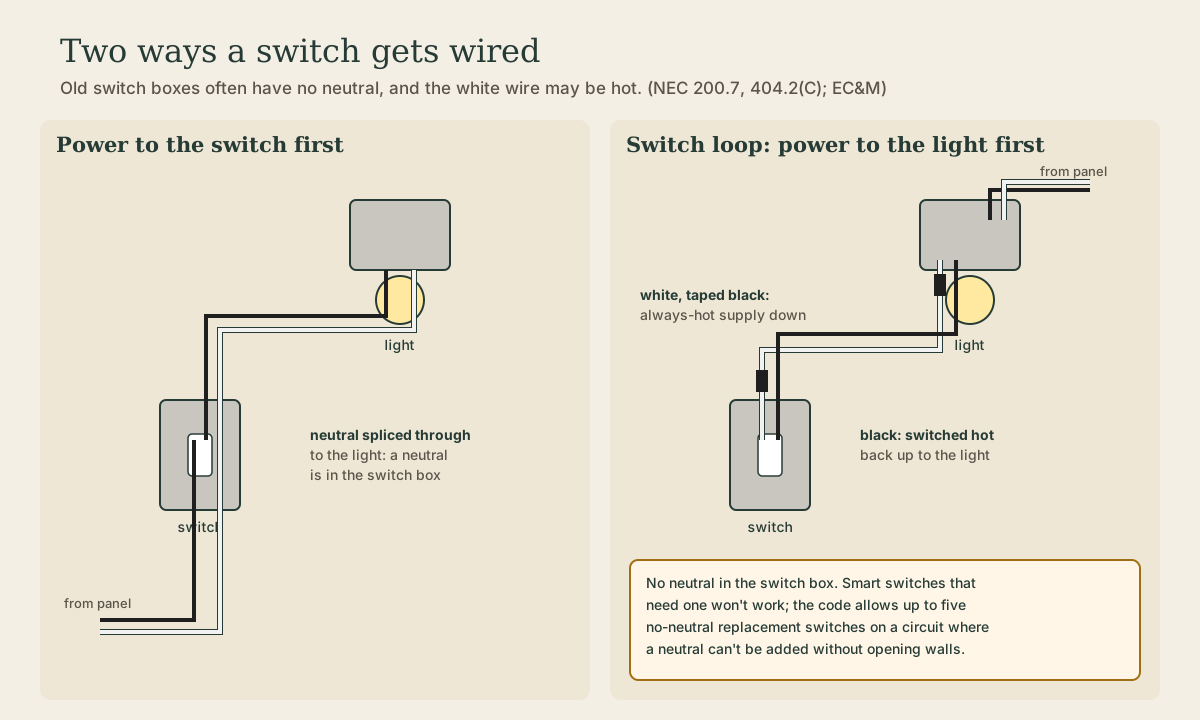
A switch always interrupts the hot wire, never the neutral, so when it’s off there’s no voltage at the light 1. There are two ways to get the hot to the switch.
In the arrangement taught today, power comes to the switch box first. The hot goes through the switch and up to the light; the neutral is spliced straight through to the light. The switch box has hot, neutral, and ground.
In many older houses, power went to the ceiling light box first, and a single two-wire cable was run down to the switch. That’s a switch loop. One wire of that cable carries the always-hot supply down to the switch, and the other brings the switched hot back up to the light. There’s no neutral in the switch box at all.
What a switch loop is
Since the cable has a white wire and a black wire, one of them has to be white even though it’s hot. The code allows a white wire in a cable to be used in a switch loop if it’s permanently re-identified, typically with black tape or marker, wherever it’s visible 2. And the code is specific about which job it does: the re-identified white may be the supply to the switch, but not the return from the switch to the light. In older work you may find it either way, and often unmarked.
So:
- When you see a white wire on a switch, assume it’s hot.
- When you replace the switch, wrap black tape around the white at the switch and at the light so the next person knows.
- Test before touching. A non-contact tester and then a two-probe tester on the actual terminals, with the breaker off, tell you more than wire colors ever will.
Quick check
A re-identified white may serve as the supply to the switch, never the return to the light.
Smart switches and the missing neutral
Here’s where switch loops bite modern homeowners. Many smart switches, timers, and occupancy sensors need a little power all the time to run their electronics, and they get it from a connection between hot and neutral. In a switch loop box there’s no neutral to connect to.
Current code requires a neutral at most new switch locations, in habitable rooms, bathrooms, hallways, and stairways, precisely so these devices will work 2. For an old house, the code makes an exception for replacement switches: where the location was wired before that rule and a neutral can’t be extended without removing finish materials, you can install an electronic switch that doesn’t need a neutral, up to five such switches on one branch circuit 2.
Your options in a no-neutral box, then:
- Buy a smart switch designed to work without a neutral (they exist; read the box carefully).
- Put the smart device at the light instead, where both hot and neutral are present: a smart bulb or a smart fixture module, and leave the wall switch on or replace it with a battery remote.
- Run a new cable with a neutral from the light box down to the switch, which is the best long-term fix when you have the walls open or can fish a cable from the attic.
Quick check
Choose a model made to work without a neutral, or bring a cable with a neutral to the box.
Three-way loops
Old three-way switches can be wired in many patterns, some of them not ones a modern electrician would choose. The basic theory, a common terminal and two travelers between the two switches, is covered in the Residential Electrical course. In an old house, label every wire before you disconnect anything; a phone photo of each switch before you touch it saves hours.
Playback is optional. If the player is unavailable, open the video at its source.
Try it
Next time you replace a switch, with the breaker off and verified dead, look in the box. Count the cables entering it and note the colors. One two-wire cable with a black and a white on the switch? Switch loop: tape the white. A bundle of whites spliced together in the back? Power comes to this box first, and you have a neutral.
Lesson complete
Nice work.
Sources for this lesson
- 1Electrical Tech Note 330: Wiring Circuits, Basic Rules. Michigan State University, Biosystems & Agricultural Engineering. verifiedEach hot wire is about 120 V to earth and 240 V hot to hot; voltages above about 15 V can be dangerous; NM-B cable for dwellings is commonly 14 AWG for 15 A circuits (white jacket), 12 AWG for 20 A (yellow), and 10 AWG for 30 A (orange); NM cable is for dry locations only; keep the equipment grounding conductor continuous; one wire per device screw terminal.
- 2NEC Requirements for Switches. EC&M (Electrical Construction & Maintenance). verifiedOnly phase (hot) conductors may be switched in 3-way and 4-way circuits [404.2(A),(B)]. A permanently reidentified white conductor in a cable may be used as a switch leg [200.7(C)(1)]. Switches controlling line-to-neutral lighting loads need a neutral at switch locations serving bathrooms, hallways, stairways, and habitable rooms [404.2(C)], with exceptions. Replacement switches needing line-to-neutral voltage to power electronics require a neutral [404.22], except in locations wired before 404.2(C) where the neutral can't be extended without removing finish materials; no more than five such no-neutral electronic switches per branch circuit and 25 per feeder.