Concrete: Mixing, Placing, and Curing
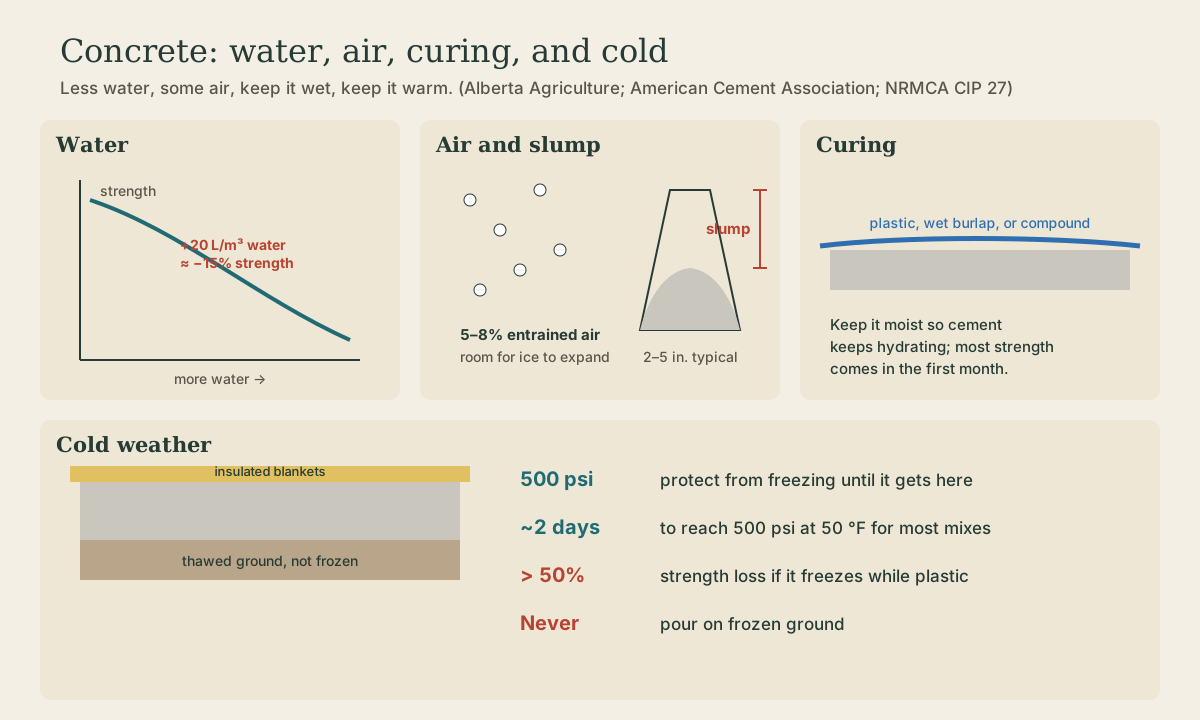
What makes concrete strong and durable: the least water that will do (20 extra liters per cubic meter costs about 15 percent of the strength), 5 to 8 percent entrained air for freeze-thaw, a 2 to 5 inch slump, keeping it moist so the cement keeps hydrating, and in Wisconsin weather, protecting it from freezing until it reaches 500 psi, about two days at 50 °F. How to order it, place it, and finish a slab.
- 5 min
- 8 steps
- 3 questions
- Lesson 6 of 111
In this lesson
- What concrete is
- Water
- Air
- Slump
- Placing and finishing a slab
- Curing
- Cold weather
- What to take from this
Picking up where you left off.
What concrete is
Concrete is portland cement, water, sand, and stone. Cement and water react (hydration) to form a paste that binds the aggregate and keeps gaining strength for weeks; most of the gain happens in the first month, and it continues slowly for years 1. Ready-mix concrete is ordered by strength (psi at 28 days), slump, air content, and maximum stone size.
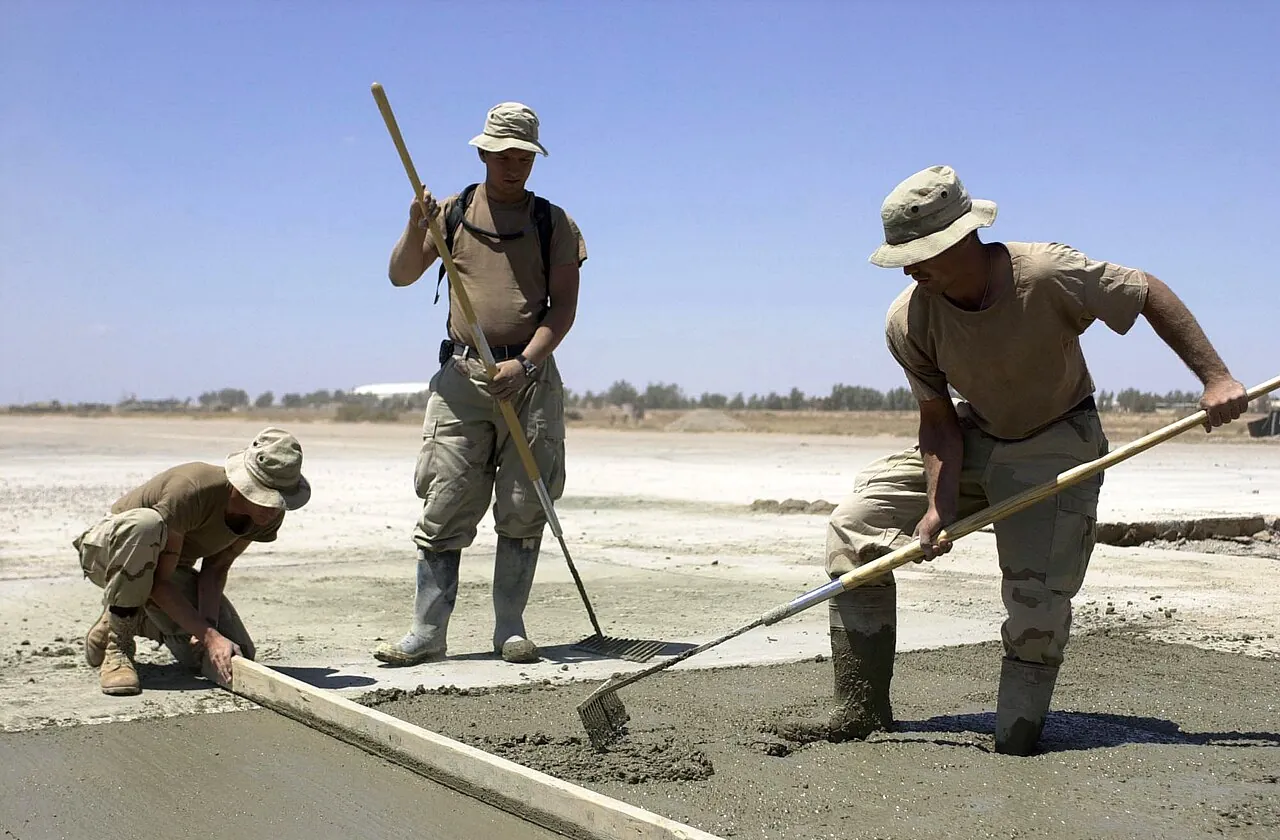
_smooth_the_surface_of_newly_poured_concrete_slab,_using_a_screed_board_and_rakes,_during_repair_and_improvements_for_the_ru.jpg)
Water
The single biggest control on strength and durability is the ratio of water to cement: less water, stronger and less permeable concrete. Alberta’s agriculture guide puts a number on it: adding as little as 20 liters of water per cubic meter cuts strength about 15 percent, so water shouldn’t be added at the site unless it was planned into the mix 2. A cubic yard is about three-quarters of a cubic meter, so that’s roughly 4 gallons a yard.
If the concrete arrives too stiff to place, the fix is ordering a higher slump or a water-reducing admixture next time, not a hose in the drum.
Quick check
Order the slump you need instead, or use a water reducer planned into the mix.
Air
Water in concrete expands when it freezes. Air-entrained concrete contains billions of tiny bubbles, normally 5 to 8 percent of the volume for freeze-thaw exposure, which give the ice room and keep the surface from scaling and cracking 2. Driveways, walks, steps, garage slabs, and anything exposed to Wisconsin winters and road salt should be air-entrained.
Quick check
Freeze-thaw cycles and deicing salt destroy non-air-entrained concrete.
Slump
The slump test measures workability: fill a 12-inch cone with fresh concrete, lift it, and measure how far the pile sags. Most farm and residential work uses slumps of about 2 to 5 inches (50 to 125 mm) 2: stiff enough for slabs to hold their shape, wet enough to flow into wall forms with vibration.
Placing and finishing a slab
- Prepare: compacted base, vapor retarder where required, forms set to grade, reinforcement or mesh supported off the ground, everything dampened so the base doesn’t suck water out of the concrete. Never pour on frozen ground 3.
- Place concrete close to its final position; don’t drag it long distances, which separates the stone from the paste.
- Screed it off level with a straightedge riding the forms.
- Bull float to push down the stone and bring up paste.
- Wait for the bleed water on the surface to disappear. Working water back into the surface makes a weak, dusty top.
- Edge, joint, and trowel or broom. Control joints, cut or tooled to a quarter of the slab’s depth, tell the inevitable shrinkage cracks where to go.
Curing
Curing keeps the concrete moist so the cement keeps hydrating and the concrete keeps gaining strength 1. Methods: sprinkling or fogging, wet burlap or curing blankets, plastic sheeting, or a sprayed curing compound 1. Concrete that dries out in the first days, from sun, wind, or heat, ends up weaker and more likely to crack and dust. The rate of hardening also depends on temperature: cold concrete gains strength slowly 1.
Cold weather
Wisconsin pours a lot of concrete in spring and fall. The National Ready Mixed Concrete Association’s rules 4:
- Protect concrete from freezing until it reaches at least 500 psi, about two days for most concrete kept at 50 °F.
- Concrete that freezes while still plastic can lose more than half its potential strength, and its durability suffers.
- Concrete that will see repeated freeze-thaw cycles should be protected until it reaches about 3,500 psi.
In practice: thaw and keep the ground unfrozen, order heated concrete and an accelerator, cover the work with insulated blankets right after finishing, and don’t strip forms early. And never place a footing on frozen soil 3.
Playback is optional. If the player is unavailable, open the video at its source.
Quick check
Freezing while still plastic can cut its strength by more than half.
What to take from this
Concrete’s strength comes from the cement paste, so keep water to what the mix was designed for: 20 extra liters per cubic meter costs about 15 percent. Air-entrain anything that freezes outdoors (5 to 8 percent), order a 2 to 5 inch slump, place without segregating, wait out the bleed water before finishing, and cut control joints. Keep it moist to cure, and in cold weather keep it from freezing until 500 psi, about two days at 50 °F.
Lesson complete
Nice work.
Sources for this lesson
- 1Curing in Construction. American Cement Association (formerly Portland Cement Association). verifiedCuring keeps cement hydrating so concrete keeps gaining strength after placing; most hydration and strength gain happen in the first month and continue slowly for years; cure by sprinkling, fogging, or moisture-retaining fabrics, or seal with plastic or curing compounds; hardening rate depends on cement, mix proportions, moisture, and temperature.
- 2Specifying Concrete for Agricultural Applications. Government of Alberta, Agriculture and Forestry. 2014. verifiedAdding as little as 20 liters of water per cubic meter of concrete cuts strength about 15 percent, so don't add water at the site unless planned in the mix; air entrainment of 5 to 8 percent by volume for freeze-thaw resistance; slumps of 50 to 125 mm (2 to 5 inches) for most farm work; strength specified by exposure, about 32 MPa (4,600 psi) for severe outdoor exposure and 20-25 MPa for protected indoor uses.
- 3Wis. Admin. Code ch. SPS 321, Uniform Dwelling Code: Construction Standards. Wisconsin Department of Safety and Professional Services. verifiedDesign loads (SPS 321.02): complete load path to the foundation; live loads 40 psf floors, 50 garage floors, 40 decks and porches, 20 ceilings with storage, 5 without; roof snow loads from the zone map, Zone 1 (north) 40 psf and Zone 2 (south) 30 psf; wind 20 psf horizontal and uplift or ASCE 7-05; span tables in SPS 325 Appendix A. Frost (321.16): footings and foundations, including stoops and landings, below frost penetration or at least 48 inches below grade, whichever is deeper, never on frozen material; exceptions for ASCE 32 frost-protected shallow foundations, areaways, and clean bedrock. Exits (321.03): two first-floor exit doors separated by the greater of 20 feet or a third of the floor's longest diagonal; egress windows at least 20 by 24 inches net clear opening, sill no more than 60 inches above the floor (a platform if over 46); basement sleeping rooms need a second exit. Ceilings at least 7 feet (321.06). Smoke alarms (321.09) in each sleeping room, outside sleeping areas within 21 feet, and on every level, hardwired and interconnected with battery backup.
- 4CIP 27: Cold Weather Concreting. National Ready Mixed Concrete Association. verifiedProtect concrete from freezing until it reaches at least 500 psi, about two days after placement for most concrete kept at 50 °F; if plastic concrete freezes, its potential strength can drop by more than 50 percent and durability suffers; concrete exposed to repeated freezing and thawing should be protected until about 3,500 psi.