Circuits, Loads, and Overcurrent Protection
House outlets are wired in parallel, so each load gets full voltage and their currents add up on the circuit. How to add up a circuit's load, why the breaker is sized to the wire (14 AWG on 15 amps, 12 on 20, 10 on 30), and the four kinds of trouble: overloads and short circuits stopped by breakers and fuses, ground faults by GFCIs, and arcing by AFCIs.
- 5 min
- 5 steps
- 3 questions
- Lesson 47 of 111
In this lesson
- Parallel circuits
- Adding up the load
- The breaker protects the wire
- Four kinds of trouble
- What to take from this
Picking up where you left off.
Parallel circuits
A branch circuit runs from one breaker out to a set of outlets, lights, or one appliance, and back. Every outlet on it is wired in parallel: each one connects across the same hot and neutral wires. That has two consequences:
- Every load gets the full 120 volts, whatever else is plugged in.
- The currents add up on the shared wire back to the breaker.
The current goes out on the hot, through the load, and back on the neutral to its source; if the loop is broken, it stops 1. A switch is just a deliberate break in the hot.
Quick check
In parallel, voltage is the same across every load, and the currents add up on the shared wires.
Adding up the load
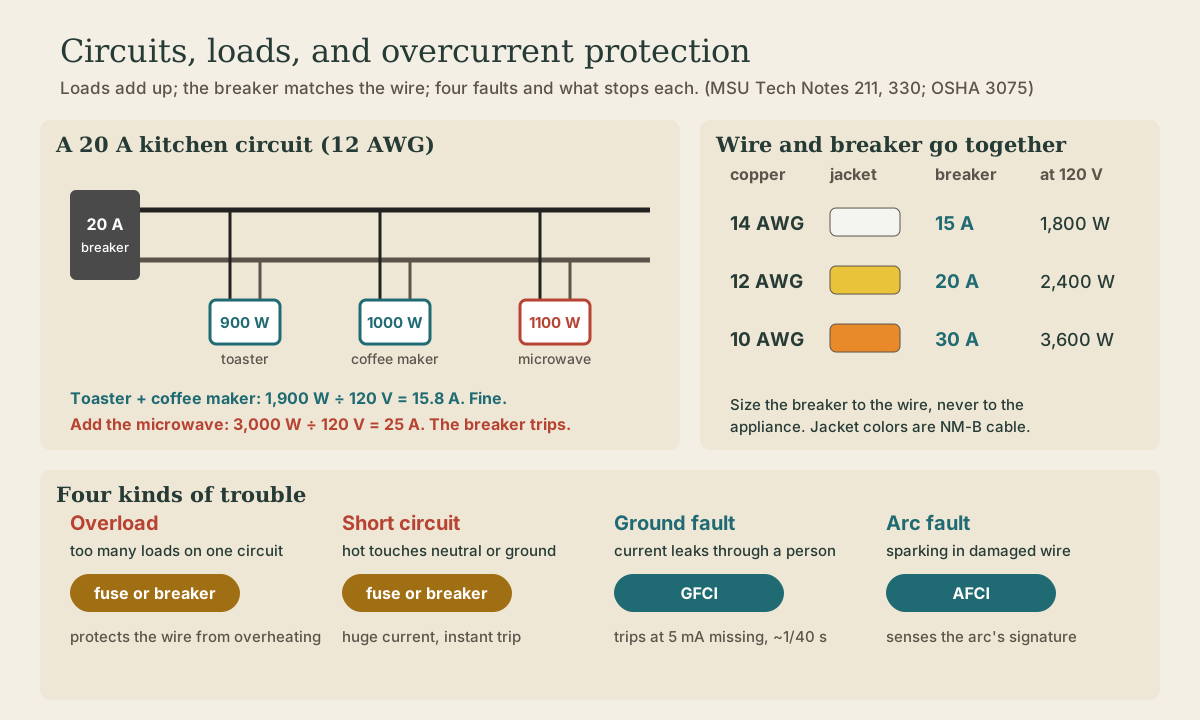
To know whether a circuit can handle what’s on it, add the watts and divide by the voltage. On a 20-amp kitchen circuit:
- A 900-watt toaster and a 1,000-watt coffee maker: 1,900 W ÷ 120 V ≈ 15.8 A. Fine.
- Add an 1,100-watt microwave: 3,000 W ÷ 120 V = 25 A. The breaker trips.
The breaker isn’t broken. It’s doing its job. The fix is to spread the loads over more circuits, which is why kitchens get several.
Useful capacities at 120 volts: a 15-amp circuit is 1,800 watts and a 20-amp circuit is 2,400 watts. Heaters, hair dryers, and space heaters are the big users.
The breaker protects the wire
Current heats wire, and too much current for the wire’s size overheats its insulation. A fuse or breaker opens the circuit when too much current flows: fuses melt, breakers trip. They’re there to protect the conductors and equipment 2.
So the breaker size follows the wire, not the appliance. The smallest wire for a power circuit is 14 AWG copper, in most cases protected at no more than 15 amps 3. For NM-B cable in a house, the common pairings are 4:
| Copper | NM-B jacket | Breaker |
|---|---|---|
| 14 AWG | white | 15 A |
| 12 AWG | yellow | 20 A |
| 10 AWG | orange | 30 A |
Never put a bigger breaker on a circuit because it keeps tripping. The wire would then be allowed to carry more current than it can safely handle, inside your walls.
Quick check
Move loads to another circuit, or run a new 12 AWG circuit for a 20-amp breaker.
Four kinds of trouble
| Trouble | What happens | What stops it |
|---|---|---|
| Overload | too many loads on one circuit | fuse or breaker |
| Short circuit | hot touches neutral or ground: huge current | fuse or breaker, instantly |
| Ground fault | current leaks to ground, perhaps through a person | GFCI |
| Arc fault | sparking in damaged or loose wiring | AFCI |
A GFCI (ground-fault circuit interrupter) compares the current going out on the hot with the current coming back on the neutral. If more than about 5 milliamps is missing, it must be leaking somewhere, perhaps through you, and the GFCI shuts the power off within as little as 1/40 of a second 2. That’s why they’re required in wet locations.
An AFCI (arc-fault circuit interrupter) recognizes the electrical signature of arcing, such as a nail through a cable or a loose connection, and shuts the circuit off before it starts a fire 2.
The equipment grounding conductor, the bare or green wire, gives a fault on a metal box or appliance frame a low-resistance path back, so the breaker trips instead of leaving the metal energized for someone to touch 5. It has to be continuous through every box on the circuit 4.
Playback is optional. If the player is unavailable, open the video at its source.
Quick check
It compares current going out with current coming back and trips within as little as 1/40 second.
What to take from this
Outlets on a circuit are in parallel: each gets 120 volts, and their currents add. Add the watts and divide by volts to check a circuit; 15 A is 1,800 W and 20 A is 2,400 W at 120 V. The breaker protects the wire, so it’s sized to the wire: 14 AWG on 15 A, 12 on 20, 10 on 30, and never upsized to stop tripping. Breakers and fuses stop overloads and shorts; GFCIs stop 5-milliamp ground faults that would otherwise go through people; AFCIs stop arcing; the grounding wire makes faults trip the breaker.
Lesson complete
Nice work.
Sources for this lesson
- 1Electrical Tech Note 211: Electrical Quantities. Michigan State University, Biosystems & Agricultural Engineering. verifiedOne ampere is one coulomb per second; voltage is often called push or pressure but is energy per charge, one joule per coulomb; resistance doubles when length doubles and halves when cross-sectional area doubles; power in watts is volts times amps, and 746 watts is one horsepower; 200 ft of 12 AWG copper is about 0.361 ohm; an electron in 14 AWG wire carrying 1 A drifts only about 1.8 m per minute; current always returns to its source.
- 2Controlling Electrical Hazards (OSHA 3075). Occupational Safety and Health Administration. 2002. verifiedConductors and insulators; impurities make water conduct, and wet skin conducts; shocks happen when the body completes a path between both wires, a wire and ground, or an energized metal part and ground; effects of current hand to foot for one second: under 1 mA not felt, 1 mA faint tingle, 5 mA slight shock, 6-30 mA painful and the let-go range, 50-150 mA respiratory arrest and possible death, 1,000-4,300 mA the heart stops pumping, 10,000 mA cardiac arrest and burns; fuses and breakers protect conductors and equipment; GFCIs compare outgoing and returning current and trip at a 5 mA difference within as little as 1/40 s; AFCIs detect arcing.
- 3Electrical Tech Note 212: Conductor Properties. Michigan State University, Biosystems & Agricultural Engineering. verifiedAWG wire gets larger as the number gets smaller; the smallest power-circuit wire is 14 AWG copper, in most cases protected at no more than 15 A; wire area is given in circular mils.
- 4Electrical Tech Note 330: Wiring Circuits, Basic Rules. Michigan State University, Biosystems & Agricultural Engineering. verifiedEach hot wire is about 120 V to earth and 240 V hot to hot; voltages above about 15 V can be dangerous; NM-B cable for dwellings is commonly 14 AWG for 15 A circuits (white jacket), 12 AWG for 20 A (yellow), and 10 AWG for 30 A (orange); NM cable is for dry locations only; keep the equipment grounding conductor continuous; one wire per device screw terminal.
- 5Electrical Tech Note 216: Electric Shock and Safety. Michigan State University, Biosystems & Agricultural Engineering. verifiedShock is current through the body; thousandths of an ampere can be felt; most shock fatalities are reported to come from contact with 120 V; an equipment grounding conductor keeps a faulted frame from reaching dangerous voltage.