Volts, Amps, Ohms, and Watts
The four quantities behind every house circuit. Amps are how much charge flows; volts are the energy each bit of charge carries; ohms are how hard a material resists; watts are volts times amps. Ohm's law and the power formula with a worked heater example, why wire length and size matter, and why it's milliamps, not amps, that injure people.
- 5 min
- 7 steps
- 3 questions
- Lesson 45 of 111
In this lesson
- Amps: how much flows
- Volts: the push
- Ohms: resistance
- Ohm’s law
- Watts: volts times amps
- Milliamps and your body
- What to take from this
Picking up where you left off.
Amps: how much flows
Electric current is charge moving through a wire. Its unit, the ampere (amp, A), is one coulomb of charge passing a point each second 1. In copper, loosely held outer electrons do the moving.
They move surprisingly slowly. With 1 amp of direct current in 14 AWG wire, a single electron drifts about 1.8 meters per minute, roughly ten seconds to travel a foot. The light comes on instantly because all the free electrons along the wire start moving at once, like water in a full hose 1.
Current always flows in a loop. It leaves its source and returns to the same source; break the loop anywhere and it stops 1. That one idea explains switches, breakers, and every shock.
Volts: the push
Voltage is usually described as pressure or push. Strictly, it’s the energy carried by each bit of charge: one volt is one joule per coulomb 1. The charges pick up energy at the source and give it up in the loads, as heat in a heater or light in a lamp.
Household circuits are 120 volts and 240 volts. Anything over about 15 volts can be dangerous 2.
Ohms: resistance
Resistance, measured in ohms (Ω), is how strongly a material opposes current. It depends on the material and its shape: double a wire’s length and you double its resistance; double its cross-sectional area and you halve it 1. As an example, 200 feet of 12 AWG copper has about 0.36 ohm 1.
Metals are conductors; glass, plastic, porcelain, and dry wood are insulators. Impurities in water make it conduct, so wet wood and wet skin become conductors 3.
Quick check
Doubling the cross-sectional area would halve it. Long runs need bigger wire.
Ohm’s law
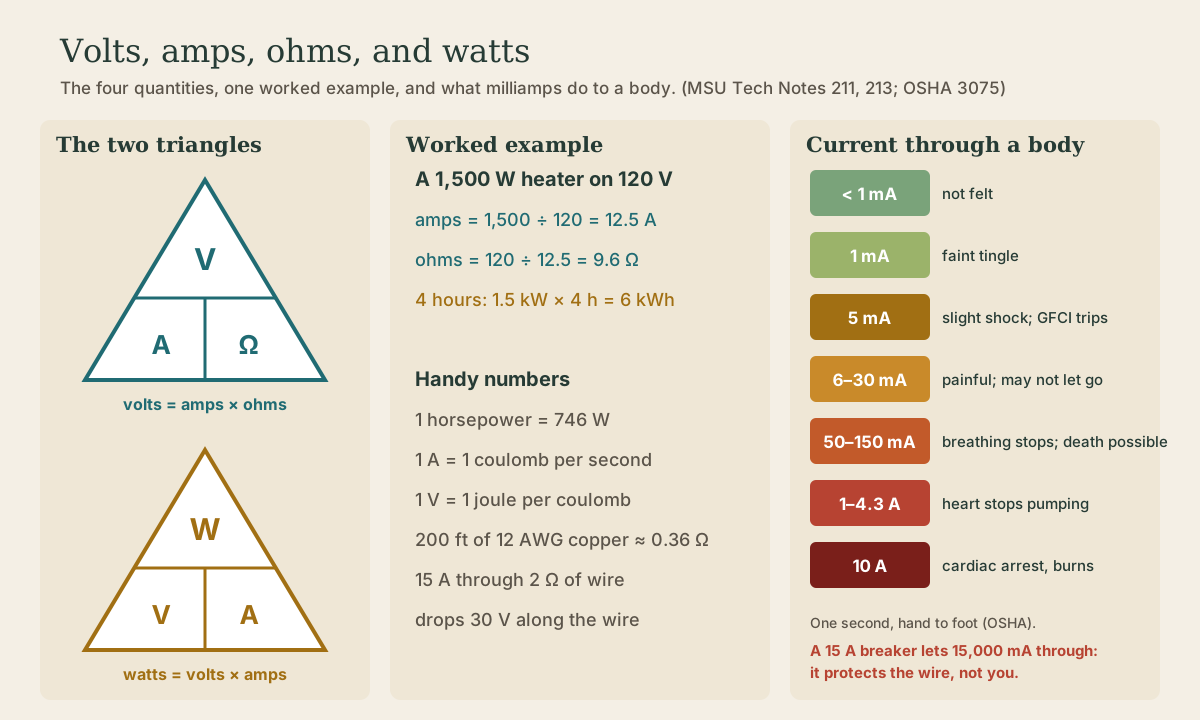
The three are tied together by Ohm’s law: volts = amps × ohms. Draw a triangle with V on top and A and Ω on the bottom, cover the one you want, and what’s left tells you whether to multiply or divide 4.
A practical use is voltage drop. If 15 amps flows through wire with 2 ohms of resistance, 15 × 2 = 30 volts is lost along the wire before it reaches the load 4. That’s why long runs to a shop or barn need larger wire.
Watts: volts times amps
Power is the rate of using energy, measured in watts: watts = volts × amps 1. It uses its own triangle, W over V and A.
Work it for a 1,500-watt space heater on 120 volts:
- Amps = 1,500 ÷ 120 = 12.5 A.
- Ohms = 120 ÷ 12.5 = 9.6 Ω for the heating element.
- Running it 4 hours uses 1.5 kW × 4 h = 6 kilowatt-hours, the unit on your electric bill.
Two notes. The simple watts = volts × amps works directly for resistive loads like heaters and incandescent bulbs; motors need a correction called power factor 4. And motors are rated in horsepower: 1 horsepower = 746 watts 1.
Quick check
Amps = watts ÷ volts = 1,500 ÷ 120. That’s most of a 15-amp circuit by itself.
Milliamps and your body
A shock is current through your body, and it takes very little. For current passing hand to foot for one second, OSHA gives these effects 3:
- Under 1 mA: not felt.
- 1 mA: faint tingle.
- 5 mA: slight shock, not painful but disturbing.
- 6–30 mA: painful; the “let-go” range, where muscles may clamp onto the conductor.
- 50–150 mA: extreme pain, breathing stops; death possible.
- 1,000–4,300 mA: the heart stops pumping normally; death likely.
- 10,000 mA: cardiac arrest and severe burns.
Your body completes a circuit when it touches both wires, a hot wire and ground, or a metal part that has become energized and ground 3. Most shock deaths are reported to come from ordinary 120-volt contact 5. A 15-amp breaker trips at 15,000 milliamps, hundreds of times more than it takes to kill. Breakers protect wire. People are protected by GFCIs, safe practice, and shutting the power off.
Playback is optional. If the player is unavailable, open the video at its source.
Quick check
Breakers and fuses protect the wire. A GFCI, which trips at a 5-milliamp leak, is the device that protects people.
What to take from this
Amps are charge per second, volts are energy per charge, ohms are resistance (double the length, double the ohms), and watts are volts times amps. Ohm’s law (V = A × Ω) and the power formula (W = V × A) solve almost every everyday problem: a 1,500 W heater draws 12.5 A at 120 V. Current only flows in a complete loop. A few tens of milliamps through the body can kill, far below what any breaker notices.
Lesson complete
Nice work.
Sources for this lesson
- 1Electrical Tech Note 211: Electrical Quantities. Michigan State University, Biosystems & Agricultural Engineering. verifiedOne ampere is one coulomb per second; voltage is often called push or pressure but is energy per charge, one joule per coulomb; resistance doubles when length doubles and halves when cross-sectional area doubles; power in watts is volts times amps, and 746 watts is one horsepower; 200 ft of 12 AWG copper is about 0.361 ohm; an electron in 14 AWG wire carrying 1 A drifts only about 1.8 m per minute; current always returns to its source.
- 2Electrical Tech Note 330: Wiring Circuits, Basic Rules. Michigan State University, Biosystems & Agricultural Engineering. verifiedEach hot wire is about 120 V to earth and 240 V hot to hot; voltages above about 15 V can be dangerous; NM-B cable for dwellings is commonly 14 AWG for 15 A circuits (white jacket), 12 AWG for 20 A (yellow), and 10 AWG for 30 A (orange); NM cable is for dry locations only; keep the equipment grounding conductor continuous; one wire per device screw terminal.
- 3Controlling Electrical Hazards (OSHA 3075). Occupational Safety and Health Administration. 2002. verifiedConductors and insulators; impurities make water conduct, and wet skin conducts; shocks happen when the body completes a path between both wires, a wire and ground, or an energized metal part and ground; effects of current hand to foot for one second: under 1 mA not felt, 1 mA faint tingle, 5 mA slight shock, 6-30 mA painful and the let-go range, 50-150 mA respiratory arrest and possible death, 1,000-4,300 mA the heart stops pumping, 10,000 mA cardiac arrest and burns; fuses and breakers protect conductors and equipment; GFCIs compare outgoing and returning current and trip at a 5 mA difference within as little as 1/40 s; AFCIs detect arcing.
- 4Electrical Tech Note 213: Electrical Equations. Michigan State University, Biosystems & Agricultural Engineering. verifiedOhm's law triangle (volts over amps times ohms); 15 A through a wire of 2 ohms drops 30 V along it; the power triangle (watts = volts x amps) applies directly to resistive loads such as heaters and incandescent lamps, not to motors without power factor.
- 5Electrical Tech Note 216: Electric Shock and Safety. Michigan State University, Biosystems & Agricultural Engineering. verifiedShock is current through the body; thousandths of an ampere can be felt; most shock fatalities are reported to come from contact with 120 V; an equipment grounding conductor keeps a faulted frame from reaching dangerous voltage.