Grounding and Bonding
Two different jobs with confusingly similar names. System grounding ties the neutral to the earth at the service to cap lightning and surge voltages; the equipment grounding conductor gives faults on metal parts a path back so the breaker trips. The grounded conductor versus the grounding conductor, bonding, why neutral and ground join only at the service, and neutral-to-earth voltage on farms.
- 5 min
- 7 steps
- 3 questions
- Lesson 49 of 111
In this lesson
- Two jobs, similar names
- System grounding
- Equipment grounding
- Grounded versus grounding
- Bonding
- Neutral-to-earth voltage
- What to take from this
Picking up where you left off.
Two jobs, similar names
“Grounding” covers two separate things, and most confusion comes from mixing them up 1:
- System grounding: connecting the electrical system’s neutral to the earth.
- Equipment grounding: connecting the metal parts of boxes, appliances, and tools back to the panel.
They meet at one place, the service panel, and do different jobs.
System grounding
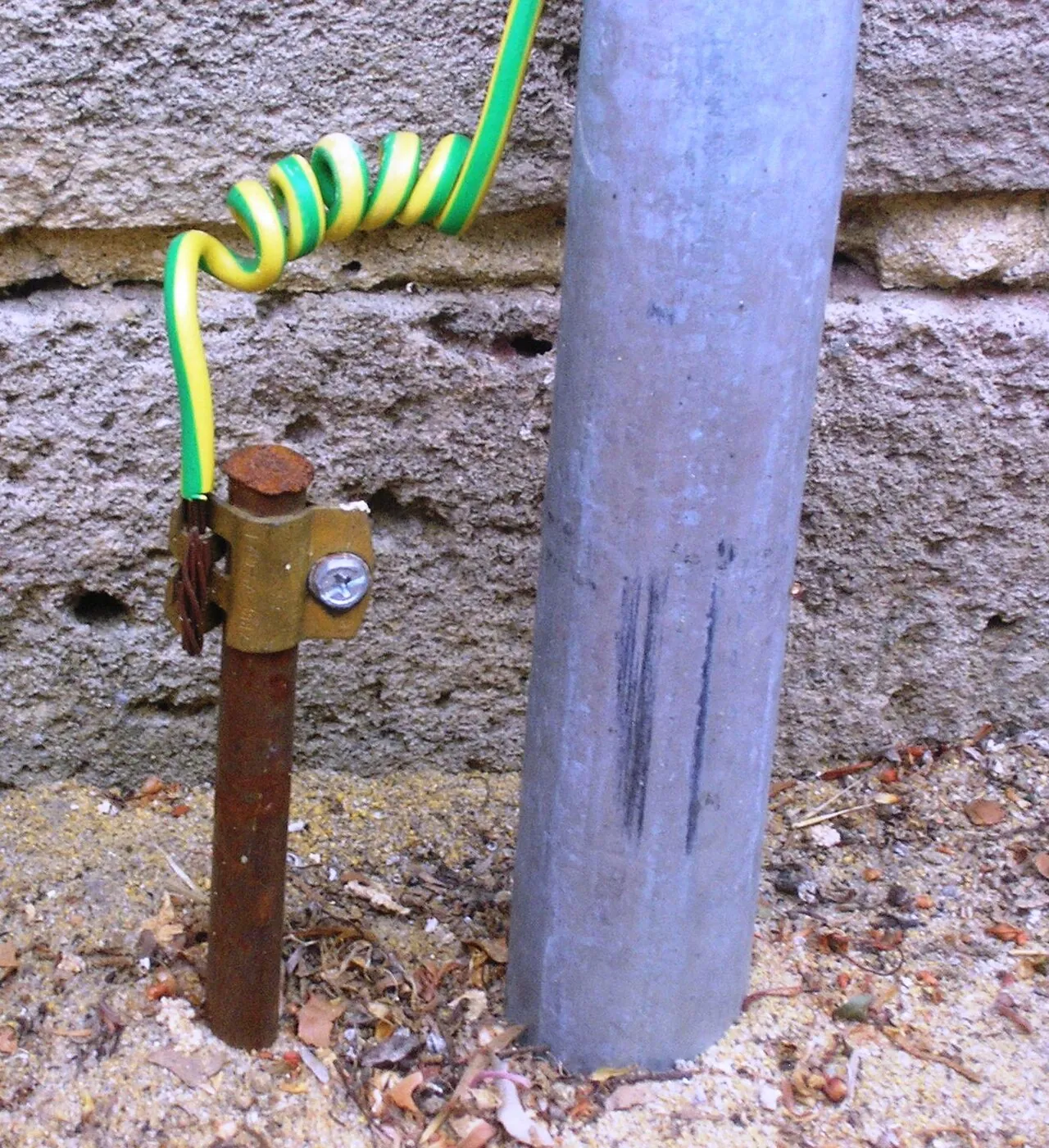
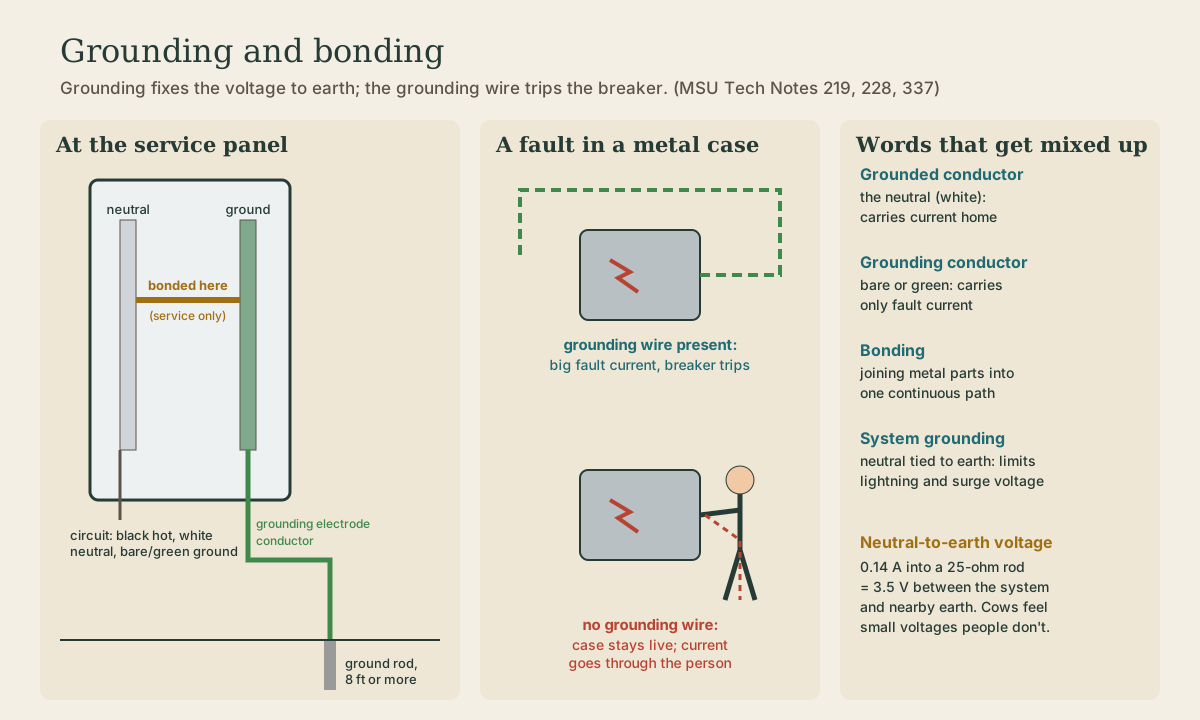
At the service, a heavy bare copper wire, the grounding electrode conductor, runs from the neutral bar to the earth: a ground rod driven at least 8 feet, a metal water pipe, or another electrode the code allows 2 1. The utility grounds the neutral at the transformer too 2.

Its purpose is to limit voltage: from lightning, line surges, or accidental contact with higher-voltage lines, and to hold the system at a steady voltage relative to the earth you stand on 1. The code asks for an electrode resistance to earth as low as practical, under 25 ohms if possible 1.
System grounding does not make a shorted appliance trip its breaker. Dirt is a poor conductor; a fault into the earth through a rod may not draw enough current to trip anything. That’s the second job.
Equipment grounding
Every circuit carries an equipment grounding conductor, bare or green, to every outlet and appliance. It ties exposed metal back to the panel 1.
Suppose a hot wire rubs through its insulation inside a metal appliance case:
- With a grounding wire, the fault has a low-resistance path straight back to the panel. A large current flows, and the breaker trips, de-energizing the case. Even before it trips, the grounding wire holds the case near earth voltage 1.
- Without one, the case sits at 120 volts, waiting. The next person who touches it and something grounded completes the circuit 1 3.
Most things run fine without a grounding wire, which is exactly why missing grounds go unnoticed until someone gets hurt 1.
Quick check
In normal use it carries no current. The white neutral carries the normal return current.
Grounded versus grounding
The code’s terms 1:
- Grounded conductor: the neutral, white. It’s connected to earth at the service, but it carries current every time a 120-volt load runs.
- Grounding conductor (equipment grounding conductor): bare or green. It carries current only during a fault.
In the service panel, the neutral and the grounding wires terminate together 1: the main bonding jumper joins the neutral bar to the panel and the grounding system there. That’s the one place they meet. In a subpanel or outbuilding, neutrals and grounds are kept on separate bars; otherwise normal neutral current would flow on the grounding wires and on every piece of metal they touch.
Quick check
It’s grounded to earth at the service but carries circuit current. The bare or green wire is the grounding conductor.
Bonding
Bonding means joining metal parts into one continuous, low-resistance path: conduit sections, boxes, water and gas piping, a short piece of nonmetallic conduit jumped with a bonding wire 1. Bonded metal stays at the same voltage, so you can’t get a shock between two pieces of it, and a fault anywhere finds its way back to the panel.
Neutral-to-earth voltage
Current doesn’t “want” to go into the ground. It always returns to its source, the transformer, and the earth is just one more path back 1. Because utility and customer systems are grounded at many points, a small current flows through the earth all the time, and a small voltage between grounded metal and the earth near it is normal 4.
Ohm’s law sets the size: 0.14 amp flowing into a ground rod with 25 ohms to earth makes about 3.5 volts between the grounding wire and the earth nearby 1. People rarely notice that. Dairy cows standing in wet barns on concrete do, which is why Wisconsin farms worry about “stray voltage,” and why livestock floors are built with equipotential grids: reinforcing mesh bonded to the stalls and waterers so animal and metal are at the same voltage 1. Elevated neutral-to-earth voltage can come from the utility, the farm’s own wiring, or a neighbor’s, and tracking it down takes specialized testing 4.
Playback is optional. If the player is unavailable, open the video at its source.
Quick check
Current always returns to its source. The earth is just one more, usually poor, path back.
What to take from this
System grounding ties the neutral to earth at the service, through a grounding electrode conductor to a rod or water pipe, to limit lightning and surge voltages. The equipment grounding conductor (bare or green) gives faults on metal a path back so breakers trip; the neutral (white, the grounded conductor) carries normal current. Neutral and ground join only at the service; subpanels keep them separate. Bonding joins metal into one path. Current returns to its source, and the small earth current that results can put a few volts on grounded metal, which livestock feel.
Lesson complete
Nice work.
Sources for this lesson
- 1Electrical Tech Note 228: Grounding, Bonding, and Equipotential Grids. Michigan State University, Biosystems & Agricultural Engineering. verifiedSystem grounding ties the neutral to earth at the service to limit voltage from lightning, surges, or contact with higher-voltage lines and to stabilize voltage to earth; the equipment grounding conductor (bare or green) carries fault current back so the breaker trips and limits touch voltage; the neutral is the grounded conductor and carries current; the equipment grounding wire and neutral terminate together in the service panel; bonding joins metal parts into one continuous path; current returns to its source, not into the earth for its own sake; electrodes should be under 25 ohms if possible; 0.14 A into a 25-ohm rod gives about 3.5 V neutral-to-earth voltage; GFCI receptacles trip at 5 mA; equipotential grids in livestock and pool areas.
- 2Electrical Tech Note 219: Single-Phase, 120/240 Volt, 3-Wire Electrical System. Michigan State University, Biosystems & Agricultural Engineering. verifiedA center-tapped transformer secondary gives 120 V from the center (neutral) to either end and 240 V end to end; codes require the neutral to be grounded, at the transformer and again at the service (water pipe or ground rod at least 8 ft); balanced 120 V loads leave the neutral carrying only the difference; the panel has two bus bars; single-pole breakers make 120 V circuits (black to breaker, white to neutral bar), two-pole breakers make 240 V circuits; ranges and dryers also use the neutral.
- 3Controlling Electrical Hazards (OSHA 3075). Occupational Safety and Health Administration. 2002. verifiedConductors and insulators; impurities make water conduct, and wet skin conducts; shocks happen when the body completes a path between both wires, a wire and ground, or an energized metal part and ground; effects of current hand to foot for one second: under 1 mA not felt, 1 mA faint tingle, 5 mA slight shock, 6-30 mA painful and the let-go range, 50-150 mA respiratory arrest and possible death, 1,000-4,300 mA the heart stops pumping, 10,000 mA cardiac arrest and burns; fuses and breakers protect conductors and equipment; GFCIs compare outgoing and returning current and trip at a 5 mA difference within as little as 1/40 s; AFCIs detect arcing.
- 4Electrical Tech Note 337: Neutral-to-Earth Voltage. Michigan State University, Biosystems & Agricultural Engineering. verifiedBecause utility and customer systems are grounded at many points, a small current flows in the earth and a small neutral-to-earth voltage (NEV) is normal; in wet conditions it can affect livestock and cause mild shocks around pools; elevated NEV can come from the utility, the customer's system, or a neighbor's, and finding it takes specialized equipment.