The Service Entrance and Meter
The parts between the pole and your panel and who owns each: the utility's service drop, attachment, connectors, and sealed meter; your service head, mast, entrance conductors, meter socket, and main disconnect. Overhead and underground services, the rules that keep the drop high and the meter accessible, and why everything upstream of the main breaker stays live even with the main off.
- 4 min
- 6 steps
- 3 questions
- Lesson 48 of 111
In this lesson
- Who owns what
- The overhead service
- The underground service
- The meter
- The main disconnect
- What to take from this
Picking up where you left off.
Who owns what
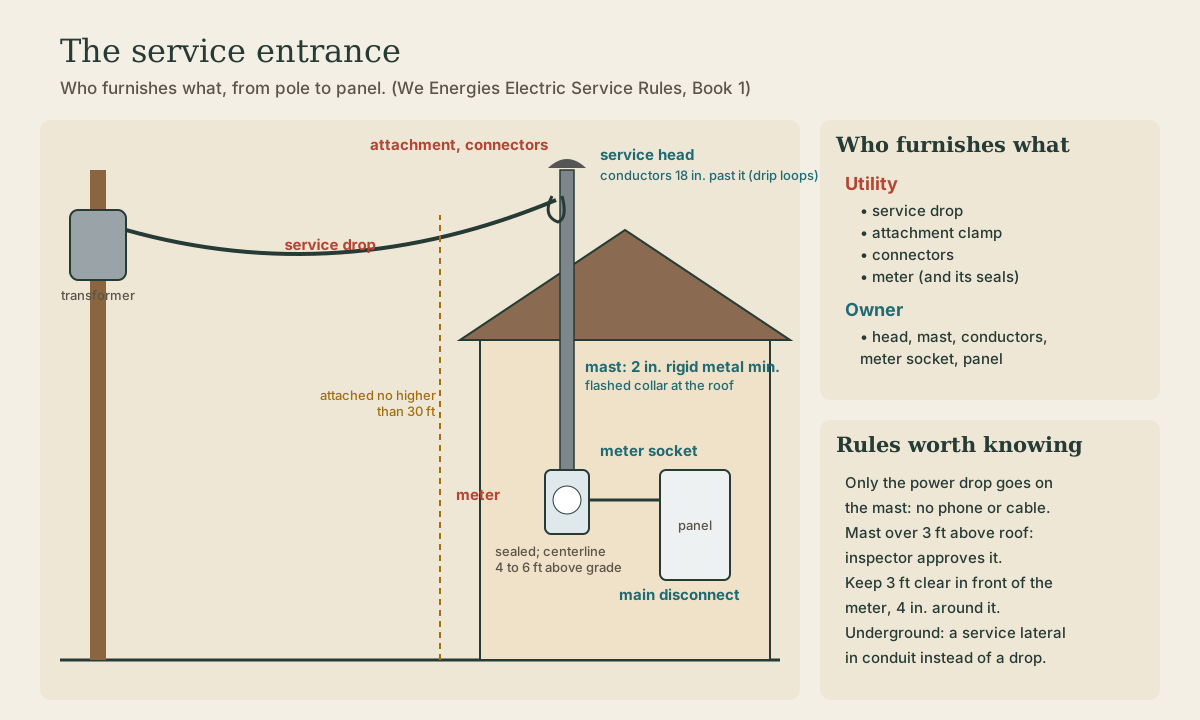
Every house service has a boundary between the utility’s equipment and yours. We Energies lays it out in its service rules 1:
| The utility furnishes and installs | The owner furnishes and installs |
|---|---|
| service drop conductors | service entrance conductors |
| attachment (the clamp that holds the drop) | service head (weatherhead) |
| connectors joining drop to entrance conductors | service mast or entrance raceway |
| watthour meter | utility-listed meter socket |
| service equipment (the main disconnect) |
The owner also has to provide a wall or mast strong enough to hold the drop’s pull; the utility tells you how many pounds to design for 1. Other Wisconsin utilities’ rules are similar; check yours before building.
Quick check
The utility also furnishes the attachment, connectors, and meter. The owner furnishes the head, mast, entrance conductors, meter socket, and service equipment.
The overhead service
From the pole transformer, three wires, two hots and a neutral, run to the house as the service drop 2. On a typical one-story house they land on a service mast: a pipe through the roof with a service head on top that keeps rain out of the conductors inside.
Key rules from We Energies 1:
- The mast is at least 2-inch rigid metal conduit, continuous above its top support, sealed to the roof with a flashing collar.
- Entrance conductors extend at least 18 inches past the head, so they can droop into a drip loop before joining the drop, so water runs off the bottom of the loop instead of into the head.
- Only the power drop attaches to the mast: no phone, cable, or antenna wires.
- The drop is attached low enough that it isn’t more than 30 feet above the ground, but high enough for required clearances.
- A mast rising more than 3 feet above the roof needs the local inspector’s approval.
Quick check
We Energies wants at least 18 inches beyond the head on a mast service.
The underground service
Many newer homes are fed underground instead: a service lateral in conduit from a pad-mounted transformer or pole to the meter socket. The same ownership split applies, with burial depth matched to the utility’s, and conduit plans sent to the utility for acceptance 1.
The meter
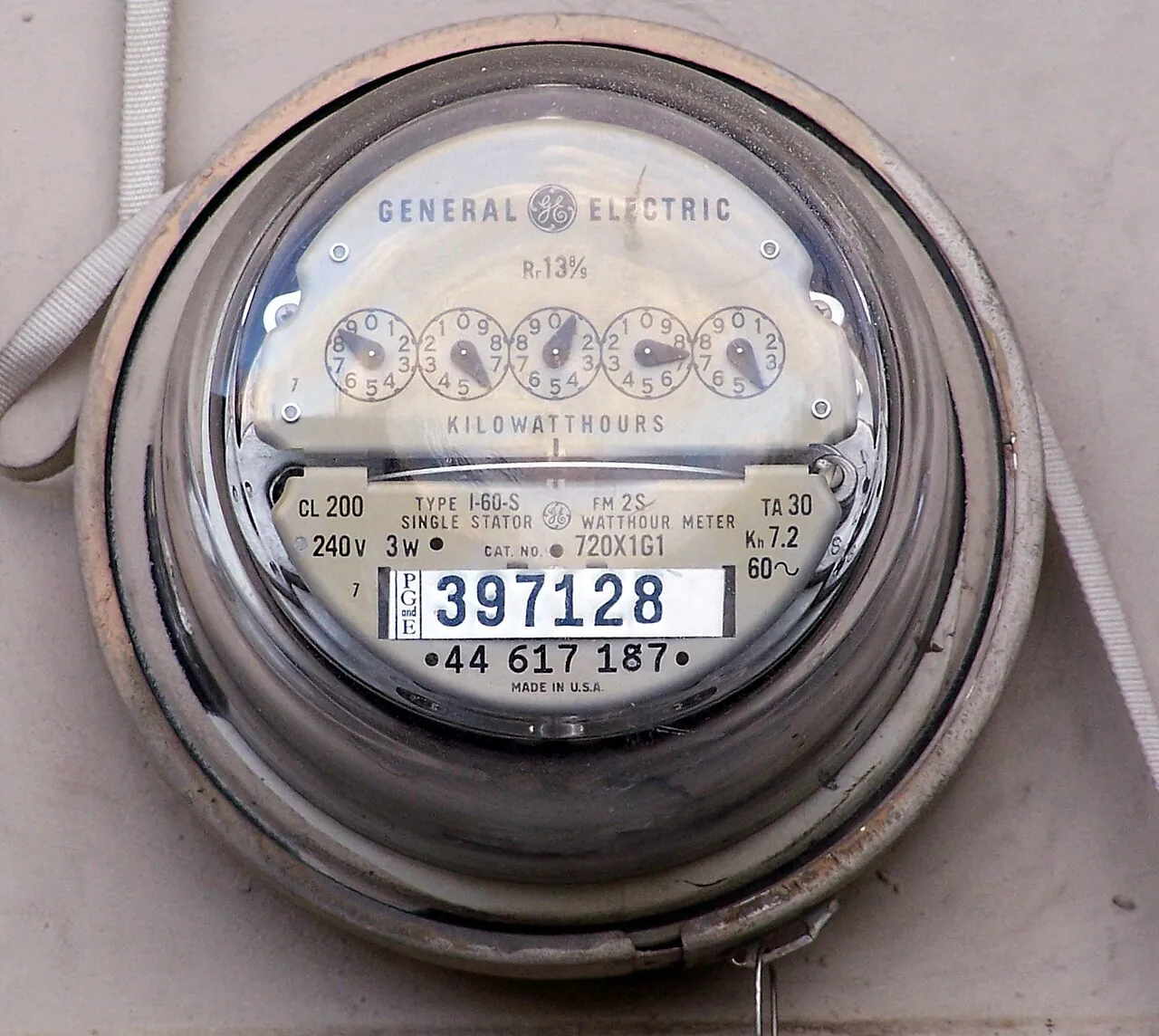
The meter socket (meter base) is yours, but it must be a model listed by the utility. The meter plugged into it belongs to the utility, which seals it along with any enclosure holding unmetered conductors 3. Breaking those seals is tampering.

The meter has to stay accessible 3:
- centerline 4 to 6 feet above grade,
- 4 inches clear around it,
- 3 feet of open working space in front of it,
- and no extra circuits spliced inside the meter socket.
Don’t build a deck, plant a shrub, or wall in a porch around it.
The main disconnect
Past the meter, the two hots land on the main service disconnect, usually the main breaker at the top of the panel; the neutral goes to the neutral bar, which is grounded to earth right there 2.
The main is the switch that kills everything downstream. It does nothing to the conductors upstream: the drop, the meter, and the entrance conductors up to the main’s line terminals stay live no matter what. Only the utility can turn those off, which is why that equipment is sealed. Treat the top of the panel, where the service conductors land, as always hot.
Playback is optional. If the player is unavailable, open the video at its source.
Quick check
Only the utility can de-energize the conductors ahead of the main. That’s why meter equipment is sealed.
What to take from this
The utility owns the service drop, attachment, connectors, and meter; you own the service head, mast, entrance conductors, utility-listed meter socket, and main disconnect. Overhead masts are at least 2-inch rigid metal with conductors 18 inches past the head for drip loops and nothing but the power drop attached. Keep the sealed meter 4 to 6 feet up with 3 feet clear in front. The main breaker shuts off the house, never the service conductors ahead of it.
Lesson complete
Nice work.
Sources for this lesson
- 1Electric Service Rules, Book 1: Overhead Services. We Energies. 2026. verifiedThe company furnishes and installs the service drop, attachment, connectors, and watthour meter; the customer furnishes the service entrance conductors, service head, service mast (2-inch minimum rigid metallic conduit), company-listed metering equipment, and service equipment; conductors extend at least 18 inches beyond the service head; only the power service drop may attach to the mast; drops not installed higher than 30 feet; masts extending more than 3 feet above the roof need the local inspector's approval; the customer provides adequate wall strength for drop tension.
- 2Electrical Tech Note 219: Single-Phase, 120/240 Volt, 3-Wire Electrical System. Michigan State University, Biosystems & Agricultural Engineering. verifiedA center-tapped transformer secondary gives 120 V from the center (neutral) to either end and 240 V end to end; codes require the neutral to be grounded, at the transformer and again at the service (water pipe or ground rod at least 8 ft); balanced 120 V loads leave the neutral carrying only the difference; the panel has two bus bars; single-pole breakers make 120 V circuits (black to breaker, white to neutral bar), two-pole breakers make 240 V circuits; ranges and dryers also use the neutral.
- 3Electric Service Rules, Book 1: Metering. We Energies. 2026. verifiedMeters and equipment containing unmetered conductors are sealed by the company; meter centerlines 4 to 6 feet above the floor or grade; 4 inches clear around the meter and 3 feet of unobstructed working space in front; metering compartments may not be used as junction boxes for customer circuits; the company must have access to meters at all times.