Wire Sizing and Box Fill
Two sizing problems. Wire: first the ampacity pairing (14 AWG on 15 A, 12 on 20, 10 on 30), then voltage drop on long runs, figured as 2 × amps × one-way resistance against a 3 percent branch-circuit target, worked for a 100-foot shop run. Boxes: count every conductor, the grounds once, each device yoke twice, and clamps once, then multiply by 2.00 cubic inches for 14 AWG or 2.25 for 12 AWG.
- 4 min
- 4 steps
- 3 questions
- Lesson 52 of 111
In this lesson
- First: ampacity
- Voltage drop
- Box fill
- What to take from this
Picking up where you left off.
First: ampacity
Wire size starts with how much current it can carry without overheating. In houses the familiar pairings for copper NM-B are 14 AWG on 15 A, 12 AWG on 20 A, 10 AWG on 30 A 1. Remember that AWG numbers run backward: smaller numbers are bigger wire 2. The breaker protects the wire, so it never exceeds the wire’s rating.
That settles short runs. Long runs need a second check.
Voltage drop
Every wire has resistance, and current flowing through it loses voltage along the way. For a single-phase circuit, both wires carry the current, so 3:
drop = 2 × I × R, where R is the resistance of the one-way length.
Wire resistance comes from tables. For copper at 75 °C, per 1,000 feet 3 2:
| Copper | Ω per 1,000 ft |
|---|---|
| 14 AWG | 3.14 |
| 12 AWG | 1.98 |
| 10 AWG | 1.24 |
| 8 AWG | 0.778 |
The NEC doesn’t set a hard limit for ordinary circuits, but it recommends no more than 5 percent from source to the farthest load, about 3 percent on a branch circuit and 2 percent on the feeder 3. Too much drop wastes energy and burns out motors, which run hot on low voltage 3.
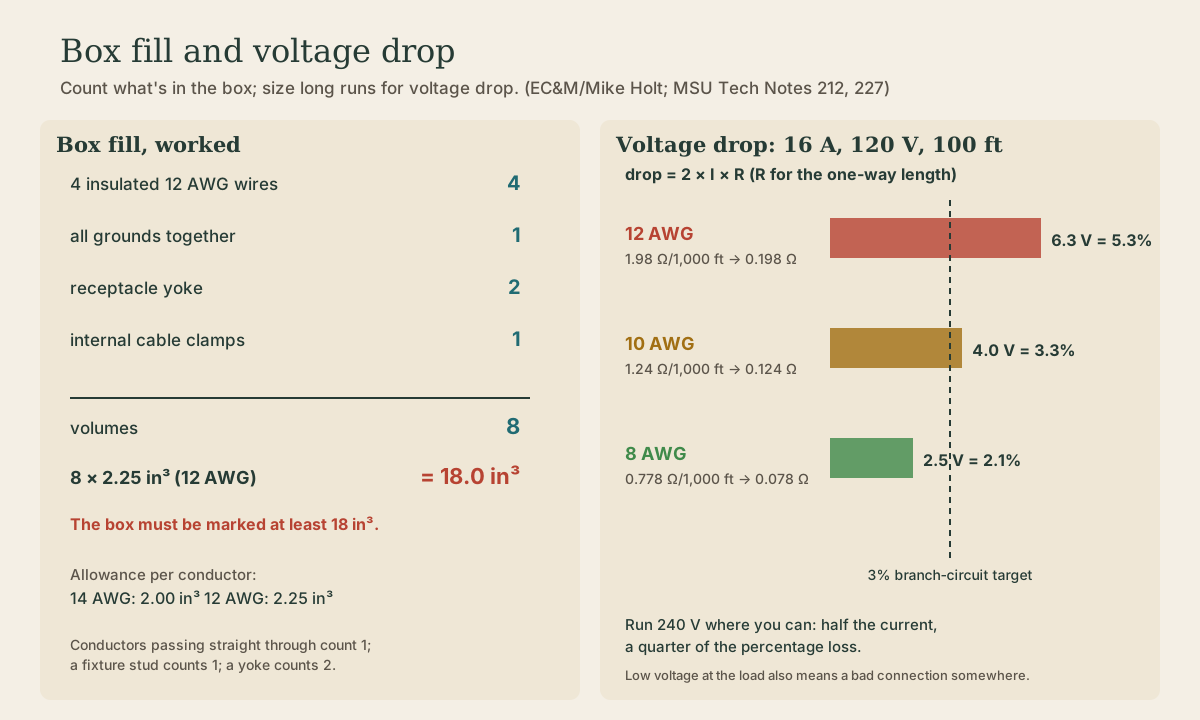
Worked example: a 16-amp, 120-volt compressor at the far end of a shop, 100 feet from the panel.
- 12 AWG: R = 1.98 × 100/1,000 = 0.198 Ω. Drop = 2 × 16 × 0.198 = 6.3 V, which is 5.3 percent. Too much.
- 10 AWG: R = 0.124 Ω. Drop = 4.0 V, 3.3 percent. About right.
- 8 AWG: R = 0.078 Ω. Drop = 2.5 V, 2.1 percent. Comfortable.
Two other ways out: run the load at 240 volts if it allows (half the current, so a quarter of the percentage), or put a subpanel near the loads. And if you measure more drop than the math predicts, there’s an extra resistance somewhere, usually a bad connection 3.
Quick check
Drop = 2 × 16 A × 0.198 Ω. Going to 10 AWG brings it to about 3.3 percent.
Box fill
A box stuffed with too many wires and devices runs hot and damages insulation when everything gets pushed back in. The NEC limits fill by volume. Each item in the box takes an allowance based on wire size: 2.00 cubic inches per 14 AWG volume, 2.25 per 12 AWG 4.
How to count 4:
| Item | Counts as |
|---|---|
| each insulated conductor entering and ending in the box, or passing through | 1 |
| all equipment grounding conductors, together | 1 (by the largest) |
| each device yoke (receptacle or switch) | 2 (by the largest wire on it) |
| internal cable clamps, any number | 1 |
| a fixture stud or hickey | 1 |
Worked example: a single-gang box with a receptacle fed by two 12/2 cables, using the box’s internal clamps:
- 4 insulated 12 AWG conductors: 4
- all grounds: 1
- receptacle yoke: 2
- clamps: 1
- total: 8 volumes × 2.25 = 18.0 cubic inches.
Boxes are marked with their volume. Use one marked at least 18 cubic inches, and go bigger when you can: the extra room makes the work easier and the connections better.
Playback is optional. If the player is unavailable, open the video at its source.
Quick check
A device yoke, by contrast, counts two.
Quick check
4 conductors + 1 for grounds + 2 for the yoke + 1 for clamps = 8.
What to take from this
Size wire for current first (14 on 15 A, 12 on 20, 10 on 30), then check voltage drop on long runs: drop = 2 × amps × one-way resistance, aiming for about 3 percent on a branch circuit; a 16-amp load 100 feet away wants 10 AWG, not 12. Size boxes by counting conductors once each, all grounds once, each device twice, and clamps once, times 2.00 cubic inches (14 AWG) or 2.25 (12 AWG).
Lesson complete
Nice work.
Sources for this lesson
- 1Electrical Tech Note 330: Wiring Circuits, Basic Rules. Michigan State University, Biosystems & Agricultural Engineering. verifiedEach hot wire is about 120 V to earth and 240 V hot to hot; voltages above about 15 V can be dangerous; NM-B cable for dwellings is commonly 14 AWG for 15 A circuits (white jacket), 12 AWG for 20 A (yellow), and 10 AWG for 30 A (orange); NM cable is for dry locations only; keep the equipment grounding conductor continuous; one wire per device screw terminal.
- 2Electrical Tech Note 212: Conductor Properties. Michigan State University, Biosystems & Agricultural Engineering. verifiedAWG wire gets larger as the number gets smaller; the smallest power-circuit wire is 14 AWG copper, in most cases protected at no more than 15 A; wire area is given in circular mils.
- 3Electrical Tech Note 227: Sizing Conductors to Minimize Voltage Drop. Michigan State University, Biosystems & Agricultural Engineering. verifiedSingle-phase voltage drop is 2 x I x R, with R for the one-way length; excessive drop wastes energy and burns out motors; high-resistance connections, including improper copper-aluminum joints and wet aluminum connections, also cause drop; the NEC recommends no more than 5 percent from source to farthest load, about 2 percent on feeders and 3 percent on branch circuits; Table 227.1 gives resistance per 1,000 ft (copper at 75 C: 14 AWG 3.14, 12 AWG 1.98, 10 AWG 1.24, 8 AWG 0.778 ohms).
- 4Mike Holt. NEC Requirements for Sizing Outlet Boxes. EC&M. 2019. verifiedTable 314.16(B) allows 2.00 cubic inches per 14 AWG conductor and 2.25 per 12 AWG; each conductor entering and terminating or passing through counts once; all equipment grounding conductors together count once, by the largest; each single-gang device yoke counts two volumes by the largest conductor terminating on it; one or more internal cable clamps count once; each fixture stud or hickey counts once.