Faucets and Sinks
The four faucet valves (compression with washers, ball, cartridge, ceramic disc), what makes each one drip and how to fix it, Wisconsin's flow limits (2.2 gpm for lavatory and kitchen faucets) and WaterSense's 1.5 gpm aerators, sink drains of at least 1 1/2 inches with a P-trap, and how much a drip actually wastes.
- 4 min
- 5 steps
- 3 questions
- Lesson 37 of 111
In this lesson
- Four kinds of valves
- Fixing a drip
- How much water a faucet uses
- Sinks and their drains
- What to take from this
Picking up where you left off.
Four kinds of valves
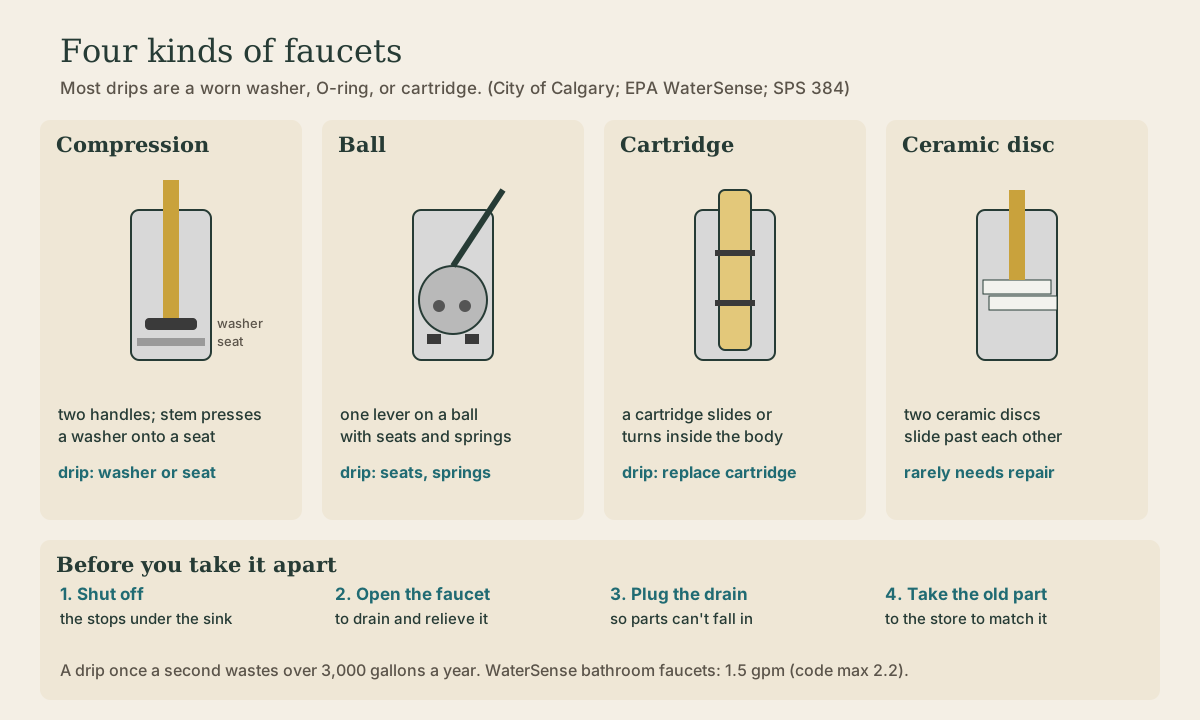
Under the handle, every faucet has a valve. The City of Calgary’s repair guide sorts them into types 1:
- Compression: separate hot and cold handles. Turning the handle screws a stem down to press a rubber washer against a seat. The oldest and simplest kind. A drip usually means a worn washer, sometimes a pitted seat.
- Ball: one lever on a hollow ball with slots; moving it lines the slots up with hot and cold inlets. Rubber seats and springs press against the ball.
- Cartridge: one handle (or two), moving a narrow cartridge inside the faucet body. Worn cartridges get replaced as a unit.
- Ceramic disc: two polished ceramic discs slide over each other to open and mix. Very durable.
- Tub and shower valves work the same ways, with most of the valve behind the wall (next lesson).
Most leaks come down to worn rubber: washers, seals, and O-rings 1. Water from the spout means the valve itself; water from around the handle or the base of the spout usually means an O-ring.
Quick check
Washerless types (ball, cartridge, disc) wear seals, springs, or the cartridge instead.
Fixing a drip
The repair guide’s routine 1:
- Shut off the supply: the stop valves under the sink. Open the faucet to drain it.
- Plug the drain so small screws and springs can’t disappear.
- Pry off the decorative cap and remove the handle screw, then the handle.
- Unscrew the packing nut or retaining clip and pull the stem or cartridge, laying parts out in order.
- Take the old part to the store; there are hundreds of slightly different cartridges.
- Reassemble, turn the stops on slowly, and run the faucet to clear air.
A faucet dripping once a second wastes more than 3,000 gallons a year 2.
Quick check
And take the old part to the store to match it.
Quick check
EPA’s figure; on a well, that’s pump run time and septic load too.
How much water a faucet uses
Wisconsin limits lavatory faucets to 2.2 gallons per minute at 60 psi and kitchen sink faucets to 2.2 gpm at 80 psi, with a flow restrictor or aerator built in 3. EPA’s WaterSense bathroom faucets and aerators use 1.5 gpm or less, about 30 percent less, which saves an average family around 700 gallons a year 4. Swapping just the aerator (the screen at the spout’s tip) is the cheapest upgrade; unscrew it and clean the screen when the stream gets uneven, since sediment collects there, especially on well water.
Sinks and their drains
Sinks are made of enameled cast iron, vitreous china, stainless steel, enameled steel, or plastic, each to its own standard 3. Every sink needs a waste outlet at least 1 1/2 inches in diameter 3 (bathroom lavatories use 1 1/4-inch), and every fixture drains through its own trap, the water-filled bend that blocks sewer gas, covered in the How Plumbing Works module.
Two common problems under a sink:
- Slow drain: hair and soap at the pop-up stopper in a bathroom sink; grease and food in a kitchen sink trap. Pull the stopper, or remove and clean the trap over a bucket.
- Drip under the sink: tighten slip-joint nuts on the trap by hand; replace the washer if it still leaks; check the supply line connections and the faucet base.
Playback is optional. If the player is unavailable, open the video at its source.
What to take from this
Faucets are compression (washer and seat), ball, cartridge, or ceramic disc, and most drips are a worn washer, seal, O-ring, or cartridge. Shut off the stops, drain the faucet, plug the sink, and take the old part to the store. Wisconsin allows 2.2 gpm at lavatory and kitchen faucets; WaterSense aerators bring bathrooms to 1.5. Sinks need at least a 1 1/2-inch outlet and a trap, and a drip once a second wastes over 3,000 gallons a year.
Lesson complete
Nice work.
Sources for this lesson
- 1Repairing faucets. City of Calgary Water Services. verifiedFaucet types: washer-type compression (separate hot and cold handles, rubber washers and O-rings), ball (a lever on a hollow ball), cartridge (a narrow cartridge inside the body), ceramic disc (single or two handles), and tub/shower valves behind the wall; most leaks come from worn rubber washers, seals, and O-rings; shut off the supply and open the taps first, plug the drain, and take old parts to the store to match.
- 2Fix a Leak Week. U.S. EPA WaterSense. verifiedToilet dye test: put food coloring in the tank; color in the bowl after 10 minutes means a leak (flush afterward to avoid staining); a worn flapper can make a toilet run on its own or silently leak thousands of gallons a year; a faucet dripping once a second wastes more than 3,000 gallons a year; a showerhead leaking 10 drips a minute wastes over 500; check the water meter before and after two hours with no water use.
- 3Wis. Admin. Code ch. SPS 384, Plumbing Products. Wisconsin Department of Safety and Professional Services. verifiedSPS 384.40 joints: copper soldered joints per ASTM B828 with NSF-approved flux and ASTM B32 solder, lead-free for water supply (solders and fluxes over 0.2 percent lead not allowed for brass); flared joints only on annealed tube with a flaring tool; PEX joints per the manufacturer's instructions; PVC solvent joints per ASTM D2855 with F656 primer and D2564 cement; ABS solvent joints with D2235 cement; ABS-to-PVC solvent joints only in non-pressurized systems, with F656 primer on the PVC and D3138 transition cement; threaded joints get compound or tape on male threads only, and plastic may be threaded only at schedule 80 or heavier; cast iron by caulked (oakum and poured lead) or mechanical sleeve joints with C564 rubber and CISPI 310 bands; different materials joined by mechanical compression joints, with dielectric fittings to prevent galvanic corrosion.
- 4Bathroom Faucets. U.S. EPA WaterSense. verifiedThe standard bathroom faucet flow is 2.2 gallons per minute; WaterSense bathroom faucets and aerators use at most 1.5, about 30 percent less, saving an average family about 700 gallons a year.