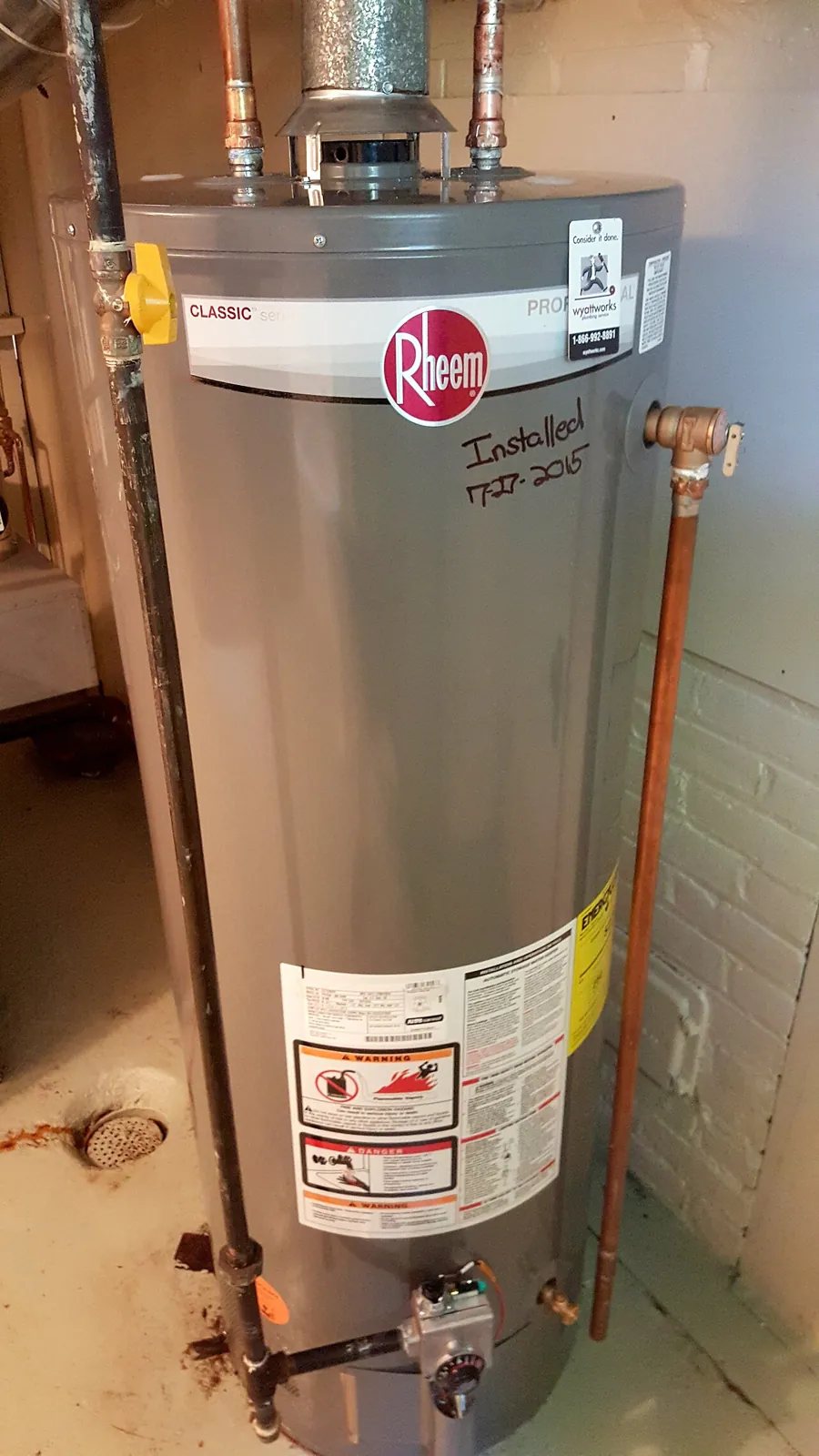
Water Heaters
How a tank water heater works (cold water down the dip tube, hot water off the top, an anode rod protecting the tank), Wisconsin's safety rules for the temperature and pressure relief valve and its discharge pipe, an expansion tank on closed systems, a drain valve and 125 °F limits, and care: 120 °F, draining sediment every 3 to 6 months, and when to plan a replacement. Tankless and heat pump heaters compared.
- 5 min
- 6 steps
- 3 questions
- Lesson 39 of 111
In this lesson
- How a tank heater works
- The relief valve
- Expansion, drain, and temperature limits
- Care
- Other kinds
- What to take from this
Picking up where you left off.
How a tank heater works
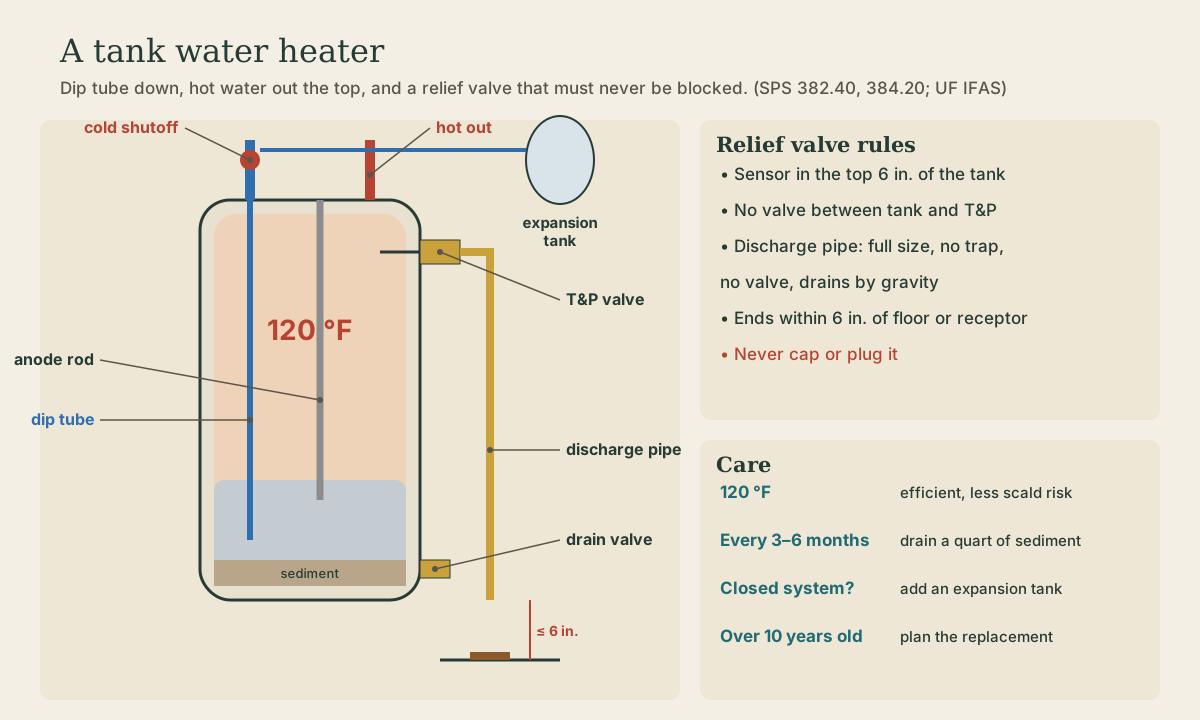
A storage water heater keeps 40 or 50 gallons hot and ready. Cold water enters at the top and runs down a dip tube to the bottom, so it doesn’t mix straight into the hot water leaving from the outlet at the top. A gas burner under the tank (with a flue up the middle) or electric elements inside heat the water, controlled by a thermostat. A sacrificial anode rod, usually magnesium or aluminum, corrodes in place of the steel tank’s weak spots; when it’s used up, the tank starts to rust.

Water heating is the second-largest energy cost in most homes, 14 to 18 percent of the utility bill 1.
The relief valve
If a thermostat fails, a tank of water can heat past boiling under pressure. The temperature and pressure (T&P) relief valve is what keeps it from becoming a bomb. Wisconsin’s rules 2:
- Every pressurized storage heater has a combination T&P relief valve, rated at least as high as the heater’s BTU input.
- Its sensor reaches into the top 6 inches of the tank, where the water is hottest.
- No valve or other restriction may be installed between the tank and the relief valve.
- The discharge pipe: an approved water pipe material, at least the size of the valve outlet, not trapped, no valve in it, draining by gravity to a floor with a floor drain or to a receptor, and ending within 6 inches of the floor or receptor but no closer than twice its diameter.
Never cap or plug a dripping relief valve. A T&P that drips now and then often means excessive pressure, frequently from thermal expansion (below); one that opens hard means overheating, and the heater needs service now.
Quick check
A blocked relief valve turns an overheating tank into a bomb.
Quick check
But no closer than twice its own diameter, so the discharge is visible and can’t be sucked back.
Expansion, drain, and temperature limits
- Thermal expansion: heated water expands. When a check valve, backflow preventer, or other one-way device makes the system closed, that expansion has nowhere to go, and Wisconsin requires an expansion tank or similar device on the heater 2.
- Drain valve: at least 3/4 inch with a hose thread at the lowest point of the tank 3.
- Shutoff: a valve on the cold supply to the heater 2.
- Temperature: instantaneous heaters for homes must deliver no more than 125 °F initially, and combination space-and-water heating systems that run hotter need a mixing valve to limit domestic hot water to 125 °F 3.
- Access: the heater must be accessible for inspection, service, and replacement 3.
Care
The University of Florida’s extension guidance 1:
- Set the thermostat to about 120 °F: efficient, and less scald risk. Electric heaters have two thermostats; set both the same.
- Drain about a quart every 3 to 6 months to remove sediment, which collects at the bottom and slows heat transfer. Hard well water makes more of it.
- Plan to replace a heater over about 10 years old before it fails; a new one costs less to run, and a planned swap beats a flooded basement.
Quick check
120 °F saves energy and reduces scald risk; sediment slows heat transfer.
Other kinds
- Tankless (on-demand) heaters heat water as it flows, with no tank to keep hot, which avoids standby losses; hard water means they need periodic descaling 1. Large gas units need a big gas line and venting; electric ones need a large electrical service.
- Heat pump water heaters use electricity to move heat from the surrounding air into the tank rather than making heat directly, using far less electricity 1. They cool and dry the room they sit in, which suits a basement in summer.
Playback is optional. If the player is unavailable, open the video at its source.
What to take from this
A tank heater takes cold water down a dip tube, delivers hot from the top, and relies on an anode rod to protect the tank. The T&P valve senses the top 6 inches of the tank, with no valve before it or in its discharge pipe, which runs full size and untrapped to within 6 inches of a drain. Closed systems need an expansion tank. Set 120 °F, drain sediment every few months, and plan replacement past about 10 years.
Lesson complete
Nice work.
Sources for this lesson
- 1Wendell A. Porter, Kathleen C. Ruppert, Randall A. Cantrell. Energy Efficient Homes: Water Heaters (FY1025). University of Florida IFAS Extension. verifiedWater heating is the second-largest home energy expense, 14 to 18 percent of the utility bill; set the thermostat to 120 °F for efficiency and to reduce scalding (electric heaters have two thermostats, set them the same); drain about a quart every 3 to 6 months to remove sediment; tankless units heat on demand without storage; heat pump water heaters move heat rather than making it; the T&P valve releases excess heat and pressure; consider replacing a heater over 10 years old.
- 2Wis. Admin. Code ch. SPS 382, Design, Construction, Installation, Supervision, Maintenance and Inspection of Plumbing. Wisconsin Legislature. 2026. verifiedRegister August 2026. SPS 382.10: plumbing protects health and the waters of the state; fixtures need adequate water volume and pressure; drains must carry waste efficiently with cleanouts and enough air circulation that trap seals are never siphoned, aspirated, or forced; every dwelling on a sewer or POWTS needs at least one water closet, wash basin, kitchen sink, and tub or shower. SPS 382.30: horizontal branch drains 2 inches or less slope at least 1/4 inch per foot, larger ones 1/8 inch per foot; drainage fixture units, e.g. residential water closet 4, bathroom group 6, residential kitchen sink 2, lavatory 1, residential shower 2, residential clothes washer 4. SPS 382.31: each gravity building sewer served by at least one 3-inch stack to a vent terminal; vent terminals at least 2 inches for frost; trap-to-vent maximum developed lengths (1/4 inch per foot, sanitary tee: 1-1/4 in. 5 ft, 1-1/2 in. 6 ft, 2 in. 8 ft, 3 in. 12 ft, 4 in. 16 ft); vents not within two diameters of the weir; air admittance valves allowed with limits. SPS 382.32: trap seals 2 to 4 inches; trap primers for evaporation; prohibited traps include bell, drum, non-integral S-traps, partition, and moving-part traps. SPS 382.40: minimum flow pressure 8 psig at fixtures, 15 for washdown and siphonic water closets, 20 for one-piece tank toilets and pressure-balance or thermostatic mixing valves, 25 for blowout fixtures; over 80 psig requires a pressure reducing valve and strainer downstream of the meter and upstream of fixtures; sizing accounts for fixture load, minimum supply pressure, elevation, device losses, minimum fixture pressure, and friction.
- 3Wis. Admin. Code ch. SPS 384, Plumbing Products. Wisconsin Department of Safety and Professional Services. verifiedSPS 384.40 joints: copper soldered joints per ASTM B828 with NSF-approved flux and ASTM B32 solder, lead-free for water supply (solders and fluxes over 0.2 percent lead not allowed for brass); flared joints only on annealed tube with a flaring tool; PEX joints per the manufacturer's instructions; PVC solvent joints per ASTM D2855 with F656 primer and D2564 cement; ABS solvent joints with D2235 cement; ABS-to-PVC solvent joints only in non-pressurized systems, with F656 primer on the PVC and D3138 transition cement; threaded joints get compound or tape on male threads only, and plastic may be threaded only at schedule 80 or heavier; cast iron by caulked (oakum and poured lead) or mechanical sleeve joints with C564 rubber and CISPI 310 bands; different materials joined by mechanical compression joints, with dielectric fittings to prevent galvanic corrosion.