Traps and Why Vents Matter
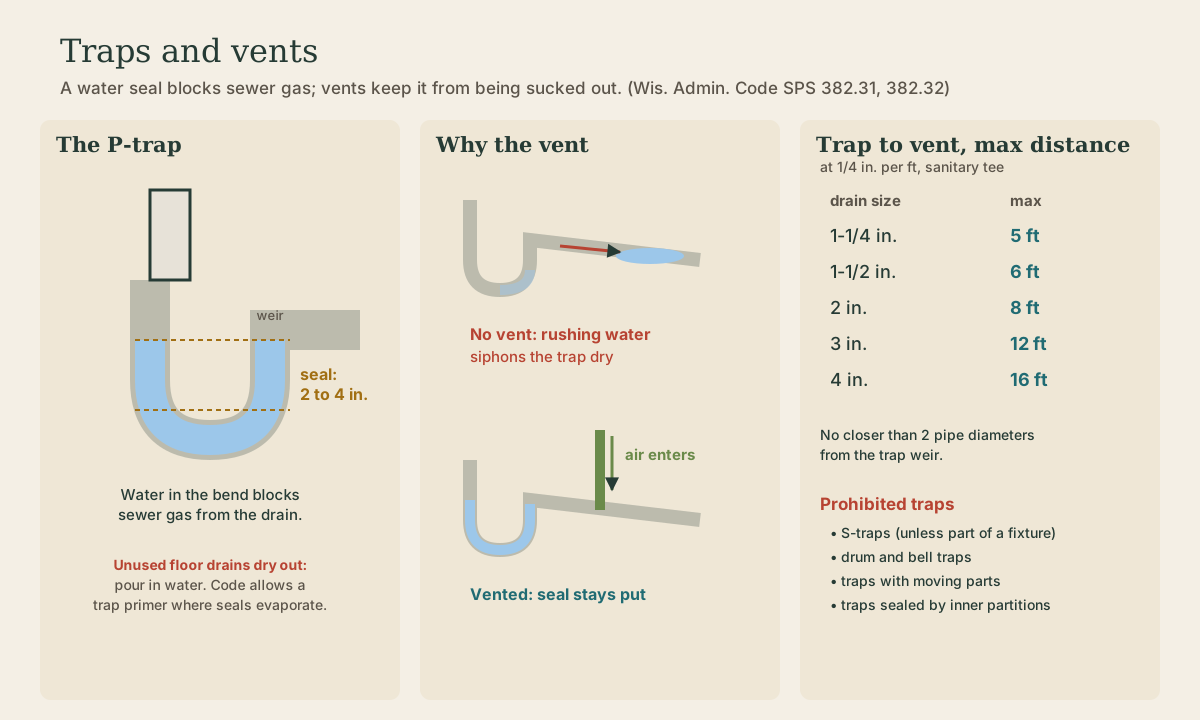
Every fixture's trap holds a 2- to 4-inch water seal that blocks sewer gas. Vents protect that seal from being siphoned out by rushing water. Wisconsin's limits on trap-to-vent distance, the traps the code prohibits (non-integral S-traps, drum and bell traps), air admittance valves, why dry floor drains smell, and what gurgling drains are telling you.
- 5 min
- 7 steps
- 3 questions
- Lesson 29 of 111
In this lesson
- The trap
- Why vents matter
- How far the vent can be
- Prohibited traps
- Air admittance valves
- When traps fail
- What to take from this
Picking up where you left off.
The trap
Sewers are full of gas that smells and can be dangerous. The thing standing between that gas and your house is a few inches of water held in a bend under every fixture: the trap.
Water flows in, down through the U-shaped bend, and out over the high point on the far side, called the weir. When the flow stops, the bend stays full of water up to the weir, sealing the pipe. Wisconsin requires that seal depth to be at least 2 inches and no more than 4 inches 1. Shallower seals are easily lost; deeper ones collect solids.
Toilets have the trap built into the china. Sinks, tubs, showers, and floor drains get a separate P-trap (named for its shape on its side).
Quick check
Too shallow and it’s easily lost; too deep and it collects solids.
Why vents matter
A trap seal is just water in an open pipe. Two things can steal it:
- Siphonage: a slug of water filling the pipe as it rushes down pulls air, and the trap’s water, along behind it. You’ve heard a sink gurgle as it finishes draining; that’s air being sucked through a trap that’s losing its seal.
- Back pressure: water dropping down a stack can push air ahead of it hard enough to blow a seal out the other way.
Vents fix both by giving the drain an air connection right downstream of the trap. Wisconsin’s code requires the drain system to be designed so trap seals face “no danger of siphonage, aspiration or forcing” in ordinary use 1.
How far the vent can be
A vent only protects a trap if it’s close enough that the pipe between them can’t run full. Wisconsin limits the developed length from the trap weir to the vent connection. For a fixture drain sloped 1/4 inch per foot entering the vent at a sanitary tee 1:
| Fixture drain | Max trap-to-vent |
|---|---|
| 1-1/4 inch | 5 feet |
| 1-1/2 inch | 6 feet |
| 2 inch | 8 feet |
| 3 inch | 12 feet |
| 4 inch | 16 feet |
The vent can’t connect too close, either: not within two pipe diameters of the weir 1. Steeper drains get shorter limits, and drains under 3 inches can’t be laid as flat as 1/8 inch per foot at all.
Quick check
Beyond that distance, the drain can run full and siphon its own trap.
Prohibited traps
Wisconsin bans traps that lose their seals easily or clog 1:
- S-traps that aren’t built into the fixture. An S-trap’s outlet drops straight down, so the draining water siphons its own seal; old houses are full of them.
- Drum traps (unless the state approves) and bell traps.
- Traps that depend on moving parts or interior partitions to hold their seal.
Air admittance valves
An air admittance valve (AAV) is a one-way valve that opens to let air into a drain when water flows and closes to keep gas in. Wisconsin allows AAVs to terminate branch, individual, and some other vents, with conditions on where and how they’re used 1. They’re handy for island sinks and remodels where running a vent to the roof is hard, but every building still needs its main stack to the outdoors.
When traps fail
- A smell from a floor drain or unused shower: the trap’s water evaporated. Pour in a gallon of water. Code allows a trap primer, which adds water automatically, on traps prone to evaporation 1.
- Gurgling and slow draining: the drain isn’t getting enough air: a blocked or frosted-over vent, a too-long trap arm, or a missing vent.
- A sewer smell after running a big tub or washer: a seal is being siphoned or blown out somewhere.
Playback is optional. If the player is unavailable, open the video at its source.
Quick check
Pour in water now and then; code allows a trap primer where evaporation is a problem.
What to take from this
A trap holds a 2- to 4-inch water seal that blocks sewer gas, and vents keep that seal from being siphoned or blown out. Wisconsin limits how far a vent can be from its trap (6 feet for a 1-1/2-inch sink drain at 1/4 inch per foot) and bans non-integral S-traps, drum traps, and bell traps. AAVs can serve branch and fixture vents, but a main stack still goes to the roof. A smelly drain usually means a dry trap; a gurgling one usually means a vent problem.
Lesson complete
Nice work.
Sources for this lesson
- 1Wis. Admin. Code ch. SPS 382, Design, Construction, Installation, Supervision, Maintenance and Inspection of Plumbing. Wisconsin Legislature. 2026. verifiedRegister August 2026. SPS 382.10: plumbing protects health and the waters of the state; fixtures need adequate water volume and pressure; drains must carry waste efficiently with cleanouts and enough air circulation that trap seals are never siphoned, aspirated, or forced; every dwelling on a sewer or POWTS needs at least one water closet, wash basin, kitchen sink, and tub or shower. SPS 382.30: horizontal branch drains 2 inches or less slope at least 1/4 inch per foot, larger ones 1/8 inch per foot; drainage fixture units, e.g. residential water closet 4, bathroom group 6, residential kitchen sink 2, lavatory 1, residential shower 2, residential clothes washer 4. SPS 382.31: each gravity building sewer served by at least one 3-inch stack to a vent terminal; vent terminals at least 2 inches for frost; trap-to-vent maximum developed lengths (1/4 inch per foot, sanitary tee: 1-1/4 in. 5 ft, 1-1/2 in. 6 ft, 2 in. 8 ft, 3 in. 12 ft, 4 in. 16 ft); vents not within two diameters of the weir; air admittance valves allowed with limits. SPS 382.32: trap seals 2 to 4 inches; trap primers for evaporation; prohibited traps include bell, drum, non-integral S-traps, partition, and moving-part traps. SPS 382.40: minimum flow pressure 8 psig at fixtures, 15 for washdown and siphonic water closets, 20 for one-piece tank toilets and pressure-balance or thermostatic mixing valves, 25 for blowout fixtures; over 80 psig requires a pressure reducing valve and strainer downstream of the meter and upstream of fixtures; sizing accounts for fixture load, minimum supply pressure, elevation, device losses, minimum fixture pressure, and friction.