PEX: Crimp and Expansion
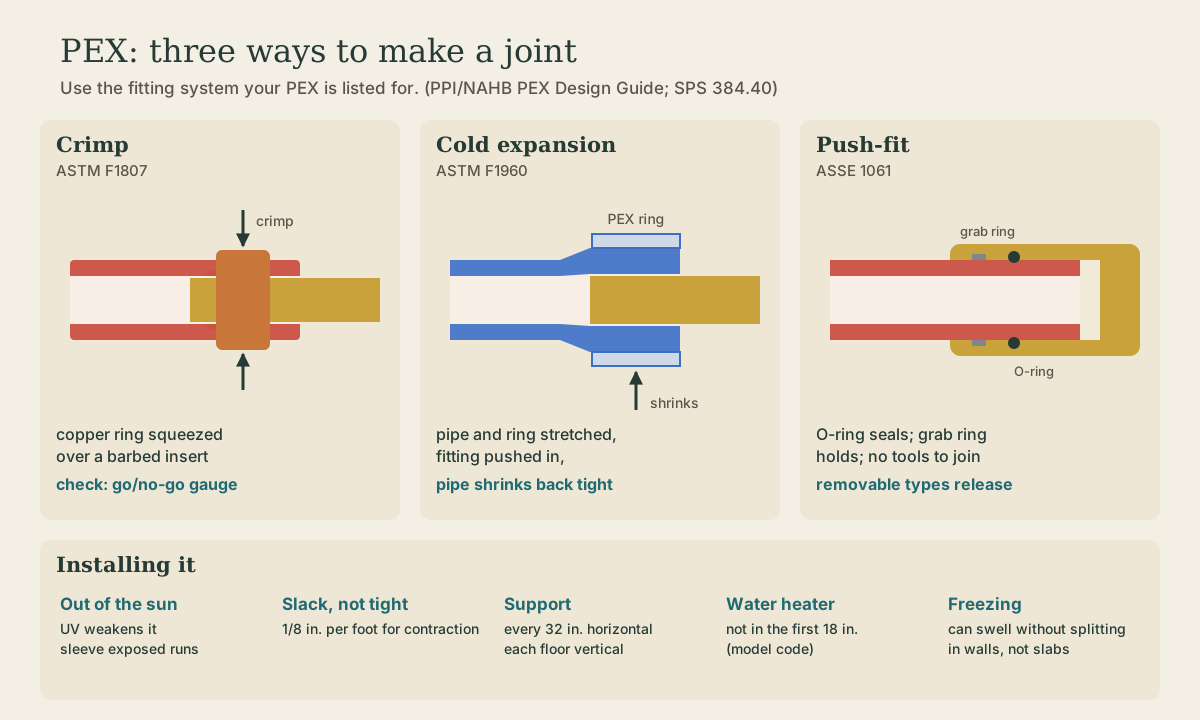
PEX is crosslinked polyethylene tubing that bends around corners, resists freeze splitting, and barely bangs. Three ways to join it: copper crimp rings over barbed inserts (ASTM F1807, checked with a go/no-go gauge), cold expansion with a PEX ring that shrinks back onto the fitting (ASTM F1960, for PEX-A), and push-fit. Wisconsin requires PEX joints per the manufacturer's instructions. Installation rules: out of sunlight, 1/8 inch slack per foot, supports every 32 inches, and not in the first 18 inches off a water heater.
- 4 min
- 4 steps
- 3 questions
- Lesson 32 of 111
In this lesson
- What PEX is good at
- Three ways to join it
- Installing it
- What to take from this
Picking up where you left off.
What PEX is good at
PEX is crosslinked polyethylene: polyethylene whose molecules are chemically linked into a network, which makes it tough and heat-resistant enough for hot water. The three ways of crosslinking give PEX-A (peroxide), PEX-B (silane), and PEX-C (radiation) 1.
What it does better than copper 1:
- Bends around obstructions, so long runs have few fittings and fewer places to leak.
- Quiet. Copper is about 180 times stiffer than PEX; the flexible tube absorbs the pressure surge when a valve slams shut, so water hammer is rare.
- Freeze tolerance. Water-filled PEX can freeze and swell without splitting when it can expand along its length, as in walls and ceilings; in a slab it may not. That’s tolerance, not permission.
- No flame, no solvent. Joints are mechanical.
Its weaknesses: sunlight degrades it, and it can’t be used right at a water heater’s connections under the model code the guide cites 1.
Three ways to join it
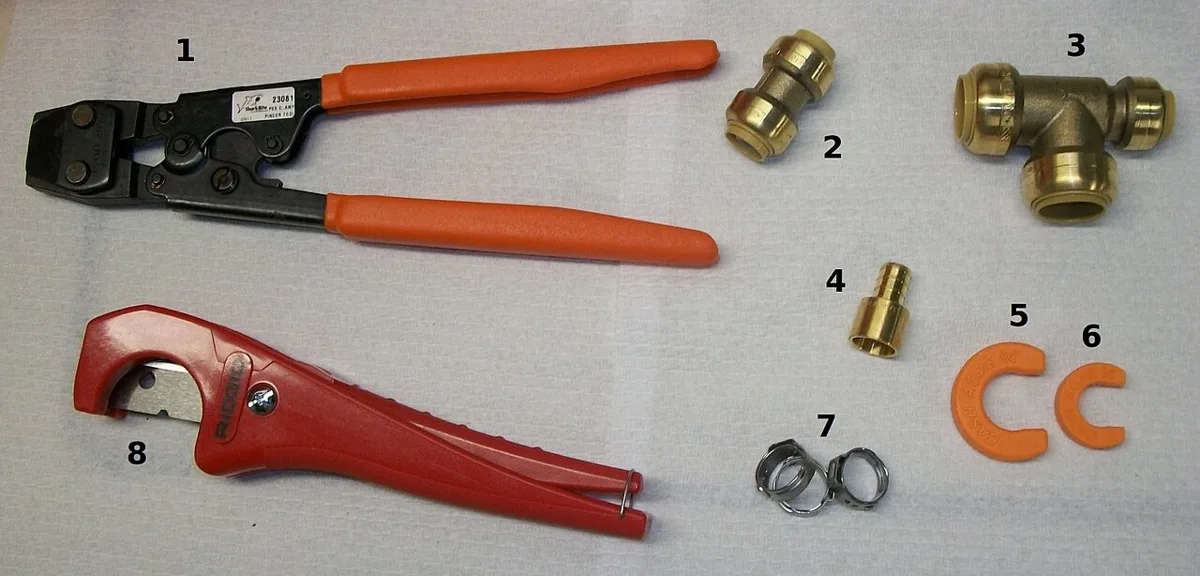
Crimp (ASTM F1807). Slide a copper crimp ring onto the pipe, push the pipe over a barbed brass or plastic insert fitting, center the ring over the barbs, and squeeze it with a crimp tool. Check every crimp with a go/no-go gauge 1. A variant uses a stainless clamp (cinch) ring and a ratcheting tool that only releases once the clamp is complete.
Cold expansion (ASTM F1960). Put a PEX reinforcing ring on the pipe end, stretch pipe and ring together with an expander tool, and push in the fitting. The pipe’s “memory” shrinks it back down onto the fitting 1. Expansion fittings are mostly used with PEX-A; check what your tubing is listed for.
Push-fit fittings seal with an O-ring and hold with a stainless grab ring, the same design used for copper: cut square, deburr, and push the tube in to its full insertion depth. Removable types release with a clip 2. They’re the go-to for a quick repair.
Not every fitting system is approved with every PEX pipe, so use the one your tubing is listed for. Wisconsin’s rule is short: PEX joints must be made per the manufacturer’s instructions 3.
Quick check
That’s ASTM F1960; crimp rings over barbed inserts are ASTM F1807.
Quick check
An under- or over-crimped ring can leak; the gauge confirms it.
Installing it
From the design guide 1:
- Sunlight. Don’t store PEX outdoors; keep it in its packaging until use. Where it stays exposed to sunlight after installation, even indirect light in an unfinished basement, cover it with a UV-blocking sleeve or insulation.
- Slack. Don’t pull runs tight. Leave 1/8 inch of slack per foot so the tube doesn’t stress fittings when it cools and contracts.
- Support. Strap horizontal runs every 32 inches (3/8 to 1 inch sizes) and vertical runs at every floor with a mid-floor guide. Strap at changes of direction so the bend doesn’t pull on a fitting. Sleeve holes through metal studs.
- Water heaters. The model code quoted in the guide keeps PEX out of the first 18 inches of piping connected to a water heater; run copper or a listed connector there.
- Layouts. A home-run system runs a separate line from a central manifold to each fixture; a remote manifold system feeds small manifolds near fixture groups. Both cut fittings and let each line be shut off at the manifold.

Playback is optional. If the player is unavailable, open the video at its source.
Quick check
Even indirect sunlight degrades PEX over time.
What to take from this
PEX bends, stays quiet, and tolerates freezing better than copper, but hates sunlight. Join it by copper crimp ring checked with a go/no-go gauge (F1807), cold expansion with a PEX ring for PEX-A (F1960), or push-fit, using the system your tubing is listed for, as Wisconsin requires. Sleeve exposed runs, leave 1/8 inch slack per foot, strap every 32 inches, and keep it out of the first 18 inches off a water heater.
Lesson complete
Nice work.
Sources for this lesson
- 1Design Guide: Residential PEX Water Supply Plumbing Systems. Plastics Pipe Institute, Plastic Pipe and Fittings Association, and PATH (prepared by NAHB Research Center). 2006. verifiedPEX is crosslinked polyethylene made by peroxide (PEX-A), silane (PEX-B), or radiation (PEX-C) methods; joining by cold expansion fittings with PEX reinforcing rings (ASTM F1960), metal insert fittings with copper crimp rings checked by go/no-go gauge (ASTM F1807), or stainless steel clamp rings; PEX is about 180 times less rigid than copper, which reduces water hammer; water-filled PEX can freeze and expand without splitting where it can expand evenly (walls, ceilings), not necessarily in slabs; keep PEX out of sunlight, sleeve exposed runs; the guide cites the model code ban on PEX within the first 18 inches of a water heater; leave 1/8 inch of slack per foot; support horizontal runs every 32 inches and vertical runs at each floor; home-run and remote manifold layouts.
- 2Copper Tube Handbook (CDA Publication A4015-14/19). Copper Development Association. 2019. verifiedCopper water tube is at least 99.9 percent copper; Types K, L, and M (ASTM B88) differ in wall thickness, K thickest, and hard tube is printed green, blue, or red; DWV tube (ASTM B306) is yellow; soldered joint sequence after ASTM B828: measure and cut square, ream, clean, flux, assemble and support, heat, apply solder, cool and clean, test; capillary gap 0.004-0.006 inch; flux thinly and not with fingers, since excess flux residue can corrode through tube; heat the tube first, then the cup, and touch solder opposite the flame; let joints cool naturally; most soldering is done at about 350-600 °F; solders with more than 0.2 percent lead are banned for potable water by the 1986 SDWA amendment; wet lines are hard to solder, so press- or push-connect joints are preferred; press-connect and push-connect fittings use EPDM seals and need no flame.
- 3Wis. Admin. Code ch. SPS 384, Plumbing Products. Wisconsin Department of Safety and Professional Services. verifiedSPS 384.40 joints: copper soldered joints per ASTM B828 with NSF-approved flux and ASTM B32 solder, lead-free for water supply (solders and fluxes over 0.2 percent lead not allowed for brass); flared joints only on annealed tube with a flaring tool; PEX joints per the manufacturer's instructions; PVC solvent joints per ASTM D2855 with F656 primer and D2564 cement; ABS solvent joints with D2235 cement; ABS-to-PVC solvent joints only in non-pressurized systems, with F656 primer on the PVC and D3138 transition cement; threaded joints get compound or tape on male threads only, and plastic may be threaded only at schedule 80 or heavier; cast iron by caulked (oakum and poured lead) or mechanical sleeve joints with C564 rubber and CISPI 310 bands; different materials joined by mechanical compression joints, with dielectric fittings to prevent galvanic corrosion.