PVC and ABS Drain Pipe
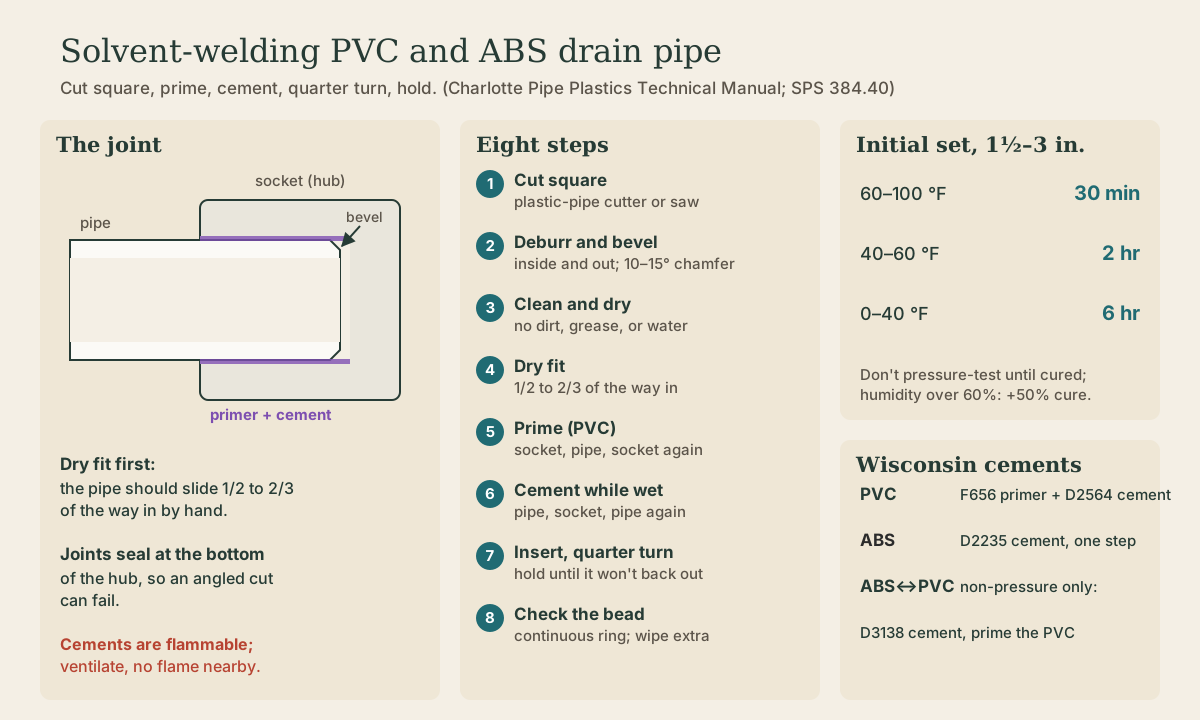
Plastic drain pipe is joined by solvent welding: the cement softens both surfaces and they fuse. PVC (white) takes purple-type primer to ASTM F656 and D2564 cement; ABS (black) takes one-step D2235 cement. The steps: cut square, deburr and bevel, dry fit, prime, cement while the primer is wet, insert with a quarter turn and hold, and check the bead. Set times by temperature, Wisconsin's rule for joining ABS to PVC, and safety with flammable cements.
- 4 min
- 6 steps
- 3 questions
- Lesson 33 of 111
In this lesson
- Welding, not gluing
- The steps
- Set and cure
- Joining ABS to PVC
- Safety
- What to take from this
Picking up where you left off.
Welding, not gluing
PVC and ABS cement isn’t glue. It’s a solvent that softens the surface of the pipe and the inside of the fitting; pushed together while soft, they fuse into one piece as the solvent evaporates. That’s why primer, fresh cement, and speed matter 1.
- PVC (usually white) is primed with a primer to ASTM F656 and joined with PVC cement to ASTM D2564; Wisconsin requires both on every PVC solvent joint 2.
- ABS (black) uses one-step ABS cement to ASTM D2235; primer is not recommended for ABS 1 2.
- CPVC water pipe has its own cement (ASTM F493) 2.
Use the cement made for the pipe; Charlotte Pipe recommends against all-purpose cement 1.
The steps
Charlotte Pipe’s procedure for 1/2 to 4 inch pipe 1:
- Cut square with a plastic-pipe cutter, miter saw, or fine saw. Every joint seals at the base of the fitting hub, so an angled cut can fail. Cut 2 inches past any visible crack.
- Deburr and bevel. Remove burrs inside and out and chamfer the outside edge 10 to 15 degrees.
- Clean and dry off dirt, grease, and moisture.
- Dry fit. With light pressure the pipe should go one-half to two-thirds of the way into the socket. Too tight or too loose, don’t use it.
- Prime (PVC): with an applicator about half the pipe’s diameter, scrub primer into the socket, then the pipe to 1/2 inch past the socket depth, then the socket again. Don’t leave puddles.
- Cement while the primer is wet: a full even coat on the pipe, a medium coat in the socket, and a second coat on the pipe, worked in.
- Join right away. Push the pipe in with a quarter turn as it goes, not after it bottoms out, then hold it until it won’t push back out.
- Check the bead. A good joint shows a continuous ring of cement around the hub; wipe off the excess. Gaps in the bead mean too little cement.
If the cement has hardened before you assemble, cut off the end and start over with a new fitting 1.
Quick check
An angled cut can make the joint fail.
Quick check
Then push the pipe in with a quarter turn and hold it until it won’t back out.
Set and cure
A joint needs time to set before it’s handled and longer to cure before it’s pressure-tested. Charlotte Pipe’s initial set times 1:
| Temperature | 1/2–1-1/4 in. | 1-1/2–3 in. | 4–8 in. |
|---|---|---|---|
| 60–100 °F | 15 min | 30 min | 1 hr |
| 40–60 °F | 1 hr | 2 hr | 4 hr |
| 0–40 °F | 3 hr | 6 hr | 12 hr |
Humidity over 60 percent adds half again to cure times, and cold weather may call for extra primer 1. Don’t bend or pull a fresh joint into line.
Quick check
Charlotte Pipe’s table: 1-1/2 to 3 inch pipe takes 30 minutes above 60 °F, 2 hours at 40 to 60 °F, and 6 hours below 40 °F.
Joining ABS to PVC
Old Wisconsin houses often have black ABS drains meeting newer white PVC. Wisconsin allows a solvent joint between them only in non-pressurized systems, with F656 primer on the PVC surfaces and a special transition cement to ASTM D3138 on both 2. Otherwise, different pipe materials are joined with mechanical compression couplings 2.
Safety
Primers and cements are extremely flammable, and their fumes are heavier than air and can collect in new piping. Keep flames and sparks away, ventilate, and read the can 1. And never use PVC, ABS, or CPVC for compressed air or gas: the manual warns of explosion and flying-fragment hazards 1.
Playback is optional. If the player is unavailable, open the video at its source.
What to take from this
Solvent cement fuses plastic pipe into one piece. PVC gets F656 primer and D2564 cement; ABS gets D2235 cement without primer. Cut square, deburr and bevel, dry fit halfway to two-thirds in, prime, cement while wet, push in with a quarter turn, hold, and look for a full bead. Give it the set time the temperature calls for, join ABS to PVC only in drains with D3138 transition cement, and keep flames away from the cans.
Lesson complete
Nice work.
Sources for this lesson
- 1Plastics Technical Manual: Installation Procedures for ABS, CPVC, and PVC Piping Systems. Charlotte Pipe and Foundry. verifiedSolvent welding steps: cut square (joints seal at the base of the hub), remove burrs and bevel 10-15 degrees, clean and dry, dry fit (pipe should go 1/2 to 2/3 of the way in), use an applicator half the pipe diameter, prime the socket, pipe, and socket again (PVC primer to ASTM F656; primer not recommended for ABS), apply cement while primer is wet, insert with a quarter turn and hold until the pipe won't back out, look for a continuous bead; all-purpose cement not recommended; initial set for 1-1/2 to 3 inch pipe: 30 min at 60-100 °F, 2 hr at 40-60 °F, 6 hr at 0-40 °F; don't pressure-test before cure; cements are flammable and fumes are heavier than air; never use these pipes for compressed air or gas.
- 2Wis. Admin. Code ch. SPS 384, Plumbing Products. Wisconsin Department of Safety and Professional Services. verifiedSPS 384.40 joints: copper soldered joints per ASTM B828 with NSF-approved flux and ASTM B32 solder, lead-free for water supply (solders and fluxes over 0.2 percent lead not allowed for brass); flared joints only on annealed tube with a flaring tool; PEX joints per the manufacturer's instructions; PVC solvent joints per ASTM D2855 with F656 primer and D2564 cement; ABS solvent joints with D2235 cement; ABS-to-PVC solvent joints only in non-pressurized systems, with F656 primer on the PVC and D3138 transition cement; threaded joints get compound or tape on male threads only, and plastic may be threaded only at schedule 80 or heavier; cast iron by caulked (oakum and poured lead) or mechanical sleeve joints with C564 rubber and CISPI 310 bands; different materials joined by mechanical compression joints, with dielectric fittings to prevent galvanic corrosion.