Water Testing and Treatment
A private well's water quality is the owner's job. The Wisconsin DNR's schedule: bacteria and nitrate every year (and bacteria whenever taste, color, or smell changes; nitrate before pregnancy or an infant), arsenic every five years (yearly in Outagamie, Winnebago, and Brown counties). The standards (no bacteria, 10 mg/L nitrate, 10 µg/L arsenic), what each contaminant does, how to take a sample, and what to do about a bad result.
- 4 min
- 6 steps
- 3 questions
- Lesson 42 of 111
In this lesson
- Nobody else is testing it
- What to test and when
- What each contaminant means
- Taking a sample
- When a test comes back bad
- What to take from this
Picking up where you left off.
Nobody else is testing it
City water is tested constantly by the utility. A private well is tested when its owner tests it. The water can look, smell, and taste fine and still carry bacteria or nitrate.
What to test and when
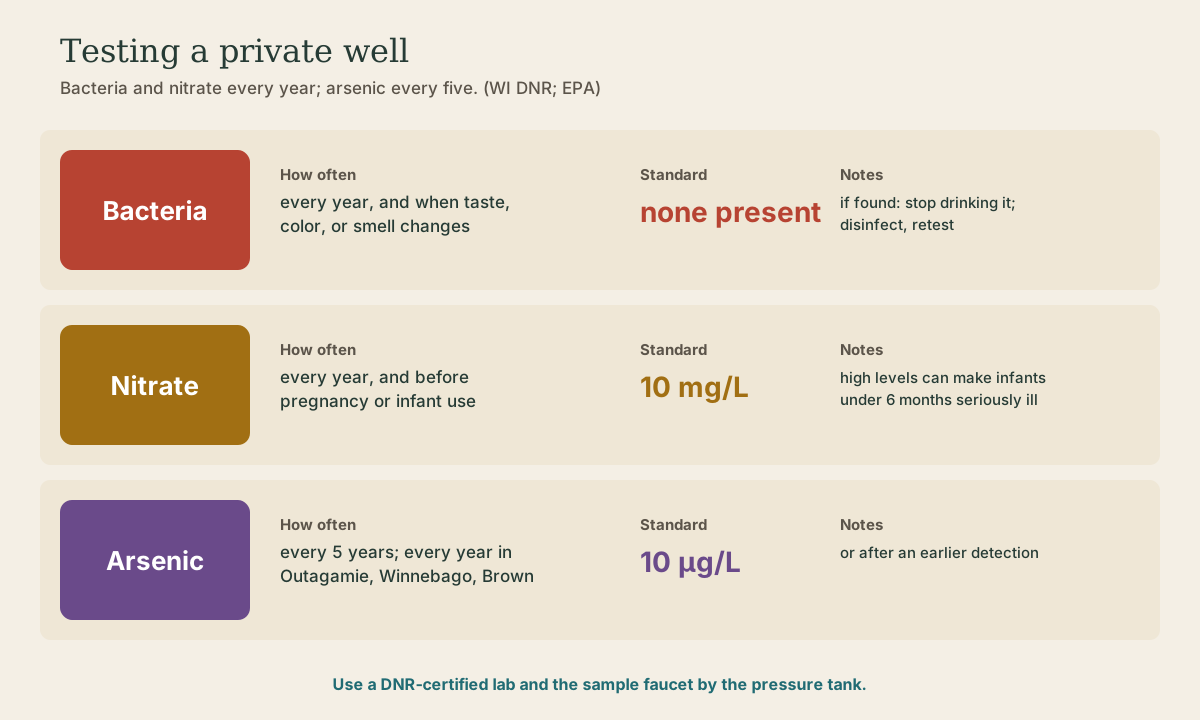
The Wisconsin DNR’s recommendations 1:
| Test | How often | Standard |
|---|---|---|
| Bacteria (coliform) | every year, and whenever taste, color, or smell changes | none present |
| Nitrate | every year, and before the water is used by someone who is or may become pregnant | 10 mg/L |
| Arsenic | every five years; every year in Outagamie, Winnebago, and Brown counties or after a previous detection | 10 µg/L |
Use a DNR-certified laboratory; most sell or supply sample kits 1. Test a new well, after any repair that opens the well, and after flooding.
Quick check
Bacteria can’t be seen, smelled, or tasted reliably.
What each contaminant means
- Bacteria and other microorganisms come from sewage and animal waste and cause gastrointestinal illness 2. Coliform bacteria are the indicator: their presence means a path exists for contamination, through a bad cap, a cracked casing, surface water, or a nearby septic system or barnyard.
- Nitrate comes from fertilizer, manure, and septic effluent soaking into groundwater 2. In Wisconsin’s farm country it’s the most common problem. Infants under six months who drink high-nitrate water can become seriously ill, a condition called blue baby syndrome 2. Never boil high-nitrate water: boiling concentrates it.
- Arsenic occurs naturally in some bedrock, notably in parts of northeastern Wisconsin, and long-term exposure raises cancer and other risks 2 1.
Quick check
The standard is 10 mg/L; test before using well water for formula.
Taking a sample
Follow the lab’s instructions exactly:
- Use the sample faucet near the pressure tank, before any softener or filter, so you’re testing the well.
- Remove any aerator, run the water several minutes, don’t touch the inside of the bottle or cap, and fill to the line.
- Keep the sample cold and get it to the lab within the holding time, usually a day for bacteria.
When a test comes back bad
- Bacteria present: stop drinking the water; use bottled water 1. Inspect the cap and casing, look for nearby sources, then disinfect the well (shock chlorination) and retest. Repeated positives mean a construction problem; a new well that tests positive must be corrected by its driller 3.
- High nitrate: use another water source for infants and pregnancy; consider treatment such as reverse osmosis at the kitchen tap, a deeper or better-sited well, and reducing sources nearby.
- Arsenic: point-of-use reverse osmosis or adsorption filters; test the treated water to confirm it works.
Treatment devices are part of the plumbing. Wisconsin’s code requires sampling valves around devices that treat regulated contaminants so their performance can be checked 4.
Playback is optional. If the player is unavailable, open the video at its source.
Quick check
A positive result often points to a cracked cap, damaged casing, or a nearby source.
What to take from this
Test a private well for bacteria and nitrate every year, bacteria again whenever the water changes, nitrate before pregnancy or infant use, and arsenic every five years (yearly in Outagamie, Winnebago, and Brown counties), using a DNR-certified lab and the sample faucet before treatment. The standards are no bacteria, 10 mg/L nitrate, and 10 µg/L arsenic. If bacteria show up, stop drinking it, find the cause, disinfect, and retest; treat nitrate and arsenic at the tap and verify.
Lesson complete
Nice work.
Sources for this lesson
- 1Test your private well water annually. Wisconsin Department of Natural Resources. verifiedTest for bacteria once a year and when taste, color, or smell changes; nitrate once a year and before use by someone who is or may become pregnant; arsenic every five years for most, yearly in Outagamie, Winnebago, and Brown counties or after a prior detection; standards: bacteria absent, nitrate 10 mg/L, arsenic 10 micrograms per liter; stop drinking the water if bacteria are present; use a DNR-certified lab.
- 2Potential Well Water Contaminants and Their Impacts. U.S. Environmental Protection Agency. verifiedMicroorganisms from sewage and animal waste cause gastrointestinal illness; nitrate from fertilizer, sewage, and animal waste can make infants under six months seriously ill (blue baby syndrome); arsenic poses acute, chronic, and cancer risks; septic effluent and leaking tanks can reach wells.
- 3Wis. Admin. Code ch. NR 812, Well Construction and Pump Installation. Wisconsin Legislature. 2026. verifiedRegister February 2026. Table A minimum separation distances from new wells (not waivable at property lines): LP tank serving a house 8 ft, sanitary building sewer 8 ft, cistern 8 ft, septic tank or other POWTS treatment component 25 ft, holding tank 25 ft, vault privy 25 ft, residential fuel oil tank under 1,500 gal 25 ft, lake or stream shore 25 ft, POWTS dispersal component (drainfield or mound) 50 ft, pit privy 50 ft, animal barn, shelter, or yard 50 ft, fabricated manure storage 100 ft, earthen manure storage 250 ft, landfill 1,200 ft; well casing must terminate at least 12 inches above grade or floor; wells may not terminate in basements or crawl spaces; vermin-proof caps; pitless adapters below frost; drillers must return and correct a new well that tests positive for coliform bacteria; 'filling and sealing' unused wells.
- 4Wis. Admin. Code ch. SPS 382, Design, Construction, Installation, Supervision, Maintenance and Inspection of Plumbing. Wisconsin Legislature. 2026. verifiedRegister August 2026. SPS 382.10: plumbing protects health and the waters of the state; fixtures need adequate water volume and pressure; drains must carry waste efficiently with cleanouts and enough air circulation that trap seals are never siphoned, aspirated, or forced; every dwelling on a sewer or POWTS needs at least one water closet, wash basin, kitchen sink, and tub or shower. SPS 382.30: horizontal branch drains 2 inches or less slope at least 1/4 inch per foot, larger ones 1/8 inch per foot; drainage fixture units, e.g. residential water closet 4, bathroom group 6, residential kitchen sink 2, lavatory 1, residential shower 2, residential clothes washer 4. SPS 382.31: each gravity building sewer served by at least one 3-inch stack to a vent terminal; vent terminals at least 2 inches for frost; trap-to-vent maximum developed lengths (1/4 inch per foot, sanitary tee: 1-1/4 in. 5 ft, 1-1/2 in. 6 ft, 2 in. 8 ft, 3 in. 12 ft, 4 in. 16 ft); vents not within two diameters of the weir; air admittance valves allowed with limits. SPS 382.32: trap seals 2 to 4 inches; trap primers for evaporation; prohibited traps include bell, drum, non-integral S-traps, partition, and moving-part traps. SPS 382.40: minimum flow pressure 8 psig at fixtures, 15 for washdown and siphonic water closets, 20 for one-piece tank toilets and pressure-balance or thermostatic mixing valves, 25 for blowout fixtures; over 80 psig requires a pressure reducing valve and strainer downstream of the meter and upstream of fixtures; sizing accounts for fixture load, minimum supply pressure, elevation, device losses, minimum fixture pressure, and friction.