Braces and Knee Braces
Short diagonal braces turn each post-and-beam rectangle into rigid triangles; lay them out from the framing square, cut their angled tenons, and seat them so they work in compression.
- 4 min
- 7 steps
- 3 questions
- Lesson 105 of 111
In this lesson
- Why braces
- Compression, in pairs
- Laying out a brace
- The brace joint
- Curved and lapped braces
- Assembly
- What to take from this
Picking up where you left off.
Why braces
Mortise-and-tenon joints between posts and beams act like hinges under sideways load: a rectangle of posts and beams will lean over, or rack, under wind. A short diagonal brace from post to beam turns the rectangle’s corner into a triangle, and triangles don’t change shape 1.
Braces go wherever the frame needs lateral stiffness: in bents (post to tie beam), in walls (post to plate or girt), and sometimes in the roof.
Compression, in pairs
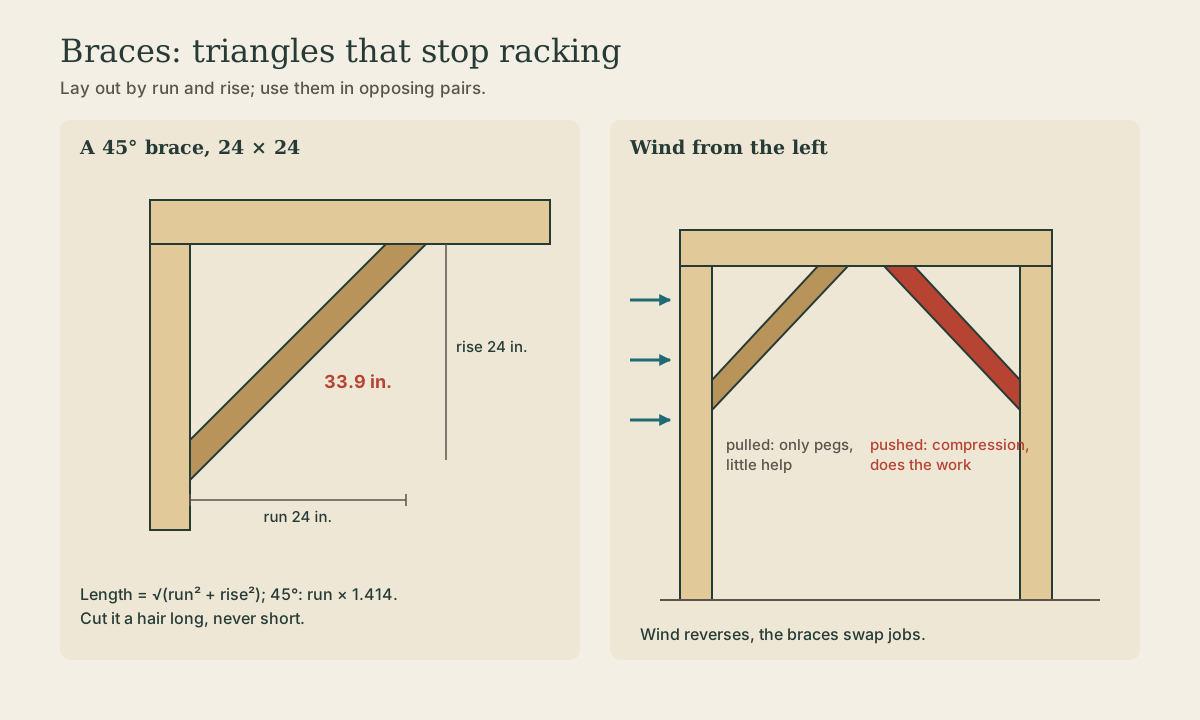
Braces are best at pushing. A brace pushed into its seats bears on solid end grain and shoulders; a brace being pulled relies on its pegs, which resist withdrawal much less. So frames use braces in opposing pairs: wind from the west pushes the east-leaning braces into compression, wind from the east pushes the others. Each brace only has to carry load one way.
Laying out a brace
Brace geometry is set by its run (along the beam) and rise (down the post), measured from the inside corner where post and beam meet 2:
- Equal run and rise give a 45-degree brace, the most common. A 24 × 24 brace is typical in small frames; 36 × 36 in larger ones.
- The brace’s length along its centerline, between the post face and beam face, is run × √2 for a 45-degree brace: 24 × 1.414 ≈ 33.9 inches. For unequal runs, use the Pythagorean theorem: √(run² + rise²).
- Use the framing square to lay out the angled shoulders: set the square’s two arms to the run and rise (for example 12 and 12) on the brace stock and scribe along it.
Longer braces are stiffer at the corner but get in the way of headroom, windows, and doors; designers balance them.
Quick check
Equal run and rise make a 45-degree brace. Its length between the post and beam faces is about 24 × 1.414 ≈ 33.9 inches.
The brace joint
Braces usually join with angled, shouldered tenons into shallow mortises in the post and beam, pegged:
- The brace mortises are cut at an angle at one end, so the brace’s end seats into them, and are shallower than main mortises, perhaps 3 inches deep.
- The tenon is cut with an angled shoulder that bears fully on the post or beam face.
- A single peg in each end holds the brace in place; the shoulders carry the load.
- Brace tenons are usually not drawbored hard; the brace must not push the post and beam apart.
Cut braces a hair long rather than short: a brace that’s too short does nothing until the frame racks enough to close the gap.
Playback is optional. If the player is unavailable, open the video at its source.
Quick check
The shoulders carry the load, so they must bear from the start.
Curved and lapped braces
Not every brace is straight or tenoned. In Norwegian grindbygg, braces are lapped into the sides of the post and beam and pegged, and they’re often made from naturally curved birch or root knees, whose grain follows the curve and makes them very strong 3. Curved braces also turn up in English and Japanese frames, where they’re as much an aesthetic choice as a structural one.
Assembly
Brace joints are assembled at the same time as the post and beam they connect, usually with the bent lying flat: tenons into post mortise and beam mortise, then the post-beam joint closed up with clamps or a come-along, then pegs driven. Brace length and angle also square the bent: if all braces are cut accurately, the bent comes together square.
What to take from this
Braces turn post-and-beam rectangles into triangles to stop racking, and they work best in compression, so they’re used in opposing pairs. A 45-degree brace has equal run and rise, for example 24 × 24 inches, about 33.9 inches long between faces. Cut angled, shouldered tenons into shallow mortises, peg each end, cut braces slightly long rather than short, and remember grindbygg’s lapped, curved alternative.
Practice
Pegs are relatively weak in withdrawal. Frames are braced so that, whichever way the wind pushes, some braces are pushed into their seats.
Lesson complete
Nice work.
Sources for this lesson
- 1Jack A. Sobon, Roger Schroeder. Timber Frame Construction: All About Post-and-Beam Building. Storey Publishing. 2012. verifiedClassic reference (first published 1984) on timber selection, tools, joinery, frame types, assembly, and raising. Cited at: Bracing.
- 2Will Beemer. Learn to Timber Frame: Craftsmanship, Simplicity, Timeless Beauty. Storey Publishing. 2016. verifiedHeartwood School's step-by-step guide from timber sourcing to a finished 12×16 frame, including layout, joinery, and raising. Cited at: Braces.
- 3Timber Frame: Build Your Own, Grindbygg-Style. North House Folk School. verifiedGrindbygg posts, tie beams, and plates; the tie beam sits in a bridle slot in the post top; braces let into the sides and pegged, often from curved birch or root knees.