Scarf Joints
Scarf joints splice timbers end to end when you can't get one long enough; the bladed and stop-splayed scarfs, where to put them, and how they're keyed and pegged.
- 4 min
- 5 steps
- 3 questions
- Lesson 107 of 111
In this lesson
- When one timber isn’t long enough
- Common scarfs
- Where to put them
- Cutting a keyed scarf
- What to take from this
Picking up where you left off.
When one timber isn’t long enough
A scarf joint splices two timbers end to end so they act as one. Builders scarf sills, plates, and long beams when the length they need exceeds what the forest, the mill, or the trailer can supply. North House, for example, notes that its 24×28 frame’s longest timbers are 24 feet but it can redesign the frame so all timbers are 16 feet or less for easier transport 1. Scarfs make that possible.
A scarf is never quite as strong as an uncut timber, so its design and placement matter.
Common scarfs
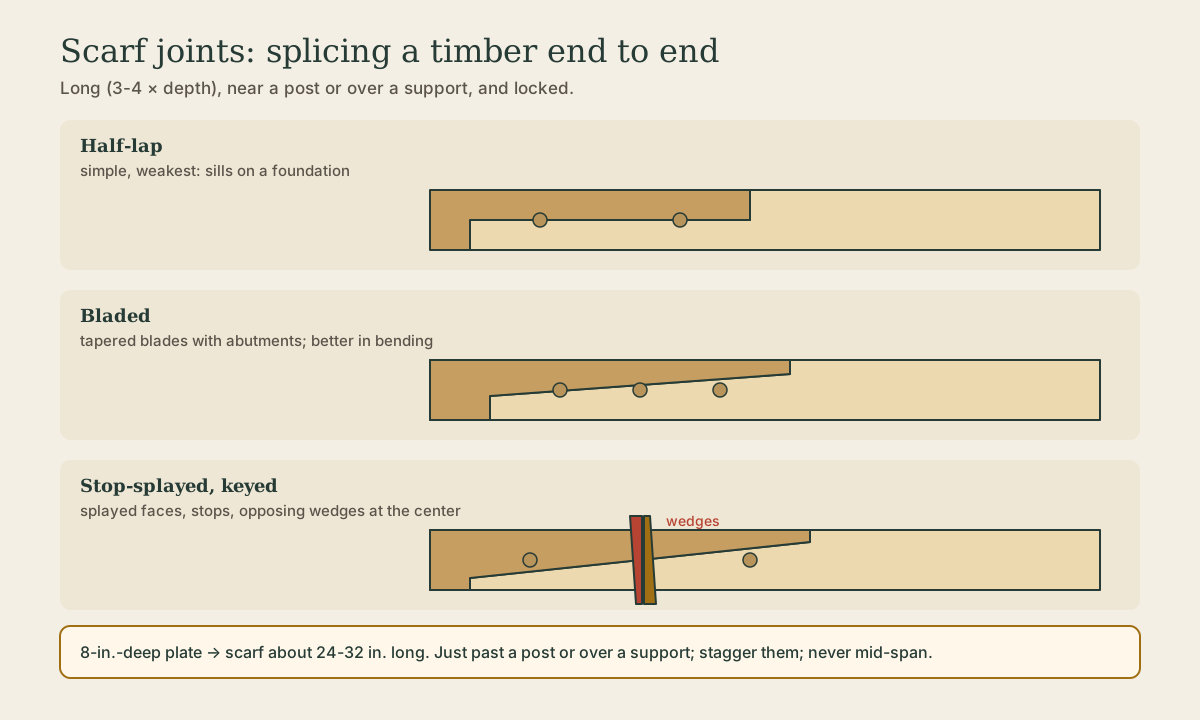
- Half-lap scarf: each timber cut to half thickness over a lap length, overlapped and pegged. Simple, but weakest; best where loads are low, like sills on a continuous foundation.
- Bladed scarf: long tapering “blades” overlap with abutments at the ends, pegged through; resists bending and tension better.
- Stop-splayed scarf with key (sometimes called a stop-splayed and tabled scarf): the two halves have long splayed (sloping) faces with “stops” at each end, and a pair of opposing wedges or a key driven through the middle locks them together and draws the halves tight. Common in historic plates and a classic test of a framer’s skill.
- Through-splayed and tabled variations appear in European framing and in Sobon’s catalog of traditional joints 2.
Scarfs are typically long: a common rule of thumb is a scarf length of roughly three to four times the timber’s depth, so an 8-inch-deep plate gets a scarf about 24 to 32 inches long.
Quick check
Place it just past a post, not mid-span.
Where to put them
- Near a post, just past it, rather than in the middle of a span. Bending stress in a beam is highest mid-span and lowest near supports.
- Over a support for sills: on a foundation or pier.
- Stagger scarfs so they don’t fall at the same bay on both walls.
- Orient the scarf so the loads it carries press the halves together rather than prying them apart; follow the frame designer’s detail.
Playback is optional. If the player is unavailable, open the video at its source.
Quick check
Bending stress peaks mid-span. Placing the scarf just beyond a post keeps it where loads are low and the post supports it.
Cutting a keyed scarf
- Lay out both halves together from a common reference face so their mating surfaces match.
- Saw and pare the splayed faces flat; check with a straightedge across both halves.
- Cut the abutments and the key mortise through both halves at the center.
- Fit the halves dry, then drive opposing wedges (two tapered keys driven from opposite sides) into the key slot. The wedges pull the halves along each other and tighten the joint.
- Peg through the scarf faces.
What to take from this
Scarf joints splice timbers end to end when long timbers aren’t available or transportable. Half-lap scarfs are simple but weak; bladed and keyed stop-splayed scarfs resist bending and tension. Make scarfs long (roughly three to four times the timber depth), place them near posts or over supports, stagger them, and lock them with wedges, keys, and pegs.
Practice
Scarfs exist because long timbers are scarce, expensive, or hard to transport. North House notes it can redesign frames so no timber exceeds 16 feet.
Lesson complete
Nice work.
Sources for this lesson
- 1Timber Frame: Build Your Own, Larger Frames FAQ. North House Folk School. verifiedMost frames use locally milled eastern white pine, worked green because it stays fairly stable as it dries; a 24×28 frame weighs about 15,000 pounds.
- 2Jack A. Sobon, Roger Schroeder. Timber Frame Construction: All About Post-and-Beam Building. Storey Publishing. 2012. verifiedClassic reference (first published 1984) on timber selection, tools, joinery, frame types, assembly, and raising. Cited at: Scarf Joints.
Previous: Tying Joints: Posts, Tie Beams, Plates, and Rafters