Raising Day: Assembly, Rigging, and Safety
How a frame goes up - bents assembled flat and lifted by crew, pike poles, gin pole, or machine, plates and rafters set, pegs driven - and the safety rules that keep everyone out from under a moving timber.
- 4 min
- 8 steps
- 3 questions
- Lesson 110 of 111
In this lesson
- The day the frame becomes a building
- Before the day
- Assembling the bents
- Lifting
- Tying it together
- Safety
- Topping out
- What to take from this
Picking up where you left off.
The day the frame becomes a building
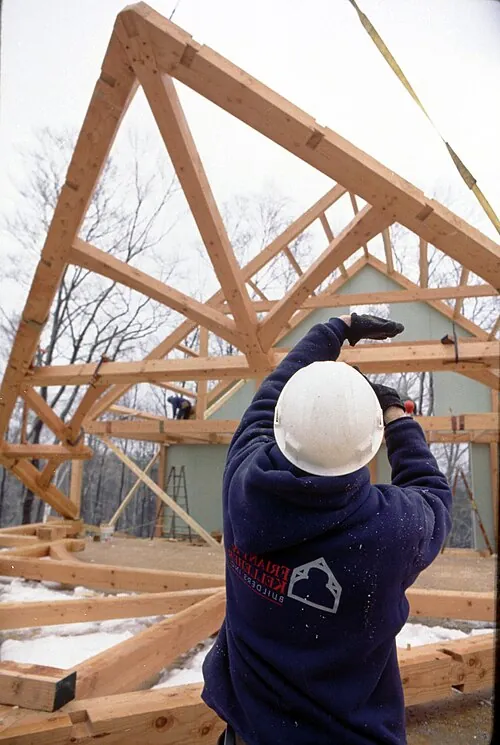
A raising is when a cut frame becomes a standing structure, often in a single day, traditionally with neighbors and food. It’s also the most dangerous part of timber framing, because heavy timbers move overhead. Preparation, a clear plan, and discipline make it safe and satisfying 1.

Before the day
- Foundation and sills done, square, and level, with sill joints cut and the sill pegged together.
- Every bent pre-fitted on the ground during cutting, then taken apart, with every piece marked.
- Pegs made and sorted by size, with spares.
- Temporary braces, stakes, and clamps ready.
- Tools: commanders (heavy mallets), come-alongs or ratchet straps, pike poles, ropes, ladders, a gin pole or machine if used.
- A written sequence: which bent goes up first, then which timbers in what order.
- One person in charge, and a crew briefed on their jobs.
Assembling the bents
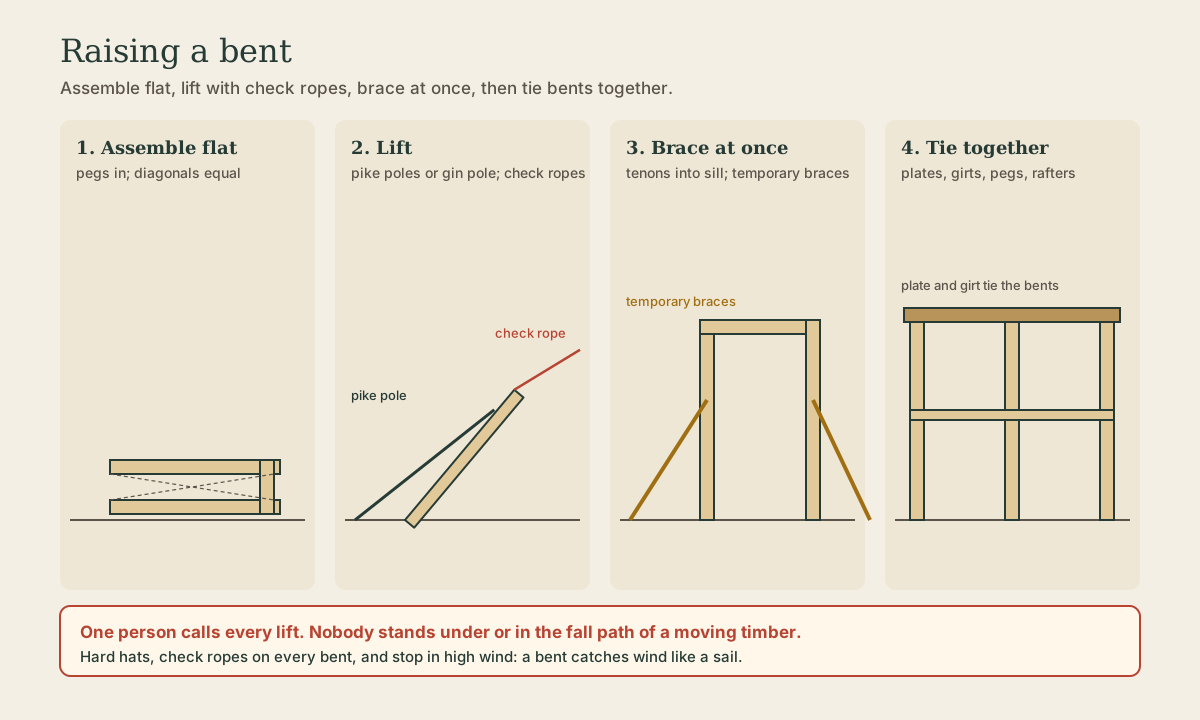
Each bent is assembled flat on the deck or on cribbing, right next to where it will stand: posts, tie beam, and braces, with tenons driven into mortises and pegs driven home. Check it for square by measuring the diagonals. The bent’s feet are positioned over or against the sill so that as it rises, the post tenons drop into the sill mortises.
Lifting
Ways to get a bent upright 2:
- By hand and pike poles. For small frames, a crew lifts the top of the bent, walks it up hand over hand, and pike poles (long poles with spikes) push it the rest of the way. Ropes held by a crew on the far side check it so it can’t fall past vertical.
- Gin pole. A tall pole, guyed in several directions, with a block and tackle or winch lifts the bent’s top. Traditional and still effective.
- Machines. A tractor with a loader, a telehandler, or a crane makes raising larger frames safer and faster, lifting with straps at the tie beam.
As the bent reaches vertical, post tenons drop into the sill mortises, and the bent is immediately braced to stakes or to the deck with temporary diagonal braces. A standing bent alone is like a tall door balanced on edge.
Quick check
A standing bent alone is like a tall door balanced on edge.
Tying it together
With two bents standing:
- Set the plates and girts between them, driving tenons into mortises. A commander or a come-along pulls joints together.
- Drive pegs in the connecting joints.
- Raise the next bent and repeat.
- Check the frame for plumb and square, adjusting with temporary braces and come-alongs before final pegging.
- Set rafters, usually in pairs, working from one end, and their collar ties.
Safety
- One person calls every lift. Everyone else listens. Agree on commands like “lift,” “hold,” and “down.”
- Nobody stands under or in the fall path of a moving timber or bent, ever.
- Check ropes on the far side of every bent being raised.
- Hard hats, gloves, and steel-toed boots.
- Ladders tied off; never work from the top of a post without fall protection.
- Don’t drive pegs from below a timber that isn’t yet secured.
- Stop work in high wind; a bent catches wind like a sail.
- Keep spectators, children, and dogs well back.
Playback is optional. If the player is unavailable, open the video at its source.
Quick check
A raising is safe when one person is in charge, everyone knows their role, and no one is ever under or in the fall path of a moving timber.
Topping out
A traditional raising ends with topping out: a small evergreen tree or bough nailed to the peak of the frame once the last rafter is set, an old Northern European custom marking a safe raising, often followed by a meal for the crew.
What to take from this
A raising goes smoothly with a finished foundation, pre-fitted bents, sorted pegs, temporary braces, a written sequence, and one person in charge. Assemble bents flat, lift them by hand and pike poles, gin pole, or machine with check ropes on the far side, brace each bent immediately, then tie bents together with plates and girts, peg, plumb, and set rafters. Never stand under a moving timber.
Practice
A standing bent alone is like a tall, narrow door. It must be braced to the ground or sills until plates and girts tie it in.
Lesson complete
Nice work.
Sources for this lesson
- 1Jack A. Sobon, Roger Schroeder. Timber Frame Construction: All About Post-and-Beam Building. Storey Publishing. 2012. verifiedClassic reference (first published 1984) on timber selection, tools, joinery, frame types, assembly, and raising. Cited at: Raising.
- 2Will Beemer. Learn to Timber Frame: Craftsmanship, Simplicity, Timeless Beauty. Storey Publishing. 2016. verifiedHeartwood School's step-by-step guide from timber sourcing to a finished 12×16 frame, including layout, joinery, and raising. Cited at: Raising.