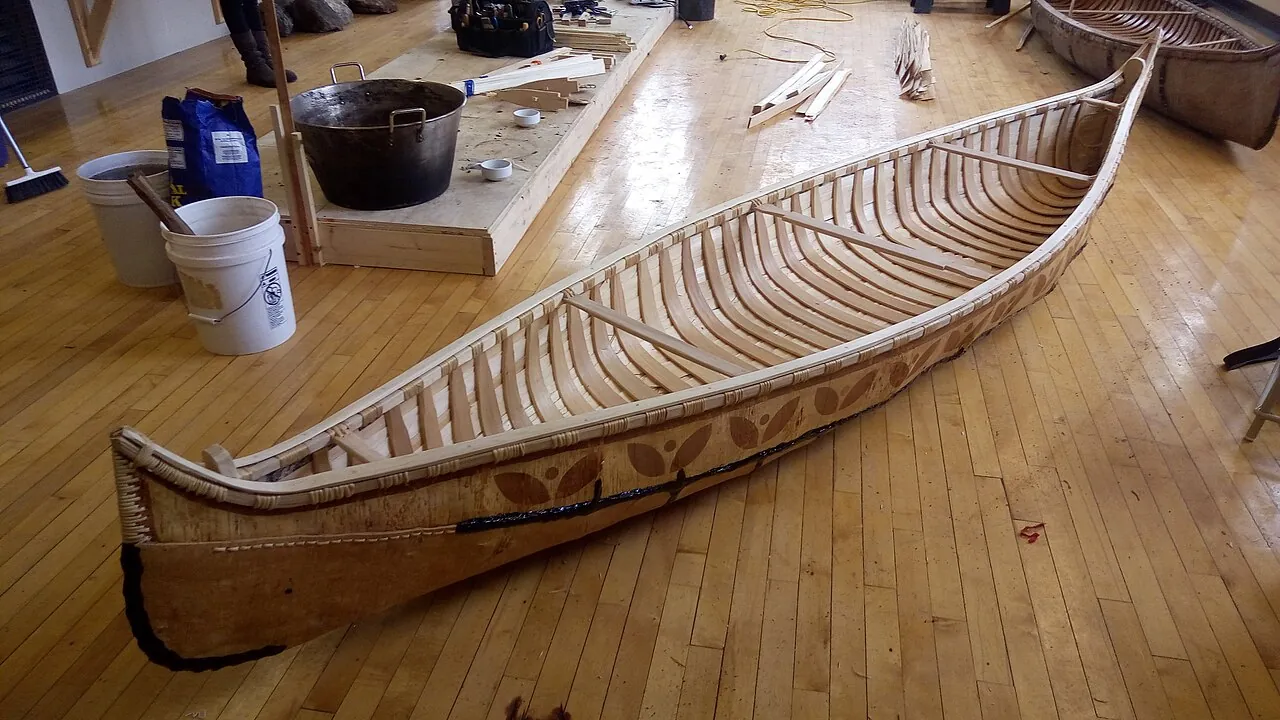
The Birchbark Canoe and Its Materials
What a bark canoe is made of and why: paper birch bark and the difference between winter and summer bark, black spruce root for sewing, northern white cedar for the frame, maple thwarts, tempered spruce gum, sizes measured in fathoms, the Ojibwe canoe forms of the Lake Superior country, and a Lac du Flambeau builder who keeps the tradition alive.
- 5 min
- 6 steps
- 3 questions
- Lesson 88 of 160
In this lesson
- Birch bark
- Root, cedar, maple, and gum
- Sizes and Ojibwe forms
- A living tradition
- Try it
- What to take from this
Picking up where you left off.
Birch bark
Bark of the paper birch, or canoe birch, was the preferred canoe material across the north. Its range runs through Wisconsin, and the country just north of Lake Superior was said to produce bark of high quality 1. Three properties made it work 1:

- It comes off in large sheets clear of serious blemishes.
- Its grain runs around the tree, not up it, so sheets can be sewn end to end to make a long canoe.
- It’s resinous: it doesn’t stretch and shrink like other barks, and it stays somewhat elastic while green or damp.
For a canoe the bark has to be more than 1/8 inch thick, tough, and from a straight trunk big enough for good-sized pieces. The thickness can’t be judged from the size of the tree 1.
Bark peels readily when the sap is flowing. Bark peeled in a winter thaw, early spring, or late fall comes away with its inner rind attached. Eastern builders called that winter bark and prized it: the rind turns orange-red, then dark brown, and could be moistened and scraped away to leave designs. Summer bark, which splits into papery layers, was a poor grade 1.
Other barks (spruce, elm, basswood, hickory, cottonwood) made temporary canoes, but they shrink and swell and can’t be sewn end to end 1.
Quick check
‘Summer bark’ that splits into papery layers was considered poor.
Root, cedar, maple, and gum
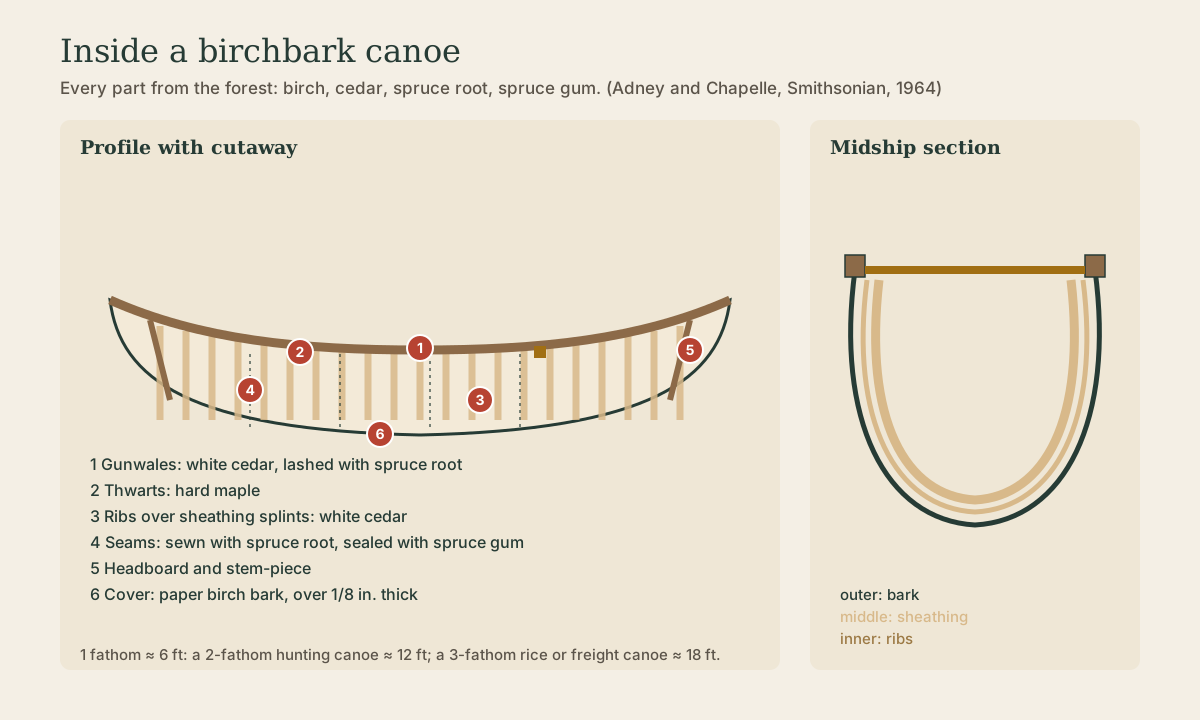
- Sewing: the root of black spruce, which grows in soft, wet ground with long roots near the surface, sometimes 20 feet long but no thicker than a pencil 1. Jack pine, tamarack, and cedar roots were substitutes. The “sewing” is really lacing, done through awl holes without a needle.
- Frame: northern white cedar, which splits cleanly when seasoned. Ribs, sheathing, gunwales, headboards, and stem-pieces were all made of it in many areas; cedar ribs are set with hot water 1. Black spruce, which splits well only green, was the alternative.
- Thwarts and paddles: hard maple, which splits easily while green 1.
- Seams: spruce gum, melted and tempered with a little animal fat and finely powdered charcoal. The test: dip a strip of bark, cool it in water, and bend it. If the gum cracks, add gum; if it’s tacky or rubs off, add more temper 1.
Wayne Valliere (Mino-Giizhig) of Lac du Flambeau, one of only a handful of Native birchbark canoe builders in the United States, harvests on the same seasonal round: bark in spring and June, cedar from the swamps in winter, spruce roots in summer, and pitch mixed with oak ash and deer tallow 2.
Quick check
Black spruce in wet ground grows roots up to 20 feet long and only pencil-thick.
Sizes and Ojibwe forms
Bark canoes were measured in fathoms, about 6 feet: a 2-fathom hunter’s canoe is about 12 feet, a 3-fathom rice-harvesting or freight canoe about 18 1.
West and northwest of Lake Superior, the most common Ojibwe model was the long-nose canoe: fairly straight sheer, slight rocker near the ends, a sheer that turns up sharply at the extremities, a round, full end profile, and well-rounded bilges 1. Eastern Ojibwe groups built an older high-ended form, and Adney documented 3-fathom rice-harvesting canoes, the kind used for ricing on northern lakes 1. All Ojibwe canoes were built with a building frame on a bed slightly higher in the middle than at the ends, with the stakes driven nearly upright 1.
Quick check
Hunting canoes ran about 2 fathoms; rice and freight canoes about 3.
A living tradition
Valliere teaches Ojibwe language and culture at the Lac du Flambeau school, has mentored more than 100 students through his program These Canoes Carry Culture, trains apprentices, and was named a National Heritage Fellow in 2020 2. The canoes, in his words, carry culture: building one passes on language, seasons, and a way of seeing the world.
Playback is optional. If the player is unavailable, open the video at its source.
Try it
Find a paper birch blown down in a storm on land where you have permission, and look closely at the bark: measure its thickness with calipers at several heights, find the horizontal lenticels, and notice where it’s thick and clean (usually between snow height and the first limbs). Then dig, gently, near a black spruce in a bog edge and see how long a root you can follow.
What to take from this
Paper birch bark, over 1/8 in. thick, makes the cover because it comes in big sheets, its grain runs around the tree so sheets can be sewn end to end, and it’s resinous. Winter bark keeps its inner rind and was prized; summer bark splits. Black spruce root sews it, white cedar frames it, maple makes thwarts, and tempered spruce gum seals the seams. Canoes were measured in fathoms; the Ojibwe long-nose canoe dominated west of Lake Superior. Wayne Valliere of Lac du Flambeau keeps building and teaching.
Lesson complete
Nice work.
Sources for this lesson
- 1Edwin Tappan Adney, Howard I. Chapelle. The Bark Canoes and Skin Boats of North America (U.S. National Museum Bulletin 230). Smithsonian Institution (Project Gutenberg edition). 1964. verifiedPaper birch bark preferred: range reaching through Wisconsin; bark over 1/8 in. thick from straight trunks; peels easily when sap flows; 'winter bark' keeps its inner rind and was prized, 'summer bark' separates into layers; grain runs around the tree so sheets can be sewn end to end; black spruce root for sewing, up to 20 ft long and pencil-thin; northern white cedar for ribs, sheathing, gunwales, headboards; hard maple for thwarts and paddles; spruce gum tempered with fat and powdered charcoal and tested on a bark strip; building bed, building frame, stakes, six stages of construction; ribs pre-bent in pairs; Ojibway long-nose canoes west of Lake Superior, 3-fathom rice-harvesting canoes, all Ojibway canoes built with a building frame.
- 2Wayne Valliere: Birchbark Canoe Builder (2020 National Heritage Fellow). National Endowment for the Arts. 2020. verifiedWayne Valliere (Mino-Giizhig), Lac du Flambeau Ojibwe, one of a handful of Native birchbark canoe builders in the U.S.; Ojibwe language and culture teacher who has mentored over 100 students through 'These Canoes Carry Culture'; harvests birchbark in spring and June, cedar from swamps in winter, spruce roots in summer, and pitch mixed with oak ash and deer tallow; artist in residence at UW-Madison.