Jointer and Planer: Flat, Square, and to Thickness
The machine version of what fore and jointer planes do: the jointer flattens one face and squares an edge, the planer makes the other face parallel. The order matters, and so do push blocks and minimum lengths.
- 5 min
- 6 steps
- 3 questions
- Lesson 34 of 160
In this lesson
- The milling sequence
- The jointer
- Jointer safety
- The planer
- Hand or machine?
- What to take from this
Picking up where you left off.
The milling sequence
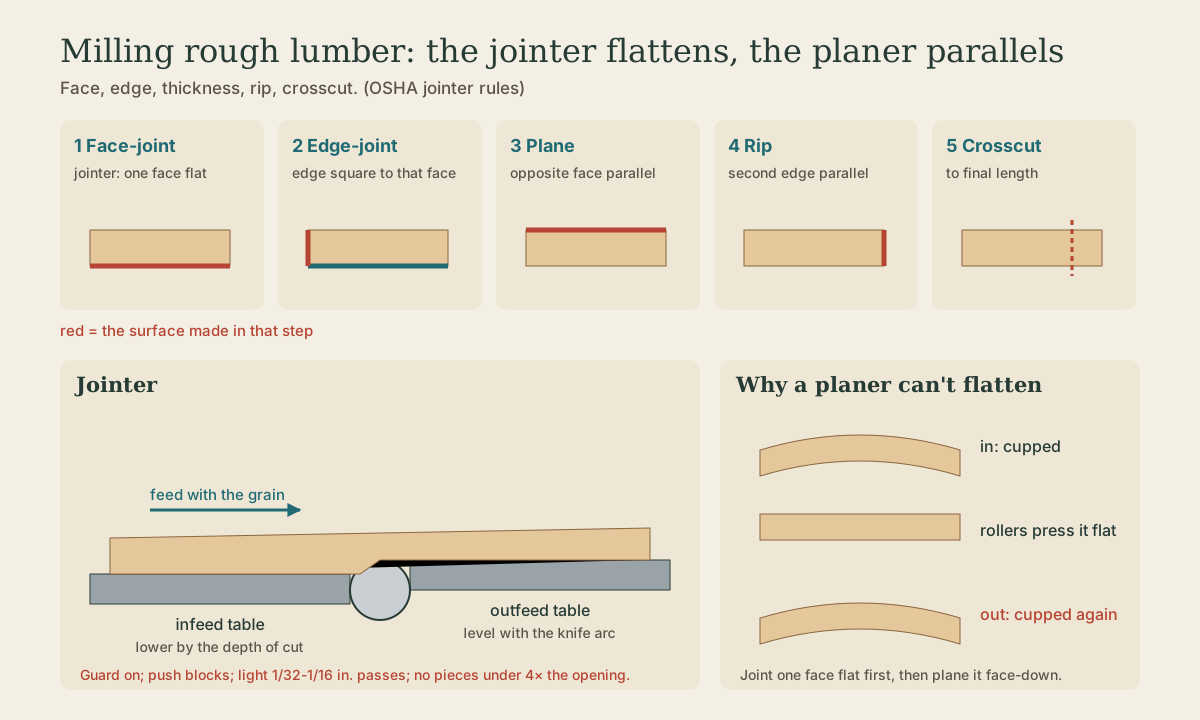
Rough lumber is cupped, bowed, twisted, and uneven. The goal is a board with two flat, parallel faces and two straight, parallel edges at right angles - the same goal as hand planing in the Hand Tools module. The order is the same too:

- Face-joint one face flat on the jointer.
- Edge-joint one edge square to that face, with the flat face against the jointer fence.
- Plane the opposite face parallel to the first in the thickness planer, to final thickness.
- Rip the second edge parallel on the table saw or bandsaw, then joint off the saw marks.
- Crosscut to length.
A planer can’t flatten a board by itself: its feed rollers press a cupped board flat while it cuts, and the board springs back afterward. It only makes the second face parallel to the first. The jointer (or a hand plane) does the flattening.
Mill parts slightly oversize, let them rest a day or two to release stress, then take them to final size.
Quick check
Flatten one face first on the jointer (or by hand), then plane the opposite face parallel to it.
The jointer
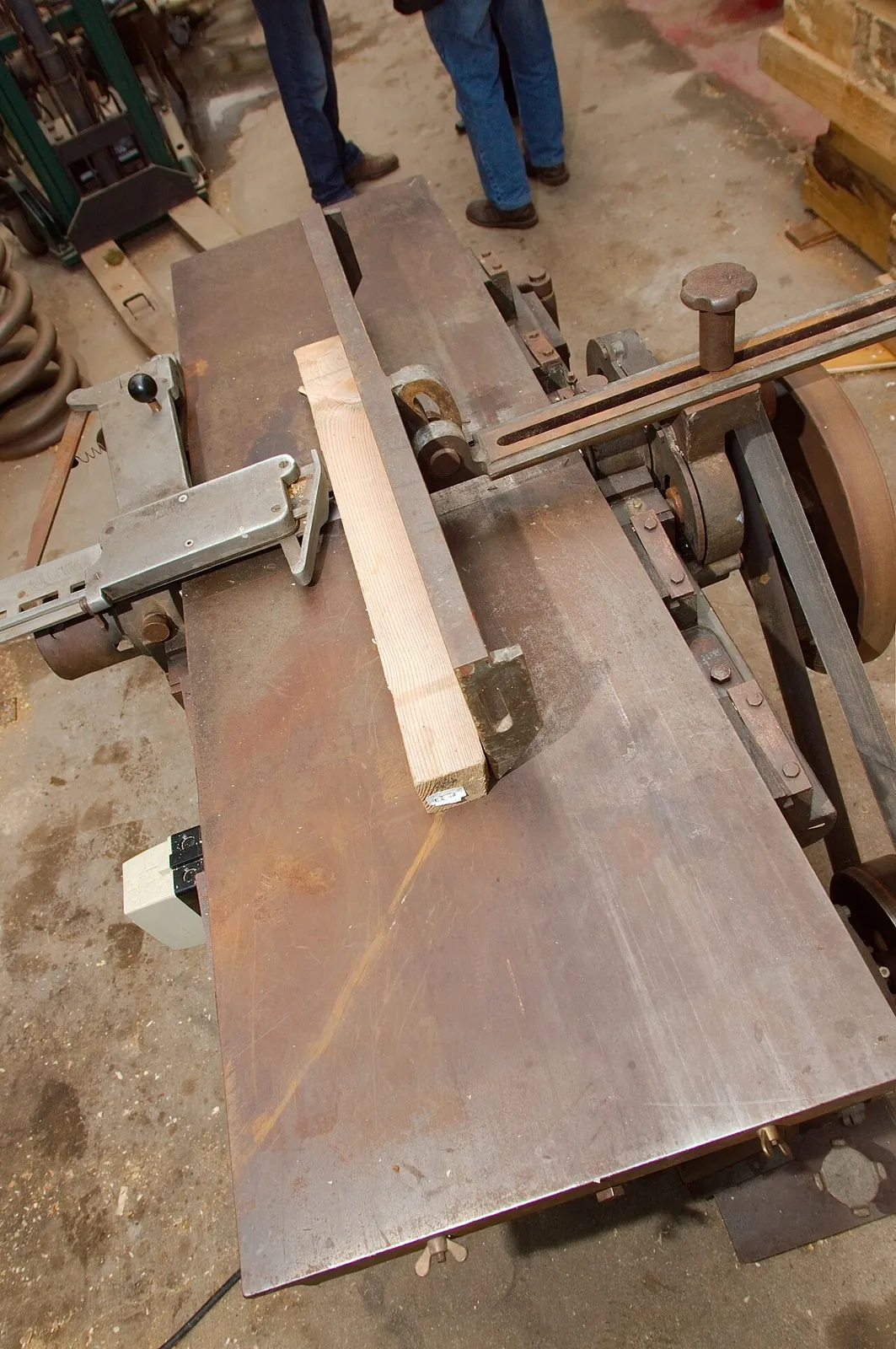
A jointer has two tables with a cutterhead between them. The outfeed table is set level with the top of the knife arc; the infeed table sits lower by the depth of cut. As the board passes over, the cutterhead removes material until the face is flat.
Technique:
- Put the concave (cupped) face down so the board rests on its two edges, and the bowed face down so it rests on its ends; it won’t rock.
- Feed with the grain (the same rule as hand planing) to avoid tearout.
- Take light passes - 1/32 to 1/16 inch.
- Transfer pressure to the outfeed side as the board crosses the cutterhead; that side is now flat and becomes the reference.
- Check with a straightedge and winding sticks; stop when the face is fully cut and flat.
Jointer safety
OSHA’s rules for jointers 1:
- Keep the spring-loaded guard over the cutterhead; it should expose only the part cutting the board.
- Use hold-down push blocks for stock narrower than 3 inches, and in practice for all face jointing; hands never pass directly over the cutterhead.
- Never joint pieces shorter than four times the width of the bed opening - a short piece can tip into the gap.
- Avoid deep cuts, which increase kickback.
- Turn off and unplug before checking or changing knives.
Quick check
OSHA also advises never jointing pieces shorter than four times the width of the bed opening.
The planer
A thickness planer feeds the board under a cutterhead on rollers at a set height.
- Feed the flat (jointed) face down.
- Feed with the grain, and plane alternate faces to equalize stress if removing a lot.
- Take light passes, about 1/32 inch on wide hardwood.
- Snipe is a dip at the ends, where only one roller holds the board. Support long boards level on infeed and outfeed, lift slightly at the start and end, and plane parts long so snipe is trimmed off.
- Don’t plane boards shorter than the machine’s minimum (usually 12 inches or so), and never stand directly behind the board’s path 2.
- Check for nails, staples, and grit, which chip knives. A metal detector is cheap insurance with reclaimed wood.
Hand or machine?
Jointers and planers do in minutes what takes an hour by hand, and many hand-tool woodworkers keep them for stock prep and do everything else by hand. The reverse is also common: a portable planer for thicknessing plus a jointer plane for faces. Either way, the sequence is the same: one flat face, a square edge, then parallel.
What to take from this
Joint one face flat, joint an edge square to it, plane the opposite face parallel, then rip and crosscut. The planer can’t flatten - only the jointer or a hand plane can. On the jointer, keep the guard on, use push blocks, take light cuts, and never joint pieces shorter than four times the bed opening. On the planer, feed the flat face down with the grain, support long boards against snipe, and keep metal out.
Practice
Snipe happens when the board is held by only one roller at the start or end of the cut. Support long boards level and plane parts long, then trim the ends.
Lesson complete
Nice work.
Sources for this lesson
- 1Woodworking eTool: Jointers. Occupational Safety and Health Administration. verifiedSelf-closing cutterhead guard; hold-down push blocks for stock narrower than 3 inches; don't joint stock shorter than four times the bed opening; avoid deep cuts.
- 2Woodworking eTool: Kickbacks. Occupational Safety and Health Administration. verifiedKickback is the saw seizing the stock and hurling it back; spreaders and anti-kickback fingers, sharp properly set blades, sound stock, and standing to the side prevent it.