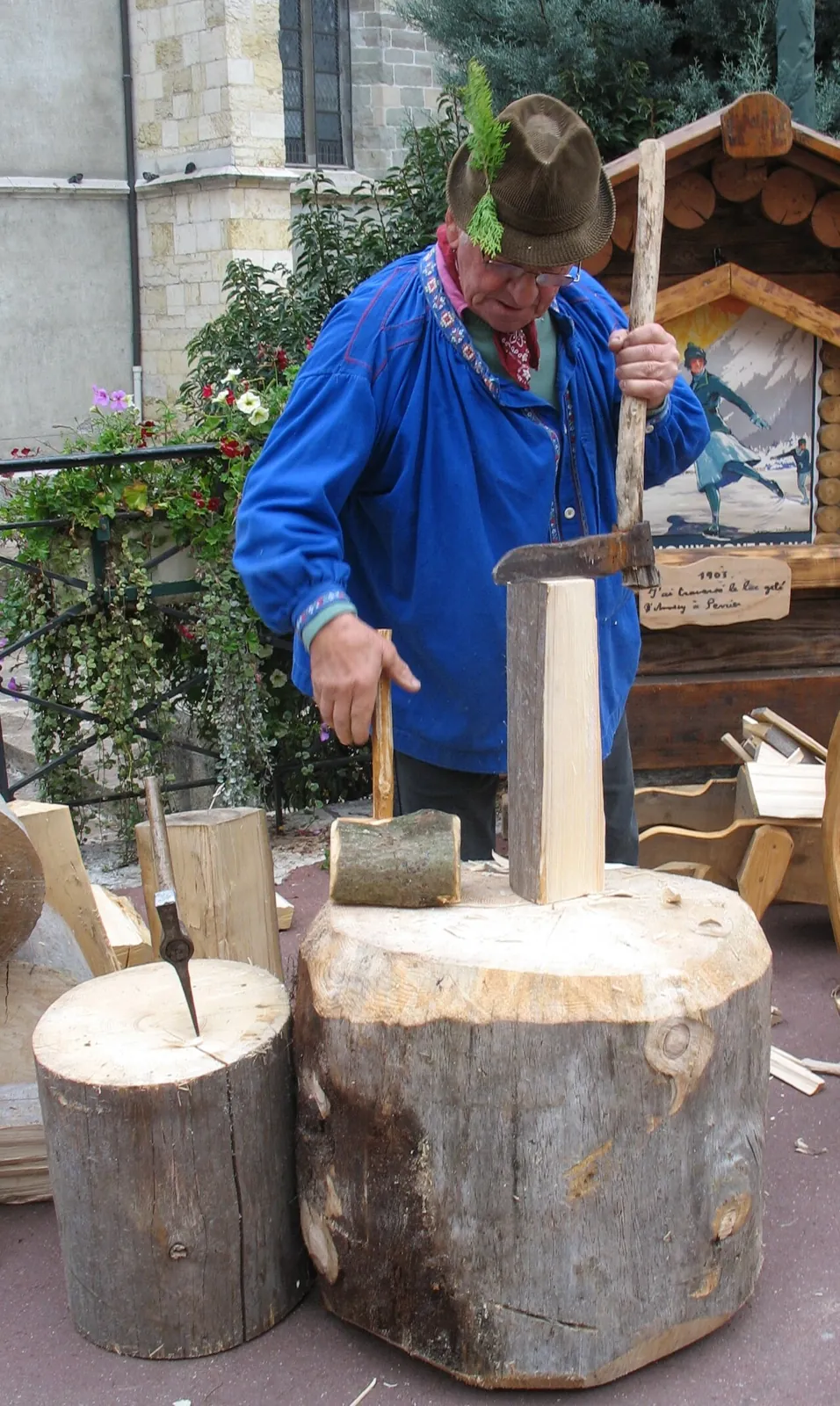
Riving with Froe and Wedges
Splitting a log along its fibers instead of sawing across them: choosing a log, opening it with wedges, halving and halving again with a froe, steering a split in a riving brake, and turning wedges into billets with the grain running end to end.
- 4 min
- 7 steps
- 3 questions
- Lesson 65 of 160
In this lesson
- Why rive
- Choosing the log
- Opening the log
- From log to billet
- Steering the split
- Store it wet
- What to take from this
Picking up where you left off.
Why rive
Riving means splitting wood along its fibers. A saw cuts a straight line whatever the grain does; a split follows the fibers, so they run unbroken from end to end. Riven parts are stronger for their size, bend without breaking, and carve cleanly because there’s no grain running out of the side 1. Mortise & Tenon Magazine argues no other operation teaches you as much about how wood is built 2.

Quick check
A saw cuts straight regardless of grain, leaving short fibers that run out of the side of the piece.
Choosing the log
- Fresh: green wood splits far more easily than seasoned wood.
- Straight and clear: no twist, no knots in the section you need. Read the bark: spiral bark means spiral grain; bumps and scars hide knots.
- Ring-porous hardwoods rive best: oak, ash, and hickory split cleanly and predictably. Birch, maple, and cherry split well enough for spoons and small work. Elm’s interlocked grain resists splitting.
- Cut to length first, a little longer than the finished part.
Opening the log
- Look at the end for a check or a line through the pith that crosses no knots, and start there.
- Drive a steel wedge into the end grain with a sledge or maul. As the crack opens down the side, start a second wedge in the crack on the bark side, leapfrogging until the log falls in half. Never strike one steel wedge with another or with an axe poll - steel on steel chips and throws shards.
- Wooden wedges (gluts) cut from hardwood can follow in a long split.
From log to billet
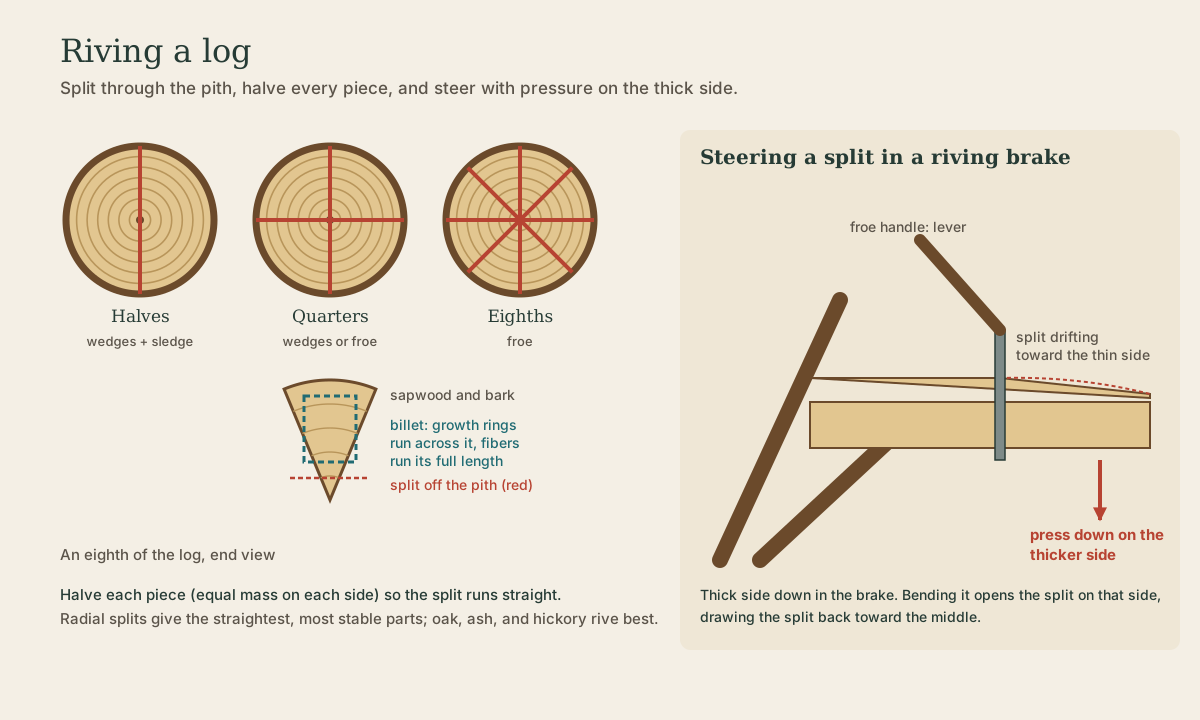
Keep halving: halves into quarters, quarters into eighths. When a piece splits into two of equal mass, the split runs straight; when one side is much thinner, the split runs out toward it 1.
For smaller pieces, switch to the froe: an L-shaped blade with a handle at right angles. Set the blade across the end grain, drive it in with a wooden club (never a steel hammer), then lever with the handle to open the split, working the blade down the crack.
From each wedge-shaped piece:
- Split or hew off the pith - it cracks as it dries.
- Split off the sapwood and bark if the part needs to be durable or clean.
- What’s left is a billet: rings running across it, fibers running full length. That’s your spoon blank, chair leg, or bowl blank. For spoons, Sundqvist chooses a blank whose curve or grain suits the shape of the spoon 3.
Quick check
An uneven split runs out toward the thinner, weaker side.
Steering the split
Splits wander. A riving brake - two poles crossed or a forked limb that grips the piece - holds the work while you lever the froe with one hand and steer with the other.
If the split drifts toward one side, turn the thicker side down and press down on it while levering. Bending the thick side opens the split on that side, so the crack moves back toward the middle 1. Small corrections early work better than big corrections late.
Playback is optional. If the player is unavailable, open the video at its source.
Playback is optional. If the player is unavailable, open the video at its source.
Quick check
Bending the thick side opens the split on that side and draws it back to the middle.
Store it wet
Riven green wood dries from the ends first and checks. Rive only what you’ll carve soon, keep billets in a plastic bag in a cool place or under wet shavings, and seal the ends of anything you’re storing (see the Wood Drying course on green chair parts and turning blanks).
What to take from this
Riven wood follows the fibers, so it’s stronger and carves cleaner than sawn wood. Choose a fresh, straight, clear log, preferably oak, ash, or hickory, open it with steel wedges, and keep halving so each split has equal mass on both sides. Finish with a froe and club, remove the pith, and steer a wandering split by pressing on the thicker side in a riving brake. Keep riven stock wet until you carve it.
Lesson complete
Nice work.
Sources for this lesson
- 1Drew Langsner. Country Woodcraft: Then & Now. Lost Art Press. 2020. verifiedExpanded edition of the 1978 book that seeded American green woodworking; shavehorses, riving, spoons, bowls, and country tools.
- 2Two Excellent Riving Videos. Mortise & Tenon Magazine. 2019. verifiedPoints to Peter Follansbee's splitting video and a cooper riving oak; riving teaches grain better than any other operation.
- 3Jögge Sundqvist. Slöjd in Wood. Lost Art Press. 2018. verifiedPublisher excerpt (PDF) of the English translation of the Swedish classic; butter knife, spoons, bowls, sheath, hooks, and painted decoration in the Västerbotten tradition.