How Long Air Drying Really Takes
The Forest Products Laboratory's own Madison data - 65 days or 212 days for the same red oak, depending on the month you stack it - and why "a year per inch" is only a rough guide.
- 5 min
- 7 steps
- 3 questions
- Lesson 10 of 160
In this lesson
- The rule of thumb and its limits
- Typical ranges
- The Madison numbers
- Thicker stock
- 20 percent is not the end
- Track it, don’t guess
- What to take from this
Picking up where you left off.
The rule of thumb and its limits
The folk rule for air drying is “a year per inch of thickness.” It’s a decent way to say “be patient,” but the real numbers show how much it hides. Species, thickness, the season you stack, the site, and your target moisture content all change the answer by months.
Typical ranges
The FPL air-drying guide gives approximate times for 1-inch lumber to reach 20 percent, from green 1:
| Species | Days to 20% |
|---|---|
| Red and silver maple | 30 to 120 |
| Basswood | 40 to 150 |
| Paper birch | 40 to 200 |
| Aspen | 50 to 150 |
| Sugar maple | 50 to 200 |
| White ash | 60 to 200 |
| Eastern white pine | 60 to 200 |
| Black cherry | 70 to 200 |
| Black walnut | 70 to 200 |
| Yellow birch | 70 to 200 |
| Northern red oak | 70 to 200 |
| Northern white oak | 80 to 250 |
The short end of each range is lumber stacked in good drying weather, spring and summer. The long end is lumber stacked too late to finish before winter, which typically won’t reach 20 percent until the following spring.
The Madison numbers
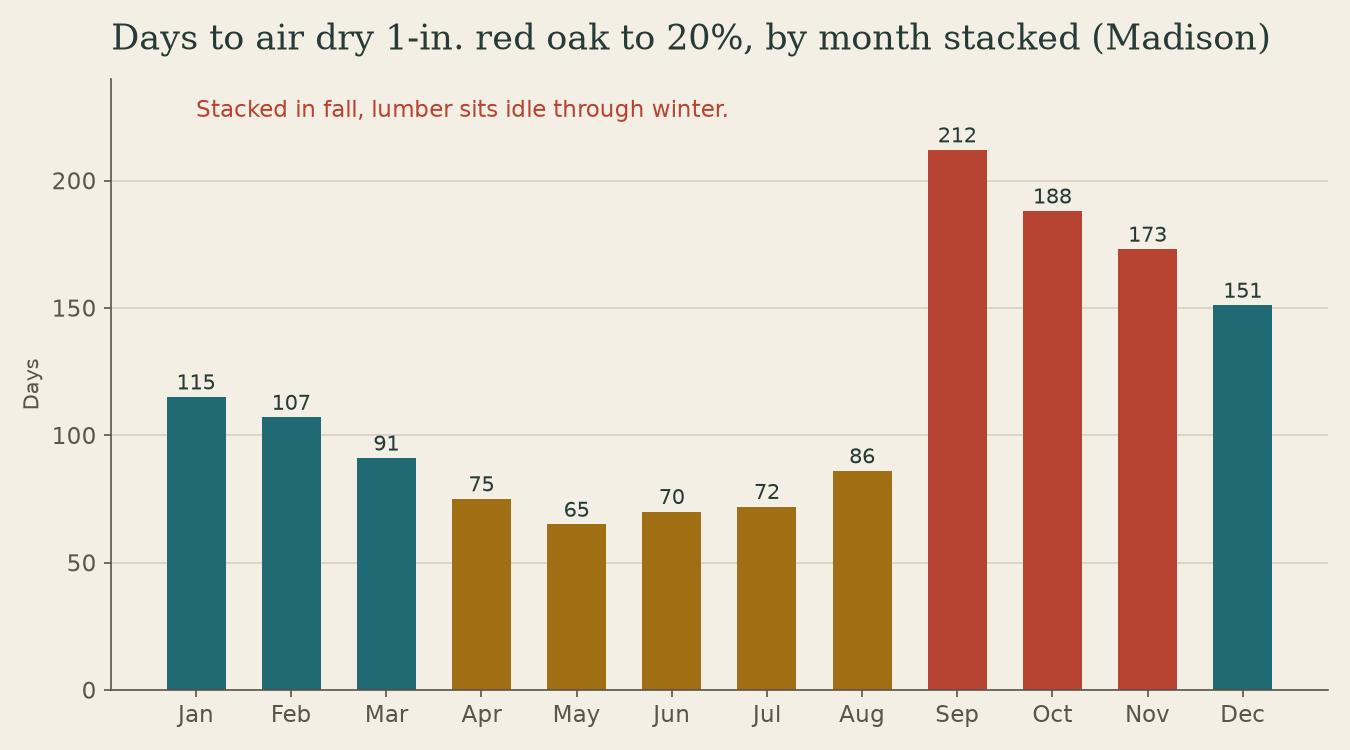
The guide also includes a remarkable table of measured drying times at specific places by month of stacking. For 1-inch northern red oak at Madison, Wisconsin, to 20 percent 1:
| Stacked | Days | Stacked | Days |
|---|---|---|---|
| January | 115 | July | 72 |
| February | 107 | August | 86 |
| March | 91 | September | 212 |
| April | 75 | October | 188 |
| May | 65 | November | 173 |
| June | 70 | December | 151 |
The same lumber takes 65 days or 212 days depending on when it went on sticks. The guide summarizes it the same way: 1-inch red oak in southern Wisconsin is often air dried to about 20 percent in about 60 days when yarded in June or July, but stock piled in late fall and winter must stay on sticks for 120 days or more 1.
Notice that January stacking (115 days) beats September (212 days). Lumber stacked in September dries a little, then freezes for four months. Lumber stacked in January sits frozen, but then has the whole spring ahead of it.
Quick check
FPL-GTR-117 Table 9 gives 212 days for September stacking, versus 65 for May. Fall-stacked lumber sits through winter barely drying.
Thicker stock
Drying time rises faster than thickness: 2-inch lumber takes roughly three times as long as 1-inch. For the central United States, 2-inch red and white oak take about 190 to 250 days to reach 20 percent; in Wisconsin, plan on a full season or more 1.
20 percent is not the end
Twenty percent is the usual target for air drying before a kiln, and it’s dry enough to stop stain and decay. It is not dry enough to build with. To get below that, the board has to keep losing water toward the outdoor EMC, around 13 to 15 percent in Madison, and that last stretch goes slowly because bound water is harder to remove and the driving force shrinks as the board approaches equilibrium 2. Reaching outdoor EMC all the way through a 1-inch board can take most of a year in Wisconsin, and thick stock much longer. That’s where “a year per inch” comes from, and it’s roughly right for reaching outdoor equilibrium, not for reaching 20 percent, and never for reaching furniture dryness.
Quick check
The last stretch to outdoor EMC takes most of a year per inch, and indoors finishes it.
Track it, don’t guess
Weigh a sample board. Cut a representative board about 2 to 3 feet long from the stack, coat its ends, weigh it, and put it back in the pile where it gets typical air. Weigh it every couple of weeks. When the weight stops dropping, the stack has reached the outdoor EMC. With an estimate of its oven-dry weight, explained in the measuring module, you can turn that weight into a moisture content at any time.
What to take from this
Air-drying time depends heavily on species, thickness, and when you stack. FPL’s Madison data show 1-inch red oak reaching 20 percent in 65 to 75 days when stacked April through July, and in 173 to 212 days when stacked September through November. Thick stock takes about three times as long. Twenty percent stops decay but isn’t dry enough to build with; the last stretch to outdoor EMC takes most of a year per inch, and furniture dryness needs indoor air or a kiln. Weigh a sample board instead of guessing.
Practice
A sample board’s weight tracks its moisture content. When the weight levels off, the board has reached the equilibrium set by the outdoor air.
Lesson complete
Nice work.
Sources for this lesson
- 1Forest Products Laboratory. Air Drying of Lumber. USDA Forest Service, Forest Products Laboratory, FPL-GTR-117. 1999. verifiedRevision of Rietz and Page (1971). Yard layout, piling and stickering, air-drying times by species and region, and days to dry 1-in. red oak at Madison, WI by stacking month (Table 9). Cited at: Table 7; Table 9; Drying Time and Final Moisture Content; Table 8.
- 2Richard Bergman. Drying and Control of Moisture Content and Dimensional Changes (Wood Handbook, Chapter 13). USDA Forest Service, Forest Products Laboratory, FPL-GTR-282. 2021. verifiedOven-dry and meter methods, outdoor EMC by city incl. Madison (Table 13-1), recommended MC (Table 13-2), kiln schedules (Table 13-3), drying defects, and dimensional change coefficients (Table 13-5). Cited at: Air Dry.