Reading a Kiln Schedule
Step through the Wood Handbook's black walnut schedule line by line - why it holds 80 percent humidity while the wood is wet, crashes the humidity near fiber saturation, heats up as it dries, then equalizes and conditions.
- 5 min
- 6 steps
- 3 questions
- Lesson 14 of 160
In this lesson
- What a schedule is
- The walnut schedule
- Reading it line by line
- A time schedule for comparison
- Why hardwoods differ by species
- What to take from this
Picking up where you left off.
What a schedule is
A kiln schedule is a list of dry-bulb temperatures and humidities, each held until a condition is met. The Wood Handbook calls it “a carefully developed compromise” between drying as fast as possible and avoiding the conditions that cause defects 1. Most schedules raise temperature and lower humidity as the wood dries, because drier wood is stronger and can take harsher conditions, and because drying slows as wood gets drier, so the kiln has to push harder to keep it moving.
There are two kinds:
- Moisture-content schedules change conditions when the lumber reaches given moisture contents. Most hardwood is dried this way, using kiln samples that are weighed during drying.
- Time schedules change conditions after set hours. Most softwood, and some hardwood dried as structural lumber, uses these.
The walnut schedule
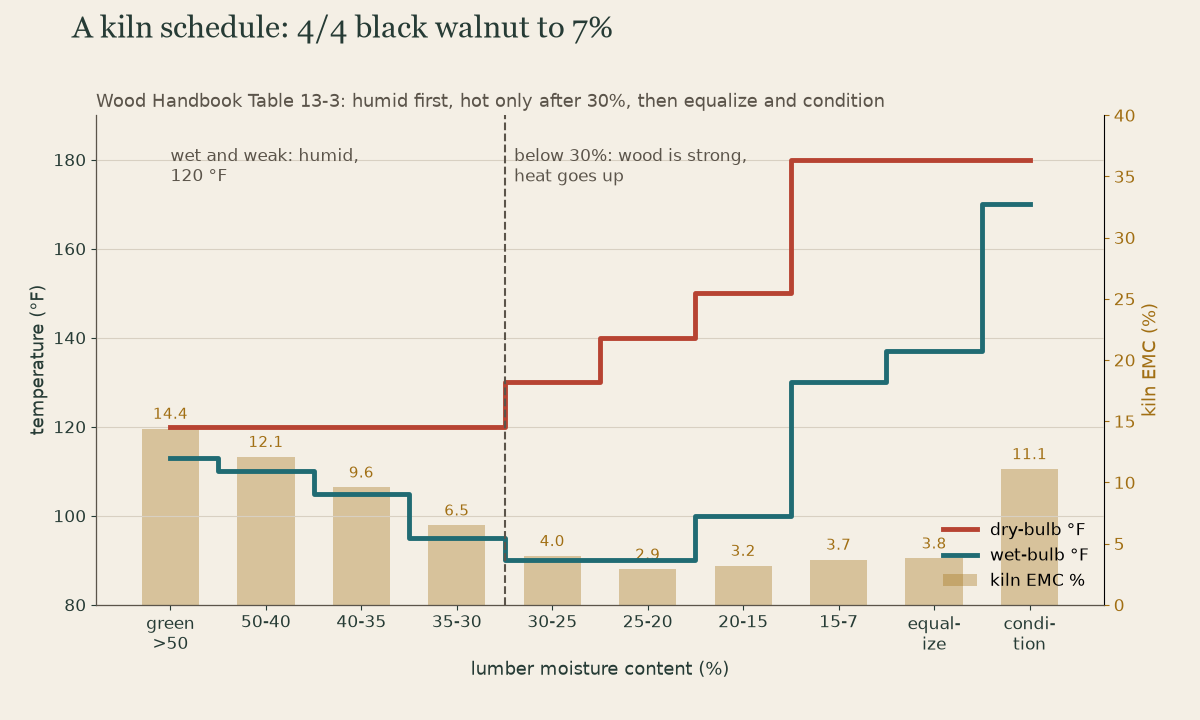
Here’s the handbook’s moisture-content schedule for 1-inch (4/4) black walnut dried to 7 percent 1:
| Lumber MC | Dry-bulb | Wet-bulb | RH | Kiln EMC |
|---|---|---|---|---|
| above 50% | 120 °F | 113 °F | 80% | 14.4% |
| 50 → 40% | 120 °F | 110 °F | 72% | 12.1% |
| 40 → 35% | 120 °F | 105 °F | 60% | 9.6% |
| 35 → 30% | 120 °F | 95 °F | 40% | 6.5% |
| 30 → 25% | 130 °F | 90 °F | 22% | 4.0% |
| 25 → 20% | 140 °F | 90 °F | 15% | 2.9% |
| 20 → 15% | 150 °F | 100 °F | 18% | 3.2% |
| 15 → 7% | 180 °F | 130 °F | 27% | 3.7% |
| Equalize | 180 °F | 137 °F | 30% | 3.8% |
| Condition | 180 °F | 170 °F | 79% | 11.1% |
Quick check
While the core is above fiber saturation, heat weakens the wood. The temperature rises only once the lumber is drier and stronger.
Reading it line by line
Wet and weak: gentle and humid. While the lumber is above 50 percent, the kiln holds 120 °F and 80 percent RH, an EMC of 14.4 percent. That’s far below the wood’s moisture, so it dries, but the high humidity keeps the surface from drying much faster than the core can follow. This is Stage I, when surface checks and end checks form, and the schedule’s whole job is to avoid them 2.
Losing free water: humidity steps down. From 50 down to 30 percent the temperature stays at 120 °F but the humidity drops in steps to 40 percent. The surface is already below fiber saturation; the core is still giving up free water. Stepping the EMC down keeps a steady driving force as drying naturally slows.
Below fiber saturation: heat up. Once the lumber averages under 30 percent, the core is drying below fiber saturation too, the wood is stronger, and the surface-checking danger has passed. Now temperature climbs, 130, 140, 150, and finally 180 °F, and the EMC sits very low, around 3 to 4 percent. The danger in this stage is different: excessive heat while the core is still wet causes honeycomb, and very high early temperatures darken or collapse wood. That’s why the big temperature jumps wait until 30 percent and below.
Equalize. When the driest samples reach a little below the target, the kiln equalizes: it sets an EMC that stops the driest boards from going lower while the wettest ones catch up. The result is a charge with a narrow moisture range instead of some boards at 5 and some at 10.
Condition. Finally the kiln conditions: a short spell at very high humidity, here 79 percent RH and an EMC of 11 percent at 180 °F. The dry, set shell regains a little moisture and swells slightly, relieving the casehardening stress locked in during drying. Conditioning is short, measured in hours, and its result is checked with prong tests 2.
A time schedule for comparison
The handbook’s sugar maple 2×6 schedule, dried to 15 percent in 5 days, uses time instead: 160 °F and 84 percent RH for the first 24 hours, stepping to 52 percent RH by 60 to 72 hours, then up to 180 °F and 27 percent RH until dry. And Southern Pine 2× lumber is dried at a single fixed condition, 240 °F and 29 percent RH, until done 1. Construction lumber can be dried hard; furniture lumber can’t.
Why hardwoods differ by species
Every species has its own schedule because each has different strength, permeability, and stain risk. Oak is refractory and starts very gently and slowly, with weeks in the early stages. Hard maple starts warmer and faster to keep it white. Walnut and cherry tolerate moderate schedules. The Dry Kiln Operator’s Manual and the FPL hardwood manual tabulate schedules by species and thickness 3.
What to take from this
A hardwood kiln schedule steps through moisture contents: humid and modest temperature while the wood is wet and weak, falling humidity as free water leaves, rising temperature once the wood is below 30 percent and strong, then equalizing to even out the charge and conditioning at high humidity to relieve casehardening.
Practice
Hardwood schedules are moisture-content schedules: each step begins when the wettest samples reach a given moisture content.
Practice
Conditioning at high humidity lets the over-stretched, set shell swell slightly, which relieves the stress locked in during drying.
Lesson complete
Nice work.
Sources for this lesson
- 1Richard Bergman. Drying and Control of Moisture Content and Dimensional Changes (Wood Handbook, Chapter 13). USDA Forest Service, Forest Products Laboratory, FPL-GTR-282. 2021. verifiedOven-dry and meter methods, outdoor EMC by city incl. Madison (Table 13-1), recommended MC (Table 13-2), kiln schedules (Table 13-3), drying defects, and dimensional change coefficients (Table 13-5). Cited at: Kiln Schedules; Table 13-3.
- 2Joseph Denig, Eugene M. Wengert, William T. Simpson. Drying Hardwood Lumber. USDA Forest Service, Forest Products Laboratory, FPL-GTR-118. 2000. verifiedPredrying, kiln schedules, safe daily drying rates (Table 8.6), stress testing and conditioning, dehumidification kilns, the semi-greenhouse solar kiln, and storage. Cited at: Stages of Drying; Conditioning with Steam.
- 3William T. Simpson. Dry Kiln Operator's Manual (Agriculture Handbook 188). Revised 1991 ed. USDA Forest Service, Forest Products Laboratory. 1991. verifiedThe standard reference for kiln design, instrumentation, kiln samples, and schedules.