The Geometry of Sitting
Turning a body into chair dimensions: seat height from popliteal height, seat depth, tilt, and back angle, upright versus reclined chairs, shaped versus compliant support, a twenty-minute plywood fitting rig, and diagnosing discomfort by where and when it happens.
- 7 min
- 6 steps
- 3 questions
- Lesson 109 of 160
In this lesson
- From body dimensions to chair dimensions
- Upright and reclined are different systems
- Support can be shaped or compliant
- Build a twenty-minute fitting rig
- Diagnose discomfort instead of naming it
Picking up where you left off.
A chair is a posture proposal. Before choosing a crest shape or a favorite species, decide what the sitter will be doing: eating, typing, talking, reading, or dozing. That purpose sets a posture; the posture sets a family of dimensions. Borrow the seat height from a dining chair and the recline from a lounge chair, and the result can feel as if it is slowly sliding the sitter onto the floor.
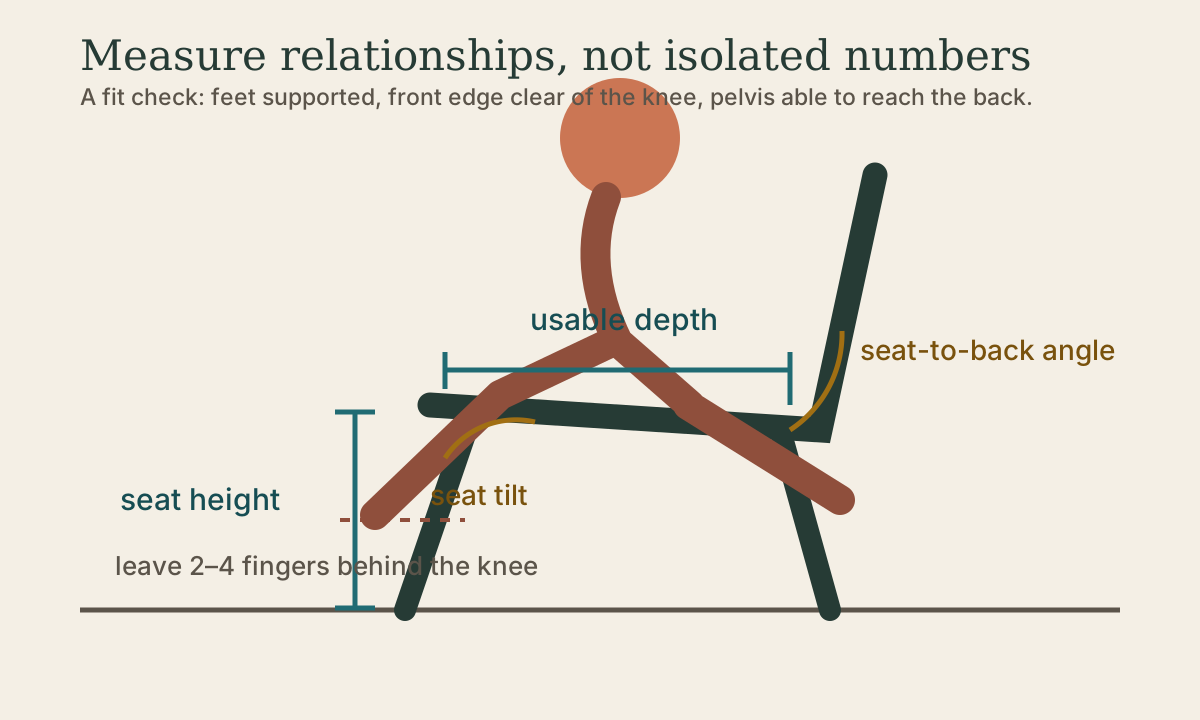
The useful mental model is a linked system, not a list of magic numbers. Remember the four contacts Feet, Knees, Hips, Back:
- Feet should find the floor or a deliberate footrest.
- Knees should clear the front edge without pressure behind them.
- Hips should settle far enough back that the pelvis is actually supported.
- Back support should meet the posture the chair promises.
If one contact fails, the body compensates somewhere else. That compensation is often what we call an uncomfortable chair.
From body dimensions to chair dimensions
The starting measurement for seat height is popliteal height: the vertical distance from the floor to the underside of the knee while the foot is supported. It is not automatically the finished seat height. Shoes add height; upholstery compresses; a back-tilted seat has a higher front edge than rear edge; and some people prefer a lower seat because it makes a relaxed posture easier.
For a personal chair, measure the intended sitter in the clothes and footwear likely to be used. Then make a test platform from plywood and blocks. Start slightly below the measured popliteal height and raise the platform in 1/4-inch increments. The best number is the one at which the foot remains supported and the front edge does not press into the thigh.
Seat depth begins with buttock-to-popliteal length: back of pelvis to back of knee. Subtract clearance so the edge cannot dig into the knee crease. A practical fitting check is more memorable than a population table: with the sitter against the back, leave roughly two to four finger widths between calf and seat edge. The exact clearance depends on body size and edge shape. A generous round-over can feel kinder, but it cannot rescue a seat that is simply too deep.
Seat width needs room for the pelvis, clothing, and movement. Between arms, also allow for hands and the natural outward angle of the thighs. Do not confuse visual delicacy with a narrow sitting space: a chair can use slender parts while leaving a generous clear width.
Schwarz’s chair-comfort chapter offers dimensions from observed vernacular chairs and stresses testing rather than treating commercial norms as law 1. Miller likewise makes full-size fitting and mockups part of the design process 2. Their shared lesson is more important than any single range: prototype the relationship at full size.
Quick check
Popliteal height starts the search; shoes, compression, and seat tilt adjust it, and a fitting rig settles it.
Upright and reclined are different systems
An upright dining chair keeps the sitter able to reach a table. Its seat is comparatively high and shallow, with modest rearward tilt. A lounge chair rotates the body backward. As the back reclines, three other things normally happen:
- The seat drops so the feet can remain supported.
- The seat tilts back enough to keep the pelvis from sliding forward.
- The seat grows deeper only if the back still reaches the sitter.
The seat-to-back angle is the included angle between the seat surface and the back support. It is not the same as the back’s angle to the floor. With rearward seat tilt \(t\) measured down from horizontal and back recline \(b\) measured behind vertical, the included angle is \(90^\circ + b - t\). A seat tilted 5° down toward the rear and a back leaning 10° behind vertical therefore make an included angle of 95°:
This simple addition is useful when comparing drawings. Label every angle by its reference—floor, vertical, or seat—because “the back is at 10°” is otherwise incomplete.
Seat tilt also changes edge height. If a seat has usable depth \(d\) and tilts by angle \(t\), the rear edge drops relative to the front by approximately
For a 16-inch-deep seat at 5°, the drop is \(16\tan 5^\circ \approx 1.4\) inches. That is large enough to matter. If your plan lists seat height at the rear but you compare it with a chair measured at the front, you are comparing different quantities.
Quick check
Included angle = 90° + back recline - seat tilt = 90 + 12 - 5 = 97°.
Support can be shaped or compliant
A saddled wooden seat supports by matching the body. A woven seat supports by deflecting under it. Upholstery adds another variable because its compressed height, not its showroom loft, governs posture. These systems can arrive at similar comfort by different routes.
The same applies to a back. A broad, rigid back must meet the body in a well-chosen place. Several slender spindles can share the load while flexing independently. A woven back distributes pressure but may allow more rotation. “Soft” and “comfortable” are not synonyms; controlled support matters more than initial plushness.
Build a twenty-minute fitting rig
Screw or bolt a plywood seat and back to braced uprights; clamps can position parts while you adjust, but never carry a person. Load the rig with weight heavier than the sitter before anyone sits, and rebuild anything that slips or rocks. Then change one variable at a time:
- Set a provisional seat height and make sure the feet are supported.
- Slide the back forward until the sitter can use it without the seat edge touching the knee crease.
- Test the seat level, then with 3°, 5°, and 7° of rearward tilt.
- Test at least two back angles while keeping the seat fixed.
- Sit for ten minutes, then for an hour. Record different verdicts.
- Have the sitter stand up. A chair that is pleasant only after landing but difficult to exit has not passed.
Use a helper to mark the position of shoulders, lumbar area, and back of knee on the rig. Photograph the setup square-on with a ruler in frame. Those records are more valuable than remembering that one arrangement “felt pretty good.”
Worked fitting note
Suppose a sitter’s test platform feels best at 17 inches at the front. A 16-inch seat tilted 5° drops about 1.4 inches, so the rear reference is about 15.6 inches before accounting for saddle or upholstery compression. The sitter prefers a 104° included seat-to-back angle. With 5° of seat tilt, the back needs to lean 19° behind vertical:
These numbers are not a universal recipe. They are a complete, internally consistent description of one tested posture.
Diagnose discomfort instead of naming it
When a test sitter says “uncomfortable,” ask where and when:
- Pressure behind the knees: lower the front edge, shorten usable depth, or soften the edge.
- Sliding forward: reduce back recline, increase rearward seat tilt, or improve pelvic support.
- Cannot reach the back: shorten the seat or bring the back forward.
- Shoulders pushed forward: lower or reshape the upper back.
- Feet searching for support: lower the seat or add a footrest.
- Comfortable for five minutes, tiring at forty: look for a support that prevents small posture changes.
Return to Feet, Knees, Hips, Back and change one relationship. A chair is not comfortable because its measurements fall inside a table. It is comfortable when its contacts cooperate for the intended body, task, and duration.
Quick check
Sliding means the pelvis isn’t held. More seat tilt or less recline keeps it back against the support.
Lesson complete
Nice work.
Sources for this lesson
- 1Christopher Schwarz. The Stick Chair Book. 2nd revised ed. Lost Art Press. verifiedPublisher page with the complete book available as a free PDF. Cited at: Chair Comfort & Design.
- 2Jeff Miller. Chairmaking & Design. Taunton Press. 1997. verifiedPractical chair-design reference covering fit, mockups, jigs, and seven projects. Cited at: design and mockup chapters.