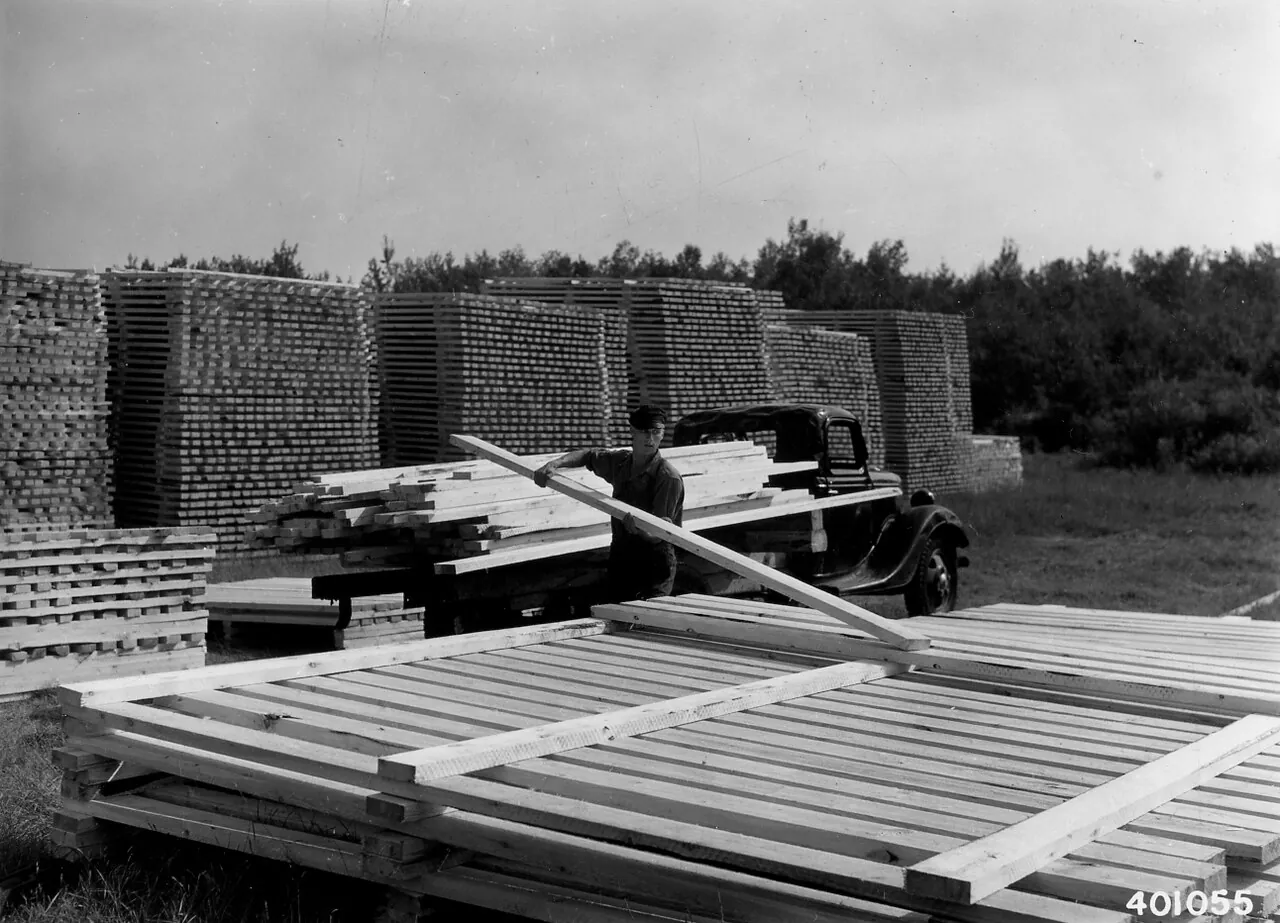
Siting an Air-Drying Pile in Wisconsin
High, open, well-drained ground with the wind blowing through the stickers dries fastest; a shed, shade cloth, and seasonal timing control the defects that fast drying brings.
- 5 min
- 6 steps
- 3 questions
- Lesson 9 of 160
In this lesson
- What drives air drying
- Pick the site
- Orient the pile to the wind
- Protection: roof, shed, shade cloth
- The Wisconsin calendar
- What to take from this
Picking up where you left off.
What drives air drying
An air-drying pile has no heater and no fans. It depends on three things the weather supplies: air movement to carry moisture away from the boards, low humidity so that air can take up more water, and warmth, which speeds moisture movement inside the wood. You can’t control the weather, but you can put the pile where those three are strongest and protect it from what hurts lumber, which is rain, direct sun, and hot dry wind on check-prone wood 1.
Pick the site
The FPL air-drying guide’s advice 1:
- High, well-drained ground. Standing water after rain slows drying and invites stain.
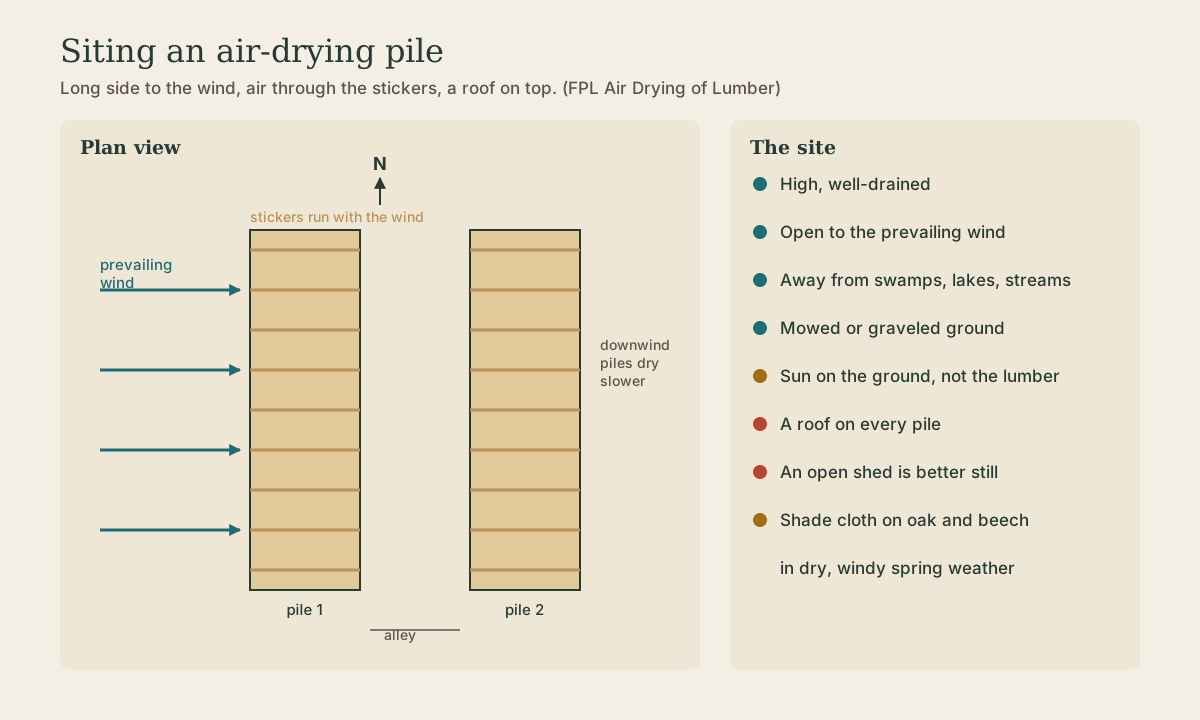
- Open to the prevailing winds. Sites in valleys, or hemmed in by tall trees, hills, or buildings, dry slowly.
- Away from water. Ground near swamps, marshes, lakes, and streams stays damper and grows mold, stain, and decay.
- Clean ground. Mow or gravel the area. Weeds and debris under a pile hold humid air and block the airflow underneath.
- Sun on the ground, not on the lumber. Sun-warmed ground heats the air passing into the pile; a dark gravel or blacktop yard helps. But sun striking the lumber itself checks and warps it, which is why piles get roofs and sometimes shade cloth.
A high, dry, windy site dries fastest but can also cause the most surface checking and end splitting, especially in oak. The ideal site for pine and soft maple is not always ideal for white oak.
Quick check
The FPL guide favors high, well-drained ground with no obstructions to prevailing winds. Low sites near water stay damp and promote stain and mold.
Orient the pile to the wind
Air should blow through the sticker spaces, so set the pile with its long sides facing the prevailing wind; the stickers run in the wind direction. In southern Wisconsin, prevailing winds are mostly from the west and northwest in winter and from the south and southwest in summer, so a pile running north–south catches spring and summer winds well.
Where several piles sit in a row, the first pile upwind adds moisture to the air, so downwind piles dry slower. Keep a small yard to one or two piles deep, with alleys between them.
Quick check
In southern Wisconsin, a pile running north-south catches spring and summer winds.
Protection: roof, shed, shade cloth
- Roof every pile. Rewetting by rain adds water you have to evaporate again and stains the top layers.
- A drying shed is the step up: a pole building with a permanent roof and open sides. Shed-dried lumber is brighter, because it isn’t weathered gray by sunlight or discolored by rewetting, and drying is faster in rainy periods 1. For a woodworker drying a few thousand board feet a year, a simple open shed is the single best investment.
- Shade cloth draped on the windward and sunny sides baffles the air enough to raise the surface moisture a little. For refractory woods, those that check easily, like the oaks and beech, this noticeably reduces surface checks in hot, dry, windy weather, and it keeps blowing rain out 1.
The Wisconsin calendar
Good air-drying weather in Wisconsin runs from about April into September. Spring is the most aggressive season: warm days, dry air, and wind, with outdoor EMC at its yearly low in May (12.6 percent at Madison) 2. That’s the best time to get fresh lumber started and also the riskiest time for oak to check. By late fall, cold and damp air slows drying almost to a stop, and through winter a pile loses very little water.
The practical rule: stack in spring or early summer when you can. Lumber stacked in June or July in southern Wisconsin reaches about 20 percent in roughly two months; lumber stacked in late fall sits through winter and doesn’t get there until the next spring (the next lesson has the numbers). Winter isn’t wasted, though: cold temperatures keep stain and insects quiet, so lumber sawn and stacked in winter is in good condition to take off fast when spring arrives.
What to take from this
Put piles on high, open, well-drained, clean ground exposed to the prevailing wind, with the wind blowing through the stickers. Roof every pile; an open shed is better still. Use shade cloth on oak and beech in windy spring weather. In Wisconsin, stack in spring or early summer for the fastest drying, and expect a pile stacked in fall to sit until the following spring.
Practice
Shade cloth baffles air movement enough to raise the surface EMC a little, cutting surface checks in refractory woods like oak and beech.
Lesson complete
Nice work.
Sources for this lesson
- 1Forest Products Laboratory. Air Drying of Lumber. USDA Forest Service, Forest Products Laboratory, FPL-GTR-117. 1999. verifiedRevision of Rietz and Page (1971). Yard layout, piling and stickering, air-drying times by species and region, and days to dry 1-in. red oak at Madison, WI by stacking month (Table 9). Cited at: Air-Drying Yard; Yard Layout and Orientation; Shed Drying; Shade Cloth.
- 2Richard Bergman. Drying and Control of Moisture Content and Dimensional Changes (Wood Handbook, Chapter 13). USDA Forest Service, Forest Products Laboratory, FPL-GTR-282. 2021. verifiedOven-dry and meter methods, outdoor EMC by city incl. Madison (Table 13-1), recommended MC (Table 13-2), kiln schedules (Table 13-3), drying defects, and dimensional change coefficients (Table 13-5). Cited at: Table 13-1.