Wood for Chairs
Choosing and preparing chair wood: grain in three directions, why riven stock makes strong slender parts, assigning species by job, moisture content and wet/dry joints, defects that rule out a blank, allocating a stock pile, and three test samples for an unfamiliar species.
- 7 min
- 7 steps
- 3 questions
- Lesson 110 of 160
In this lesson
- Read the board in three views
- Assign wood by job
- Moisture is both movement and a tool
- Defects that change the decision
- A stock-allocation workflow
- The final shop tests
Picking up where you left off.
Chairs ask slender parts to survive changing, off-axis loads. A table leg mostly holds weight downward; a chair leg also takes racking, tipping, and the shock of a sitter arriving. That makes stock selection less about finding a prestige species and more about putting continuous fibers where the load will travel.
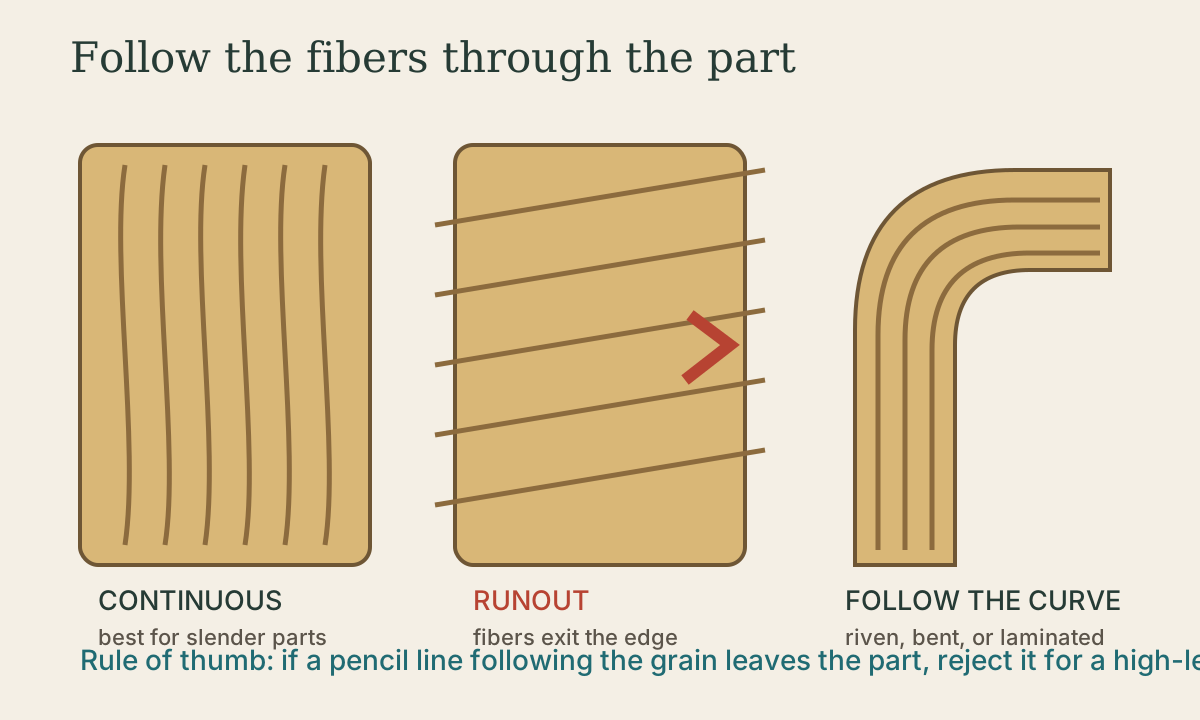
The first rule is fiber before figure. Curl, ray fleck, and color are visual qualities. Grain direction is structural. A plain board with straight fibers is better chair stock than a spectacular board whose fibers run out through the side of a leg.
Read the board in three views
Wood is anisotropic: it behaves differently along, across, and around its fibers. The USDA Wood Handbook separates properties by grain direction because the differences are large enough to govern structural design 1. In the workshop, translate that science into a three-view inspection:
- Face: follow the long grain from end to end. Does it stay inside the intended part?
- Edge: repeat the check. A board can look straight on its face and dive out on its edge.
- End: locate growth-ring direction, pith, and juvenile wood. End grain explains how the two long views relate.
Draw the part on the blank, then extend several visible grain lines with a pencil. If those lines leave a high-leverage part near a joint, move the pattern or reject the blank. The mnemonic is Face, Edge, End—then Bend: inspect all three views before testing a slender offcut by flexing it.
Why riven stock is special
Splitting follows the fibers. A riven spindle therefore begins with grain continuity almost guaranteed; shaving can preserve it. Sawing follows a fence or line whether the fibers agree or not. Sawn stock can be excellent, but it requires more reading and sometimes a curved layout inside a straight board.
Riving is most useful for legs, stretchers, posts, and sticks that can follow the split. Sawing remains sensible for broad seats, rails, and parts whose shape does not align neatly with a radial split. Galbert treats splitting and shaving as a system for preserving the tree’s own fiber path, not as historical theater 2.
Quick check
Sawing follows a line whether or not the fibers agree; splitting follows the fibers themselves.
Assign wood by job
Species names are shorthand for groups of properties. Ask what the part must do.
- Rive and bend: straight-grown oak, ash, and hickory are common choices. Ring-porous structure makes the growth layers conspicuous, which helps when splitting and shaving.
- Turn cleanly: maple, beech, and birch have more even texture and can hold crisp details. Straight grain still matters.
- Carve a thick plank seat: pine, poplar, basswood, and similar lower-density woods reduce weight and carving effort. Elm’s interlocked grain has also made it valuable for socket-filled seats.
- Make a sculpted or show surface: walnut, cherry, oak, or another visually expressive wood can work if its structure suits the part and the extra density is acceptable.
- Make a bent lamination: use sound, straight-grained veneers of consistent thickness; the glue line and form become part of the material system.
This is not a rigid tradition chart. Schwarz explicitly demonstrates that strong, local lumber can make good stick chairs and provides simple ways to compare uncertain stock 3. The practical hierarchy is soundness, grain, moisture, then species.
Moisture is both movement and a tool
Wood exchanges moisture with surrounding air until it approaches equilibrium moisture content. As moisture changes below the fiber-saturation region, wood changes dimension mostly across the grain, with tangential movement generally greater than radial and longitudinal movement comparatively small 1.
That difference drives two chairmaking strategies.
First, orient parts so predictable movement does the least harm. A wide seat moves across its width; mortise clusters, wedges, and glue-ups must respect that. When wedging a through-tenon in a plank seat, orient the wedge so it expands the tenon in a direction that does not pry the seat apart across its grain.
Second, wet/dry joinery turns movement into clamping. A thoroughly dried rung tenon enters a mortise in a post that retains more moisture. As the post dries it shrinks across the mortise; as the very dry tenon regains a little moisture it can swell. The joint gains mechanical grip. This is controlled differential moisture, not permission to assemble random wet lumber.
Moisture-content calculation
Moisture content by oven-dry mass is
If a sample weighs 112 g before oven drying and 100 g after, it was at 12% moisture content. In daily work use a calibrated meter and local experience; the oven-dry method explains what the meter estimates. Record species, temperature correction when required, and readings from more than one location.
Quick check
Controlled moisture difference turns wood movement into lasting mechanical grip.
Quick check
MC = (112 - 100) / 100 × 100 = 12%, always based on oven-dry mass.
Defects that change the decision
Reject or redesign around:
- Pith or juvenile core in a slender part; it tends to be unstable and often accompanies curved grain.
- Checks entering a mortise area, even if the check seems closed.
- Knots in tension zones or where a tenon must be cut. Grain diverts around knots long before the dark knot itself.
- Reaction wood or strongly eccentric growth that moves unpredictably.
- Case hardening or severe drying stress, especially in stock to be resawn into thin laminations.
- Decay or insect damage beyond superficial, well-understood traces.
A small sound knot in a thick decorative crest may be acceptable; the same knot at a rear-leg transition is not. Defects are decisions relative to load paths.
A stock-allocation workflow
Before milling a chair set, sort the whole pile:
- Mark the best continuous-grain blanks for rear posts, legs, and crest bends.
- Reserve the next tier for stretchers and back sticks, cutting around local runout.
- Use broad, stable boards for seats and rails.
- Assign short or visually active pieces to wedges, pegs, hands, and samples.
- Mill one extra high-risk part while the setup and matching stock are available.
- Write moisture readings and intended part directly on painter’s tape attached to each blank.
This is more economical than cutting the easiest parts first and discovering that the only remaining rear-post blank contains a knot at the seat rail.
The final shop tests
For an unfamiliar local species, make three samples before committing a chair. Break the flex sample in a vise or fixture with a lever, wearing eye protection and standing out of the path of flying splinters.
- A slender stick flexed to failure to expose runout.
- A representative mortise and tenon, including wedge or pin.
- A finish sample prepared with the same tool marks and sanding schedule as the chair.
The tests answer different questions: can the fibers carry the load, can the joint be made cleanly, and will the surface age as intended? Keep the broken flex sample. Its fracture is a readable map: a long, fibrous break usually followed the grain; a short diagonal break exposes runout.
Choose chair wood with the sequence soundness, grain, moisture, species. The species label may predict a range of behavior. The individual fibers in your hand decide whether this particular part belongs in a chair.
Lesson complete
Nice work.
Sources for this lesson
- 1Robert J. Ross. Wood Handbook: Wood as an Engineering Material. Revised 2021 ed. USDA Forest Service, Forest Products Laboratory. 2021. verifiedOfficial chapters on wood structure, moisture, mechanical properties, fastenings, composites, drying, and finishing. Cited at: Chapters 3 and 5; Chapter 4.
- 2Peter Galbert. Chairmaker's Notebook. Lost Art Press. 2015. verifiedDetailed chairmaking reference for drilling, reaming, sightlines, and compound geometry. Cited at: Chapters 7–11.
- 3Christopher Schwarz. The Stick Chair Book. 2nd revised ed. Lost Art Press. verifiedPublisher page with the complete book available as a free PDF. Cited at: Wood for Stick Chairs and Wood Strength Formulas.