Chip Carving
Karvsnitt: decorating a surface by cutting out small geometric chips with a knife. The triangle chip, straight-wall and curved cuts, laying out rosettes and borders, choosing wood, and where chip carving traditionally goes on Nordic woodenware.
- 4 min
- 6 steps
- 3 questions
- Lesson 70 of 160
In this lesson
- Karvsnitt
- Wood and tools
- The triangle chip
- Beyond triangles
- Color
- What to take from this
Picking up where you left off.
Karvsnitt
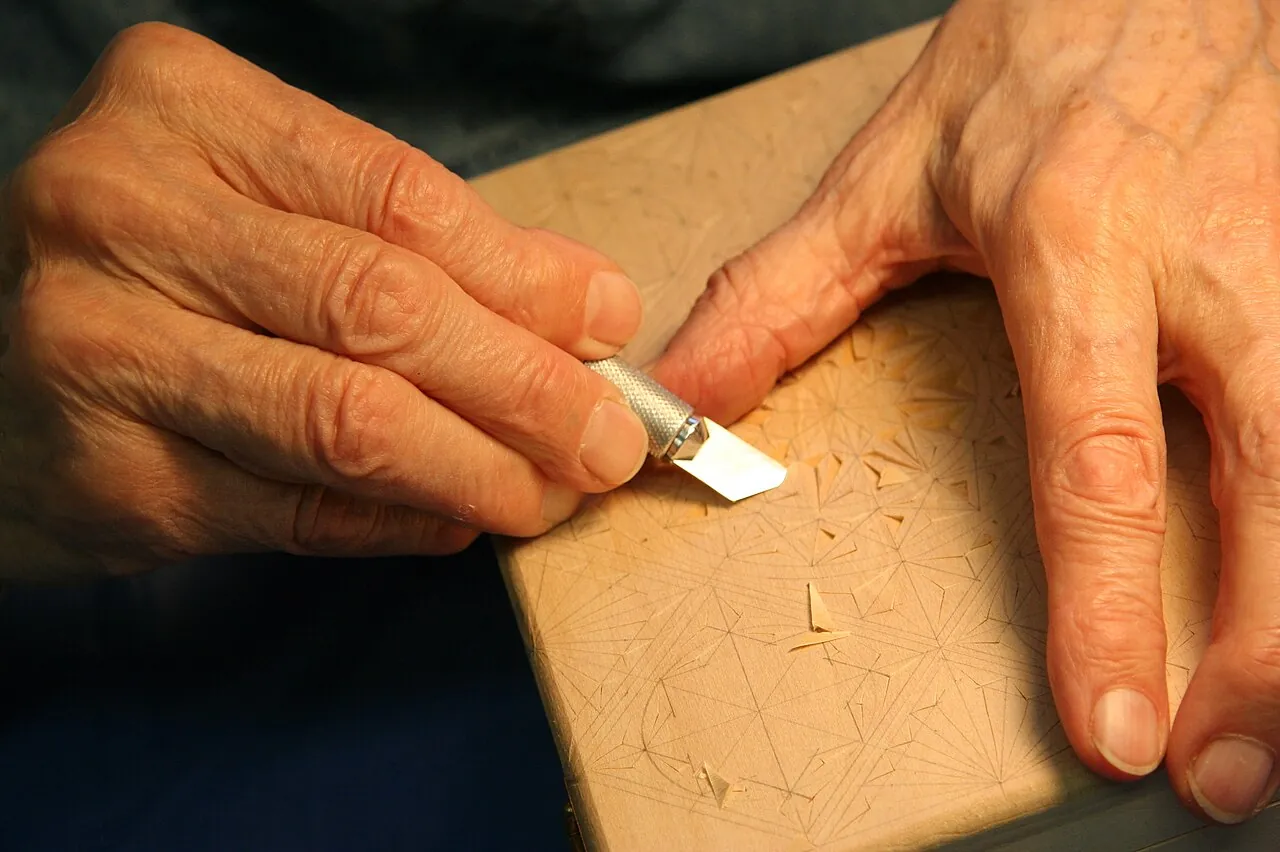
Chip carving (karvsnitt in Swedish) decorates a surface by cutting out small geometric chips with a knife. Across Scandinavia it covers mangle boards, spoon racks, boxes, distaffs, and knife handles. Jögge Sundqvist’s Karvsnitt teaches it through triangle chips, fingernail cuts, lines, and letters, and digs into what the traditional patterns meant 1.

Wood and tools
- Wood: fine, even grain with little contrast between early and late wood - basswood (linden) is the easiest; birch, alder, and aspen are traditional. Ring-porous oak and ash crumble at chip edges 1. Chip carving works on dry wood or on a green piece that’s dried; smooth the surface first.
- Knife: a dedicated chip-carving knife has a short, thin, steeply angled blade, but a sharp sloyd knife works for larger chips. A second “stab” knife with a triangular blade makes wedge-shaped stab cuts.
- Layout: pencil, ruler, compass, and dividers.
Quick check
Ring-porous woods crumble at chip edges.
The triangle chip
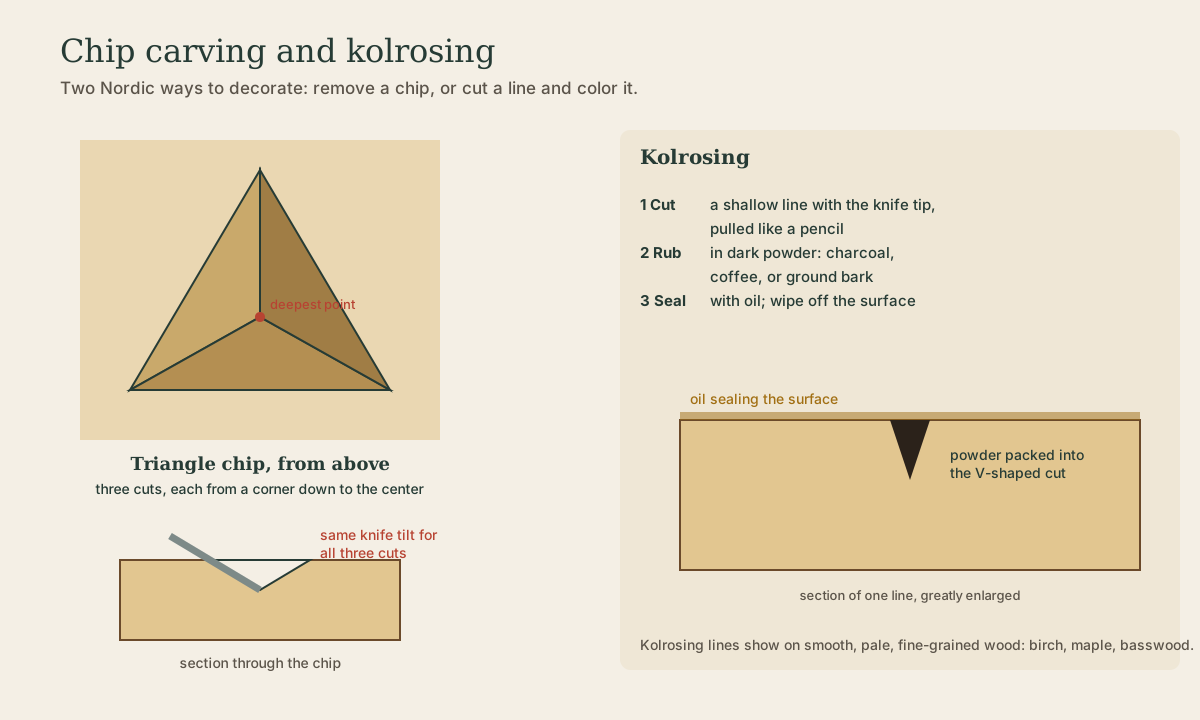
The basic unit: a triangle cut out as a small inverted pyramid.
- Lay out the triangle and mark its center.
- First cut: set the knife tip at the center at full depth and the edge along one side; tilt the blade so the cut slopes from the side down to the center. Slice from corner to corner, shallow at the corners and deepest at the center.
- Second and third cuts: the other two sides, at the same angle.
- The chip pops out. If it doesn’t, the cuts didn’t meet; re-cut the same lines rather than prying.
Habits that make chips clean:
- Lock your hand and wrist, often with the knuckles resting on the surface, so every cut has the same angle and depth.
- Watch the grain: on cuts running with the grain, the wood can split ahead of the knife; cut those last, or cut the cross-grain walls first.
- Sharp knife, stropped often. Chip carving shows every dull edge as a torn wall.
Playback is optional. If the player is unavailable, open the video at its source.
Quick check
Each cut starts shallow at a corner and goes deepest under the center, so the chip pops out as a small pyramid.
Quick check
Consistent angle and depth make walls meet cleanly; a chip that won’t release usually means the cuts didn’t meet.
Beyond triangles
- Straight-wall cuts: one vertical wall and one sloping wall, used for lines and letters.
- Curved cuts and “fingernail” chips: crescent-shaped chips cut with a rolling motion, the building block of curved borders 1.
- Rosettes: a compass circle divided into six by stepping the radius around the edge, then filled with triangles and curved chips - the classic six-petal “hexafoil” seen on Nordic woodenware and doors.
- Borders: rows of triangles, alternating up and down, along an edge.
What to take from this
Chip carving cuts small pyramids out of a surface. Lay out the triangle, make three cuts from the sides down to the center at one consistent angle, and the chip pops out; if it doesn’t, the cuts didn’t meet. Work in fine, even-grained basswood, birch, or alder with a stropped knife and a locked wrist. Triangles, straight walls, and curved chips build up into borders and six-petal rosettes, often combined with paint.
Lesson complete
Nice work.
Sources for this lesson
- 1Jögge Sundqvist. Karvsnitt: Carving, Pattern & Color in the Slöjd Tradition. Lost Art Press. 2023. verifiedTriangle chips, fingernail cuts, lines and letters; tools, wood, finishing, traditional pattern meanings, and 15 projects.
- 2Jögge Sundqvist. Slöjd in Wood. Lost Art Press. 2018. verifiedPublisher excerpt (PDF) of the English translation of the Swedish classic; butter knife, spoons, bowls, sheath, hooks, and painted decoration in the Västerbotten tradition.