Air-Drying Defects and Stain
The defects you'll actually see in an air-drying pile - checks, warp, blue stain, mold, chemical stains, sticker stain, and insects - what causes each, and how to prevent it.
- 5 min
- 8 steps
- 3 questions
- Lesson 11 of 160
In this lesson
- Two opposite dangers
- Cracks from drying too fast
- Warp
- Stain from fungi
- Chemical stains
- Insects
- Weathering
- What to take from this
Picking up where you left off.
Two opposite dangers
Air-drying defects come from drying too fast or too slow. Too fast, and the surface shrinks before the core can, and the wood cracks. Too slow, in warm weather, and fungi, bacteria, and chemical reactions discolor the wood before it dries. Many of the skills in air drying amount to steering between the two for each species: speed for light-colored woods that stain, gentleness for dense woods that check 1.

Cracks from drying too fast
- Surface checks: short cracks on the faces of flatsawn boards, usually along the rays. Caused by fast early drying: sun, hot dry wind, low humidity. Refractory woods such as oak and beech are most vulnerable, especially thick stock in spring. Prevent with a roof, shade cloth, or a shed, and by stacking oak in a sheltered spot.
- End checks and splits: cracks at board ends from fast end-grain drying. Prevent with end coating applied the day the boards are sawn, and stickers flush with the ends.
- Honeycomb: internal cracks, rare in air drying because it’s rarely hot enough; mostly a kiln defect.
Checks that opened early often close up later as stresses reverse, so they may not show until the board is planed.
Warp
Bow, crook, cup, and twist come from the wood itself (grain, reaction wood, juvenile wood) and are amplified by poor stacking. Uneven sticker thickness, misaligned stickers, overhanging ends, a sagging foundation, and unweighted top layers all add warp. Good stacking restrains a lot of it; nothing fixes reaction wood.
Stain from fungi
Blue stain (sap stain) is the most common: bluish-gray to black streaks in the sapwood, caused by fungi that feed on the sugars and starches in sapwood cells 2. Blue-stain fungi don’t decay the wood and barely affect strength, and they don’t grow in heartwood. But they ruin sapwood for clear finishes. They need warmth, moisture above about 20 percent, and slow drying, so they strike in warm, humid, still weather, in piles with poor airflow, in boards that sat before stacking, and under wet stickers. Pine, maple, birch, basswood, and ash sapwood are especially prone.
Mold is surface growth, white, green, or black fuzz, from the same conditions. It brushes or planes off but signals that drying is too slow.
Decay fungi, the ones that actually rot wood, need longer and wetter conditions. Proper air drying gets wood below 20 percent before decay has a chance; if you find soft spots, the lumber sat wet far too long.
Prevention is speed: saw promptly, stack immediately, use dry stickers, maximize airflow (open site, narrow piles, board spacing), and stack light-colored woods first in the season.
Quick check
Blue-stain fungi colonize wet sapwood in warm, humid, still conditions. They don’t weaken the wood, but they discolor it. Fast early drying prevents them.
Chemical stains
Some discolorations come from chemistry inside the wood, not fungi 3:
- Sticker stain (sticker shadow): stripes, darker or lighter, where stickers touched. Common in hard maple, ash, and other light woods. Caused by slow drying under the sticker. Use narrow, dry, heartwood stickers and fast early drying; grooved stickers touch less wood.
- Gray stain and oxidative darkening in maple and other light hardwoods when early drying is too slow or the wood gets too warm while wet.
- Iron stain: blue-black marks where steel touched wet oak or walnut (the tannins react with iron). Keep nails, steel bands, and iron-bearing water away from green oak.
Quick check
Keep iron away from wet tannin-rich woods.
Insects
Fresh logs and lumber attract ambrosia beetles (pinholes with dark stain around them) and other borers. In stored air-dried hardwood, powderpost beetles can work for years, leaving fine flour-like powder and small round exit holes. The FPL manual recommends keeping air-dried lumber away from storage areas for kiln-dried stock and keeping yards free of debris; above 20 percent moisture, stored lumber can support both insects and fungi 3. Heat sterilization, covered in the kiln module, kills insects and eggs.
Weathering
Lumber left uncovered turns gray from sunlight. It’s only skin-deep and planes off, but it signals lumber that’s also been rained on. A roof or shed keeps lumber bright.
What to take from this
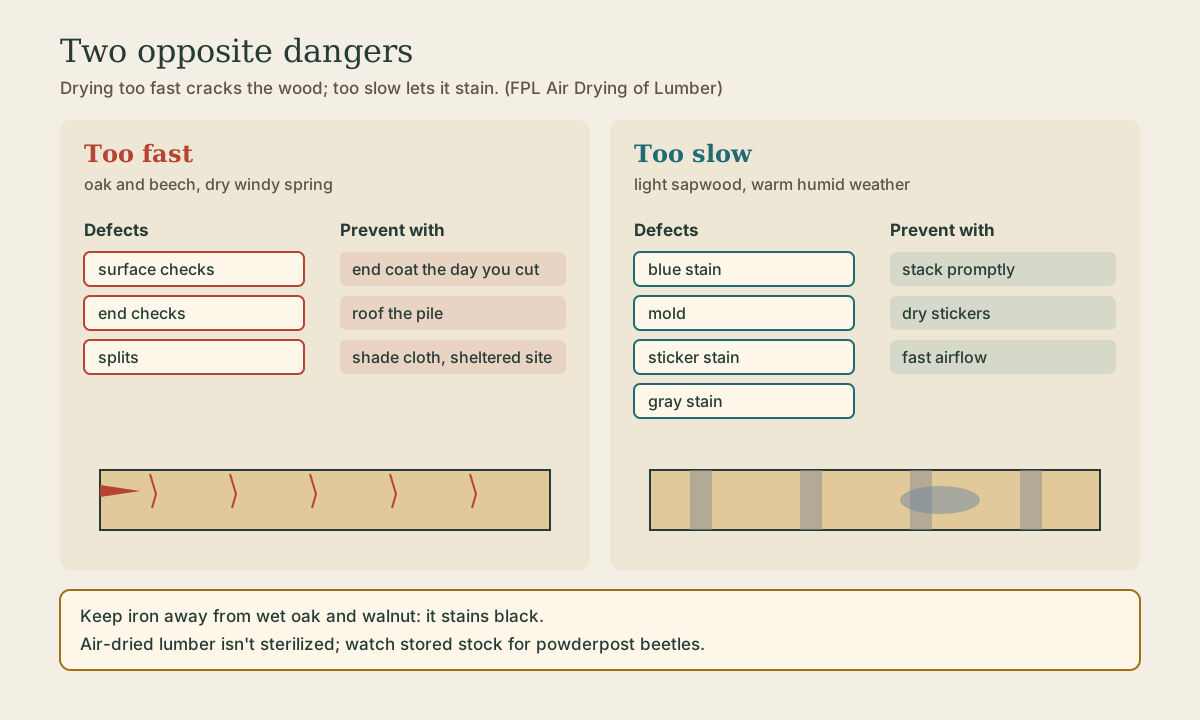
Too-fast drying causes surface checks, end checks, and splits, mainly in oak and beech in dry spring weather; prevent them with end coating, roofs, shade cloth, and sheltered sites. Too-slow drying in warm weather causes blue stain, mold, sticker stain, and gray stain, mainly in light-colored sapwood; prevent them with prompt stacking, dry stickers, and fast airflow. Keep iron away from wet oak and walnut, and watch stored air-dried lumber for powderpost beetles.
Practice
Checks form when the surface dries much faster than the core. Dry, windy spring days and direct sun do that, especially to refractory woods like oak and beech.
Lesson complete
Nice work.
Sources for this lesson
- 1Forest Products Laboratory. Air Drying of Lumber. USDA Forest Service, Forest Products Laboratory, FPL-GTR-117. 1999. verifiedRevision of Rietz and Page (1971). Yard layout, piling and stickering, air-drying times by species and region, and days to dry 1-in. red oak at Madison, WI by stacking month (Table 9). Cited at: Deterioration of Lumber.
- 2Richard Bergman. Drying and Control of Moisture Content and Dimensional Changes (Wood Handbook, Chapter 13). USDA Forest Service, Forest Products Laboratory, FPL-GTR-282. 2021. verifiedOven-dry and meter methods, outdoor EMC by city incl. Madison (Table 13-1), recommended MC (Table 13-2), kiln schedules (Table 13-3), drying defects, and dimensional change coefficients (Table 13-5). Cited at: Discoloration.
- 3Joseph Denig, Eugene M. Wengert, William T. Simpson. Drying Hardwood Lumber. USDA Forest Service, Forest Products Laboratory, FPL-GTR-118. 2000. verifiedPredrying, kiln schedules, safe daily drying rates (Table 8.6), stress testing and conditioning, dehumidification kilns, the semi-greenhouse solar kiln, and storage. Cited at: Discoloration; Storage of Dried Lumber.