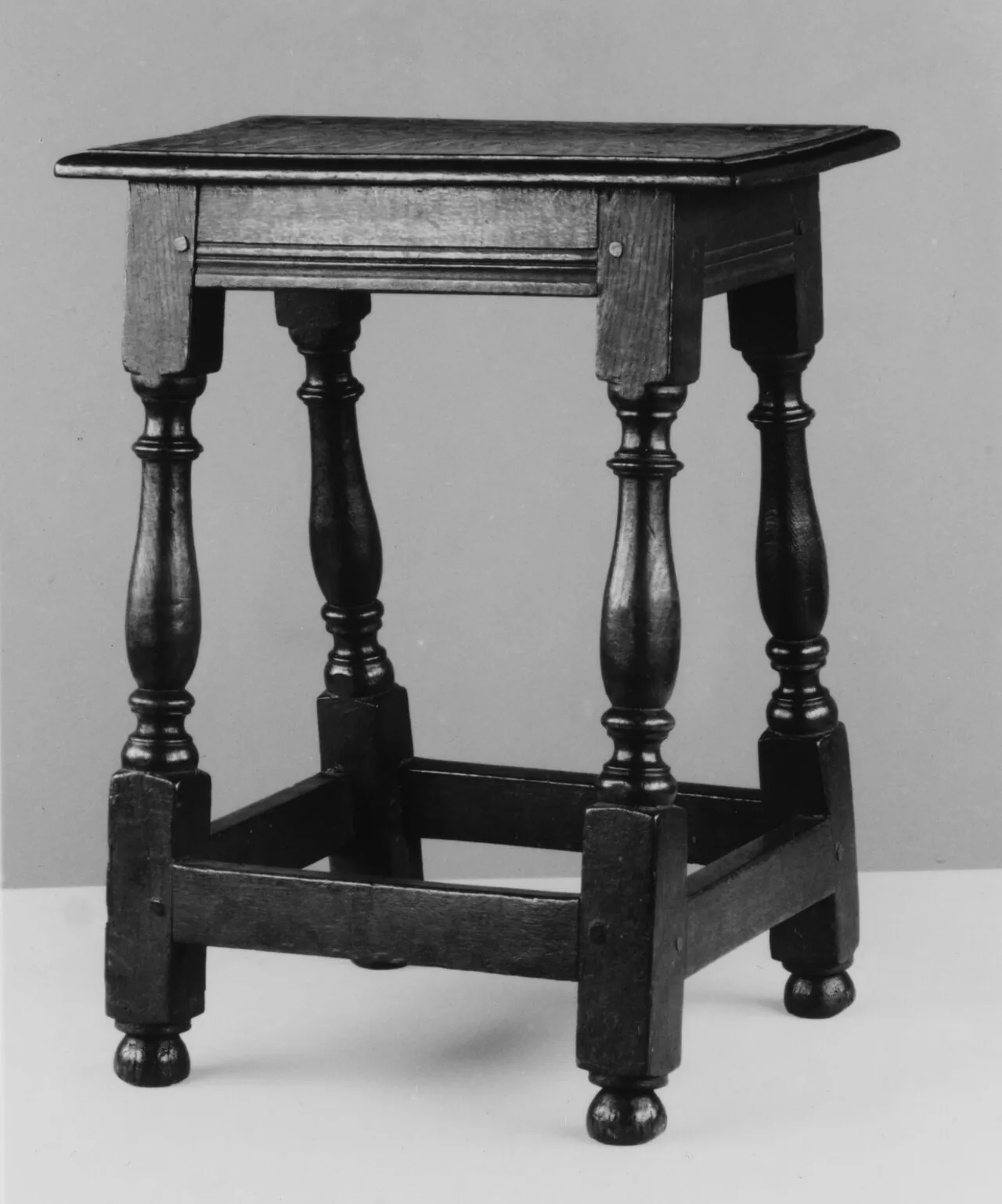
A Joint Stool
The classic 17th-century joined form, built from riven oak: parts and a story stick, mortises chopped by hand, angled shoulders for the splayed legs, turned legs, drawboring without glue, a pegged seat, and a linseed-oil paint finish.
- 4 min
- 8 steps
- 3 questions
- Lesson 53 of 160
In this lesson
- The form
- Stock
- Layout and mortising
- Turning the legs
- Drawboring
- Seat and finish
- Try it
- What to take from this
Picking up where you left off.
The form
A joint stool is the simplest piece of joined furniture: four legs, four aprons under the seat, four stretchers near the floor, and a board seat. Jennie Alexander and Peter Follansbee spent over two decades working out how these were made, from written sources, tool marks on surviving stools, and experiment 1. Theirs starts with riven green oak and ends with paint mixed from pigment and linseed oil 1.

The features 1:
- Riven, not sawn, oak for every frame part.
- Turned legs that splay outward.
- Aprons and stretchers joined to the legs with drawbored mortise and tenon joints and no glue.
- Mouldings on the aprons run with a scratch stock.
- A pegged seat, held to the frame with wooden pins.
They claim a stool built this way will last about 400 years 1, and the survivors bear it out.
Stock
Rive legs, aprons, and stretchers from a straight oak log (see Riven Oak). Hew and plane them square, leaving the legs heavy for turning. Work the frame parts while the oak is still fairly fresh; it chops and pares easily. Make the pins from the driest, straightest offcuts.
Layout and mortising
- Story stick: mark the heights of every mortise on a stick and transfer them to all four legs at once, so the legs match without measuring each one.
- Mortises are chopped with a mortise chisel and mallet, sized to the chisel. In green oak the chisel goes in quickly; lever out chips and work from the middle toward the ends.
- Angled shoulders: because the legs splay, apron and stretcher shoulders are cut at a slight bevel to meet the legs’ faces. Use a bevel gauge set from a full-size drawing.
- Tenons are sawn and pared to fit snugly, with no glue to fill gaps.
Playback is optional. If the player is unavailable, open the video at its source.
Quick check
One stick carries the heights of every mortise, so identical legs come out identical.
Turning the legs
The legs are square where the joints are and turned between them, with beads and coves marking the transitions. A pole lathe handles green oak legs well (see The Pole Lathe in Green Woodworking). Lay out and cut the mortises first while the stock is square, then turn.
Drawboring
Drawboring is what lets the stool skip glue 1:
- Bore through the mortise cheeks.
- Insert the tenon, mark the hole’s center on it, and pull it out.
- Bore the tenon about 1/16 in. closer to the shoulder.
- Reassemble and drive a tapered riven-oak pin. It bends through the offset hole and pulls the shoulder tight against the leg.
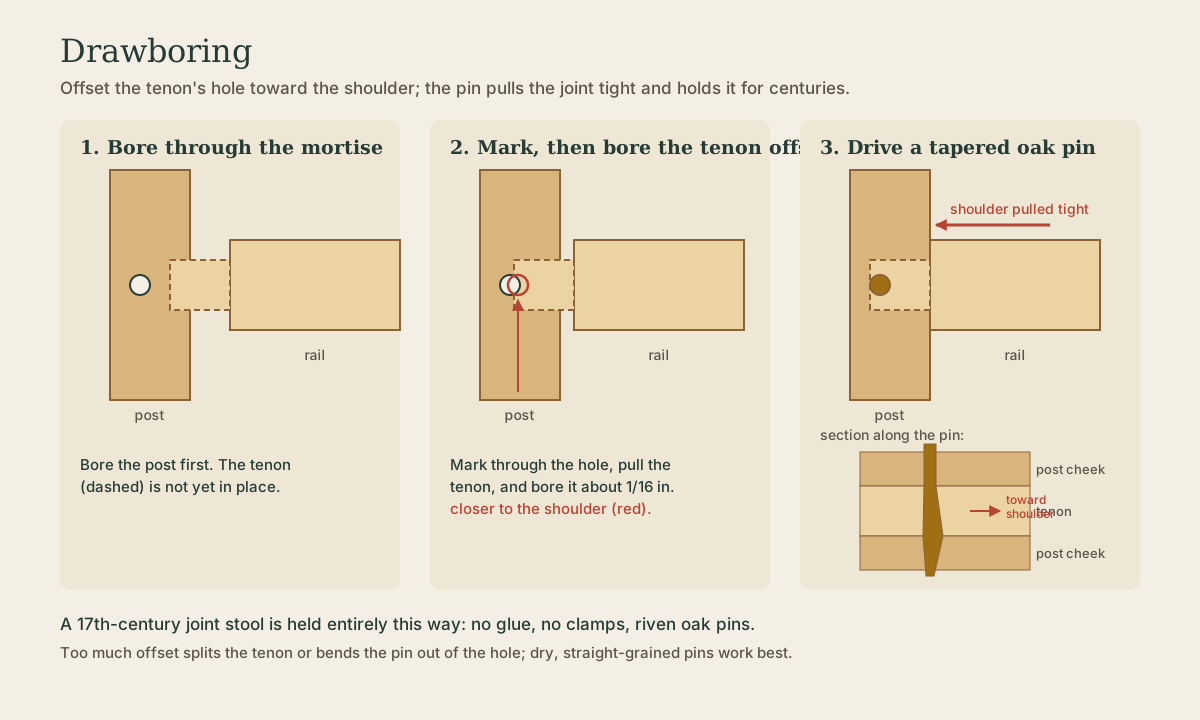
Too much offset can split the tenon or deflect the pin out of the far cheek; too little leaves the joint loose. Riven pins, split and whittled to a taper, are stronger than dowels because their grain runs straight through.
Quick check
The offset pins pull each shoulder tight and keep it there.
Quick check
Pulling the pin through the offset hole draws the shoulder against the post.
Try it
Rive the parts from one oak log. Make a story stick from a full-size end-view drawing, lay out and chop the 16 mortises, cut beveled-shoulder tenons, then drawbore with riven pins and no glue. Rock the finished stool: a tight one won’t rack.
What to take from this
A joint stool is riven oak legs, aprons, and stretchers joined by drawbored mortise and tenon joints with no glue, a pegged board seat, scratch-stock mouldings, and linseed oil paint. Lay out with a story stick, chop mortises while the oak is green, angle the shoulders to the splay, and offset each tenon’s hole about 1/16 in. toward the shoulder.
Lesson complete
Nice work.
Sources for this lesson
- 1Jennie Alexander, Peter Follansbee. Make a Joint Stool from a Tree: An Introduction to 17th-Century Joinery. Lost Art Press. 2012. verifiedRiven (not sawn) oak, turned and angled legs, drawbored mortise and tenon joints without glue, pegged seat, scratch-stock mouldings, pigment and linseed oil paint; over two decades of research from written sources, tool marks, and experiment.
Further reading
- Peter Follansbee. Joiner's Work. Lost Art Press. 2019. verifiedNew England oak joinery from about 1620-1630 to the late 17th century, when joiners' riven oak work gave way to cabinetmakers' sawn maple, pine, and later mahogany; frame-and-panel, carving, carved boxes, joined chests; 1633 Plymouth probate inventories of tools.