Finishing the Job Indoors
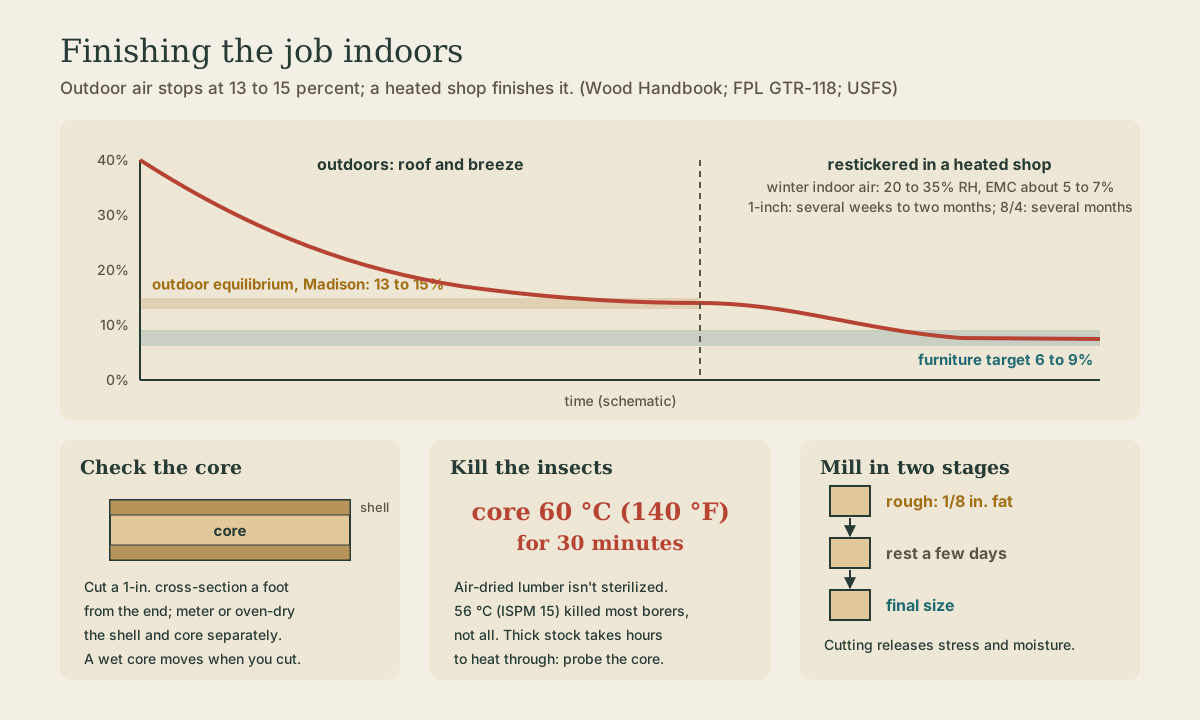
Getting air-dried lumber from 13 to 15 percent down to the 6 to 9 percent of a heated house - restickering indoors, checking the core, killing insects, milling in two stages, and storing it right.
- 5 min
- 7 steps
- 3 questions
- Lesson 12 of 160
In this lesson
- Why outdoor drying stops short
- Let the house finish it
- Check the core, not just the surface
- Insects: air-dried lumber isn’t sterilized
- Mill in two stages
- Store it right
- What to take from this
Picking up where you left off.
Why outdoor drying stops short
A roof and a breeze will take lumber from green to about 20 percent, then slowly toward the outdoor equilibrium of 13 to 15 percent in Madison. They can’t go lower: that’s what the outdoor air is in balance with 1. Furniture and interior woodwork need an average of about 8 percent, with pieces between 6 and 10 1. Build with 14-percent lumber in a heated house and it will shrink after it’s built, opening joints, loosening tenons, and cracking glued-up panels.
Let the house finish it
The simplest kiln in Wisconsin is a heated building in winter. Heated indoor air there often runs 20 to 35 percent RH, an EMC of about 5 to 7 percent. Restickered lumber in a heated shop or basement keeps drying toward that.
How to do it:
- Sticker it again indoors, with the same care as outdoors: level supports, aligned stickers, weight on top. Don’t solid-stack lumber that’s still drying; the faces in contact can’t dry, and you get mold and uneven moisture.
- Give it time. One-inch lumber usually settles over several weeks to a couple of months; 8/4 needs several months. A small fan moving air through the stack speeds it up.
- Don’t overshoot. A dry, hot shop in February can take thin stock below 6 percent. That’s not a disaster, it will regain moisture in summer, but very dry wood is brittle and its joints get fit at an unusually small size.
- Check it with a meter, at a quarter of the board’s thickness, on several boards and away from the ends (the measuring module has the details). The goal is the same moisture through the thickness, around 6 to 9 percent.
A dehumidifier in a closed room with the lumber stickered and a fan running is a step up, and the same idea as a dehumidification kiln at lower temperature.
Quick check
Outdoor air can’t take it below about 13 to 15 percent. Heated indoor air in a Wisconsin winter has an EMC around 5 to 7 percent, so the wood keeps drying when stickered inside.
Check the core, not just the surface
After indoor drying, the surface is often several points drier than the core. Saw a cross-section an inch long from a few boards, a foot or more from the end, and measure the center versus the outer quarter. Or split that section into a shell strip and a core strip and dry them separately in an oven (the oven-dry method in the measuring module). A board with a wet core will move as you cut into it.
Insects: air-dried lumber isn’t sterilized
Kiln-dried lumber leaves the kiln sterilized: the FPL hardwood manual states that kiln drying above 130 °F kills insects and their eggs 2. Air-dried lumber has had no such treatment, and powderpost beetles can emerge from it years later inside your shop or your furniture.
The international standard for heat-treating wood packaging (ISPM 15) requires holding the core of the wood at 56 °C (133 °F) for 30 minutes. A USDA Forest Service study found that schedule killed most but not all wood borers; holding the core at 60 °C (140 °F) for 30 minutes killed all of them 3. The key word is core: thick stock takes hours to heat through. Options for a small shop:
- Pay a commercial kiln to run a sterilization cycle.
- Use a solar or dehumidification kiln that reaches 140 °F and hold it there until the core of the thickest piece gets there (a probe thermometer in a drilled hole tells you).
- Inspect regularly. Fresh, light-colored powder below small round holes means active beetles.
Mill in two stages
Even well-dried lumber holds some stress and a slight moisture gradient. Cutting into it releases both, so boards can bow or cup as you work. The standard practice:
- Rough mill: crosscut and rip parts oversize, joint and plane them about 1/8 inch fat.
- Let them rest stickered for a few days, so released stress and newly exposed wetter wood can settle.
- Final mill to exact size.
This is especially important for lumber dried quickly or dried indoors in a short time.
Store it right
Store dried lumber where the humidity matches its future use: a heated, dry space. Lumber at 7 percent stored in a damp unheated barn climbs back toward 12 to 15 percent within months. Keep dried stock separate from green or air-dried stock and from debris that can harbor insects 2. Stand or rack it so it can’t sag, and solid-stack it only once it’s fully dry.
What to take from this
Outdoor air stops at 13 to 15 percent; a heated Wisconsin shop in winter, with the lumber restickered and checked by meter at quarter-thickness, carries it to 6 to 9 percent in weeks to months. Air-dried lumber isn’t sterilized: insects die only when the core holds 60 °C (140 °F) for 30 minutes. Mill in two stages, and store dried lumber in heated, dry space.
Practice
At the ISPM 15 standard of 56 °C for 30 minutes most borers died but some survived; at 60 °C for 30 minutes none did.
Practice
Cutting opens the board and releases stress and moisture gradients. Rough parts that rest a few days and are then milled to final size stay straight.
Lesson complete
Nice work.
Sources for this lesson
- 1Richard Bergman. Drying and Control of Moisture Content and Dimensional Changes (Wood Handbook, Chapter 13). USDA Forest Service, Forest Products Laboratory, FPL-GTR-282. 2021. verifiedOven-dry and meter methods, outdoor EMC by city incl. Madison (Table 13-1), recommended MC (Table 13-2), kiln schedules (Table 13-3), drying defects, and dimensional change coefficients (Table 13-5). Cited at: Table 13-1; Table 13-2.
- 2Joseph Denig, Eugene M. Wengert, William T. Simpson. Drying Hardwood Lumber. USDA Forest Service, Forest Products Laboratory, FPL-GTR-118. 2000. verifiedPredrying, kiln schedules, safe daily drying rates (Table 8.6), stress testing and conditioning, dehumidification kilns, the semi-greenhouse solar kiln, and storage. Cited at: Storage of Dried Lumber.
- 3Heat Treatment Kills Most, but Not All, Wood Borers in Wood Packaging Material. USDA Forest Service, Northern Research Station. verifiedAt a 56 °C (133 °F) core for 30 minutes most borers died but some survived; at 60 °C (140 °F) for 30 minutes none survived.