The Chairmaker's Resource Atlas
Building a plan room: telling sources apart by authority, why citation isn't permission, a complete guided build, public-domain plans from Project Gutenberg, licensed CNC files, museum records for reverse-engineering, the technical shelf, and a project packet.
- 8 min
- 8 steps
- 3 questions
- Lesson 142 of 160
In this lesson
- Citation is not permission
- Route 1: a complete guided build
- Route 2: public-domain historical plans
- Route 3: licensed CNC projects
- Route 4: museum reverse-engineering
- The technical shelf
- Assemble the project packet
Open alongside this lesson
-
Build a Chair from Bulls%$t (opens in a new tab)
Publisher-hosted book, full-size patterns, and a companion official video series.
-
Full-Scale Drawings and PDF: How to Make a democratic Side Chair (opens in a new tab)
Current maker-hosted plan listing for the Democratic Side Chair.
-
Mission Furniture: How to Make It, Part I (opens in a new tab)
Measured period projects that still require modern material, process, and test review.
-
Campeche Chair (opens in a new tab)
Thirteen views and an overall envelope; evidence for study, not a controlling shop plan.
-
SketchChair (opens in a new tab)
Sketch, simulate, nest, and export prototypes; software output is not structural certification.
-
Wood Handbook, Chapter 4: Moisture Relations and Physical Properties of Wood (opens in a new tab)
Official wood-moisture, shrinkage, and swelling data for informed stock decisions.
Picking up where you left off.
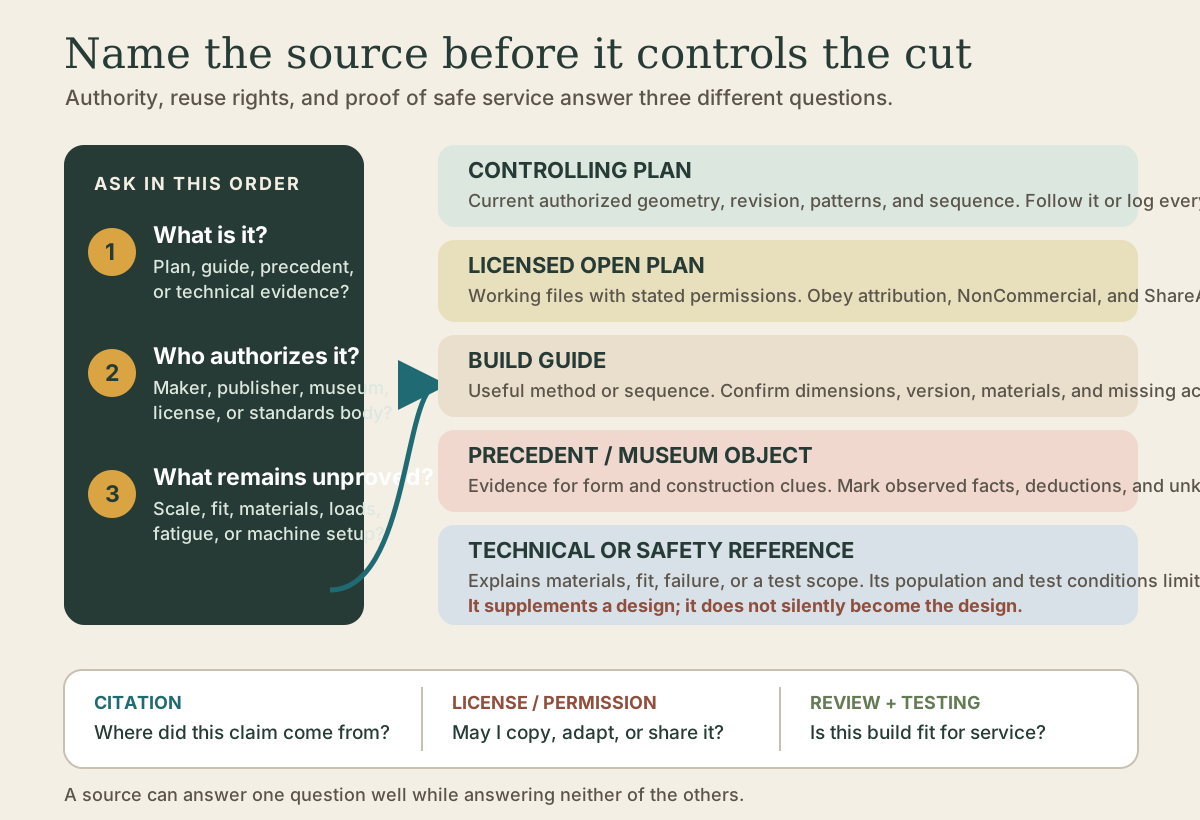
A shelf full of links is not yet a plan room. A chair photograph, a free PDF, a museum scan, a maker’s video, and a test standard can all be excellent sources, but they do not carry the same authority. The first job is to decide what each source is allowed to control.
Use five labels:
- Controlling plan: the current authorized drawings, patterns, dimensions, and sequence for the chair being built.
- Licensed open plan: working files that may be copied or adapted under stated conditions.
- Build guide: useful process instruction that may omit dimensions, revisions, or acceptance criteria.
- Inspiration or precedent: an object, photograph, historical drawing, or study that supports observation and clearly labeled inference.
- Technical or safety reference: evidence about fit, material behavior, joints, failures, or the scope of a test method.
Write the label beside every source in the project packet. If two sources disagree, the label tells you which one controls and which one merely raises a question.
Citation is not permission
A citation answers where a claim or image came from. It does not by itself grant permission to copy a drawing, republish a PDF, extract a video, or make a derivative work. A source can be free to view while remaining fully copyrighted. Conversely, a public-domain drawing may be legally reusable while still being technically unsuitable for an unsupervised modern build.
Record five things separately: exact URL, creator or institution, access date, stated rights or license, and any changes you make. “Public Domain,” “CC0,” and a named Creative Commons license are meaningful rights statements. “Free download,” “open source,” and “found online” are not substitutes for the actual terms. A private learning app reduces publication exposure, but it does not turn copyrighted material into public-domain material.
For copyrighted plans offered free by their publisher, link to the authorized download and keep the working copy in the shop packet; do not upload the complete file as if it were course-owned. Embed official videos rather than copying them. For museum material, check the rights statement on the individual object or asset, not just the institution’s general reputation.
Quick check
Record the actual rights statement. Public Domain, CC0, or a named Creative Commons license mean something; ‘free’ doesn’t.
Route 1: a complete guided build
The clearest warm-up remains Lost Art Press’s Build a Chair from Bulls%$t. Its publisher page supplies a free PDF and full-size patterns, while the official twelve-video index follows the build 1 2. Treat the downloaded book as the controlling plan. The videos demonstrate operations; they do not authorize redistributing the book or extracted footage.
For a deeper stick-chair path, The Stick Chair Book is also available as a complete publisher-hosted PDF 3. Keep its revision and patterns together. Mixing a leg sightline from one chair with an arm pattern from another creates an undocumented new design.
The green-wood capstones have similarly clear authorities. Curtis Buchanan’s free Democratic side-chair series is a twenty-part maker-hosted build path, and his store page identifies the current full-scale and digital plan options 4 5. For the post-and-rung ladderback, Jennie Alexander’s Make a Chair from a Tree controls the moisture system, growth-ring orientation, jigs, dimensions, and sequence 6. A purchased book is actionable access, not permission to reproduce its plan pages here.
Route 2: public-domain historical plans
Project Gutenberg’s illustrated Mission Furniture: How to Make It, Part I contains stock lists, measured drawings, and sequences for several chairs 7. In the United States, the text is public domain, so drawings can be excerpted and adapted with a clear credit and modification note.
That legal freedom does not modernize the engineering. Translate historical lumber sizes into actual stock, replace obsolete glue and finish advice, inspect joint proportions, make a full-size mockup, and establish a contemporary test plan. Label the result historical interpretation, not a certified reproduction.
Albert H. Good’s 1938 National Park Service furniture chapter adds eight public-domain plates of rustic precedents 8. It is valuable for material language and plan-reading, but predates current accessibility expectations and seating-test practice.
Quick check
Public-domain historical plans can be copied and adapted freely; free-to-view modern plans often can’t.
Route 3: licensed CNC projects
Open files make excellent tolerance laboratories because every assumption becomes a slot, toolpath, or sheet-thickness decision.
- Better Block’s Blue Bonnet Chair is a free one-sheet CNC design under CC BY-NC-SA 4.0 9. Credit the source, keep use noncommercial, and apply ShareAlike when distributing an adaptation.
- The Fishbone Chair provides SVG and DXF files under CC BY-NC 10. Its reported household use is not an independently established load rating.
- Open Works Baltimore’s Makers Unite desk and stool supplies free DXF/PDF files and instructions under CC BY-NC-SA 4.0 11. Open Works explicitly warns that its feeds, speeds, bits, and results were developed on one machine.
- SketchChair is GPL-3.0 software for sketching, figure-based simulation, nesting, and digital-fabrication output 12. The software can expose a bad silhouette quickly; it cannot certify a generated chair.
For any CNC route, cut a slot-and-tab coupon in the actual sheet before nesting a chair. Record measured thickness, bit diameter, dogbone choice, fit correction, sheet face, and file version. Build cardboard or inexpensive-sheet prototypes before service furniture.
Quick check
Open files assume a machine and sheet; your sheet thickness and bit decide the fit.
Route 4: museum reverse-engineering
The Met’s Shaker side chair offers four public-domain views and overall dimensions 13. Use it to annotate post continuity, rung levels, slat arrangement, and woven-seat boundaries. Do not fill unknown joint sizes with confident-looking numbers.
The Met’s Campeche Chair is richer: thirteen public-domain views show the frame and leather sling 14. Pair them with the museum’s construction study, which identifies mortise-and-tenon, half-lap, sliding-dovetail, wedged-stretcher, and sling details 15. The object images are marked Public Domain; the free journal PDF does not state a Creative Commons license for wholesale reuse of its figures.
For spatial inspection, Cooper Hewitt’s downloadable Side Chair 3D model is marked CC0 16. Orbit and section it, but verify scale and remember that a surface scan may conceal joinery. In the drawing set, use three line styles: solid for observed facts, dashed for supported deductions, and dotted for unresolved guesses.
The technical shelf
Fit starts with a population, not a magic average. NASA’s anthropometry handbook explains why a “5th-percentile person” is a fiction, why percentiles cannot be stacked, and why adjustment or multiple sizes may accommodate users better 17. OSHA’s chair purchasing guide provides useful office-chair fit checks, but those ranges should not silently become dining- or lounge-chair dimensions 18. Measure the intended sitter, mock up the contact points, and record the task.
For wood, use the Forest Products Laboratory’s chapter on moisture relations to calculate shrinkage and identify moisture assumptions 19. Its bending chapter covers stock selection, plasticizing, bending, and fixing a curve 20. A CC BY 4.0 furniture-joint experiment can support an original diagram of fit, shoulders, glue, and load, but its tested beech and connector setup does not yield a universal chair rating 21.
Failure reports prevent tidy drawings from hiding real hazards. A CPSC director’s-chair recall documents dowel, fabric, upright, armrest, and frame failures 22. Turn those facts into your own load-path and inspection diagram; do not assume the page’s manufacturer photographs share the federal text’s reuse status.
Finally, standards define categories and protocols. BIFMA’s overview identifies structural-strength and durability testing for general-purpose office chairs 23. The full standard is paid and copyrighted, and its category may not match the chair in front of you. Its office-chair tests don’t transfer directly to a stool or a rocker.
Assemble the project packet
Before buying lumber, save or print:
- one source register with classification, rights, version, and access date;
- one clearly named controlling plan, or an explicit statement that none exists;
- a dimension sheet separating published values from inferences;
- material, moisture, grain, and machine assumptions;
- mockup and coupon results;
- a decision log for every departure; and
- an inspection and test plan whose scope is honest.
That packet is the difference between collecting inspiration and building from evidence. More links help only when each link has a defined job.
Lesson complete
Nice work.
Sources for this lesson
- 1Christopher Schwarz. Build a Chair from Bulls%$t. Lost Art Press. 2025. verifiedPublisher page for the book, free PDF, and full-size chair patterns. Cited at: publisher download and full-size patterns.
- 2The Free Video Series of 'Build a Chair from Bulls%$t'. Lost Art Press. 2025. verifiedPublisher index to the twelve official build videos. Cited at: official video index.
- 3Christopher Schwarz. The Stick Chair Book. 2nd revised ed. Lost Art Press. verifiedPublisher page with the complete book available as a free PDF. Cited at: publisher page and free PDF.
- 4Video series: How to make a democratic side chair. Curtis Buchanan Chairmaker. verifiedMaker's official index to the 20-part free build series and current plan options. Cited at: official series index.
- 5Full-Scale Drawings and PDF: How to Make a democratic Side Chair. Curtis Buchanan Chairmaker. verifiedMaker's current store listing for the controlling full-scale drawings and free digital plan download. Cited at: current plan listing.
- 6Jennie Alexander. Make a Chair from a Tree: Third Edition. Lost Art Press. 2021. verifiedPublisher contents and excerpts for post-and-rung construction, moisture management, bending, assembly, and hickory-bark seating. Cited at: third-edition contents.
- 7H. H. Windsor. Mission Furniture: How to Make It, Part I. Project Gutenberg. 1912. verifiedIllustrated public-domain-in-the-USA text with measured drawings, stock lists, and construction sequences for several chairs. Historical methods, finishes, and safety assumptions require modern review. Cited at: chair projects and measured plates.
- 8Albert H. Good. Park and Recreation Structures, Part III: Furniture and Furnishings. National Park Service. 1938. verifiedPublic-domain U.S. government publication with eight plates of rustic furniture precedents. It is a historical design source, not a current accessibility or seating-load standard. Cited at: Part III, plates G-1 through G-8.
- 9Blue Bonnet Chair. The Better Block. verifiedFree CNC files for one double-thick chair from a 3/4-inch 4-by-8-foot plywood sheet, licensed CC BY-NC-SA 4.0. Better Block testing is not ANSI/BIFMA certification. Cited at: files, sheet specification, and license.
- 10Oisin Carroll. Fishbone Chair: Free Plans. im_oisin. 2021. verifiedFree SVG and DXF files for a one-sheet slotted CNC chair, licensed CC BY-NC. The maker reports personal use, not an independently verified load rating. Cited at: download and license.
- 11Makers Unite Desk and Stool Downloadable Plans. Open Works Baltimore. verifiedFree DXF/PDF cut files, instructions, and tutorial for a flat-pack desk-and-stool set under CC BY-NC-SA 4.0. Published feeds, speeds, and tooling were proved on one named CNC machine only. Cited at: plan contents, license, and machine caveat.
- 12Diatom Studio. SketchChair. GitHub. verifiedGPL-3.0 design software for sketching, figure-based simulation, part nesting, and DXF/G-code/PDF output. The software license does not certify generated chairs or automatically set the license of every shared design. Cited at: README and GPL-3.0 license.
- 13Side Chair, Shaker, 1840-1860. The Metropolitan Museum of Art. verifiedPublic Domain object record with four downloadable views, material, accession number 66.10.5, and overall dimensions. Those dimensions do not constitute a shop plan. Cited at: object 66.10.5.
- 14Campeche Chair. The Metropolitan Museum of Art. verifiedPublic Domain object record with thirteen downloadable views, materials, accession number 2000.451, and overall dimensions; useful for observation and reverse-engineering study, not a controlling plan. Cited at: object 2000.451.
- 15A Campeche Chair in The Metropolitan Museum of Art. The Metropolitan Museum Journal. 2003. verifiedScholarly construction analysis covering mortise-and-tenon, half-lap, sliding-dovetail, wedged-stretcher, and leather-sling details. Free access does not establish a Creative Commons license for the article or its figures. Cited at: construction analysis.
- 16Side Chair 3D Model. Cooper Hewitt, Smithsonian Design Museum. verifiedDownloadable Smithsonian Open Access 3D model marked CC0. Treat scan geometry as collection documentation and verify scale and construction before deriving any fabrication dimensions. Cited at: rights and downloadable model.
- 17Anthropometry, Biomechanics, and Strength. Revision A ed. National Aeronautics and Space Administration. 2023. verifiedOfficial handbook explaining representative populations, invalid percentile stacking, multivariate accommodation, adjustment, multiple sizes, and human-in-the-loop testing. Use the method, not astronaut dimensions, for civilian chairs. Cited at: sections 2.0-3.4.
- 18Computer Workstations Purchasing Guide - Chairs. Occupational Safety and Health Administration. verifiedOfficial office-workstation chair fit and adjustability criteria. The ranges are task-specific guidance, not universal dining, lounge, or one-off chair dimensions. Cited at: chair criteria 4-18.
- 19Wood Handbook, Chapter 4: Moisture Relations and Physical Properties of Wood. USDA Forest Service, Forest Products Laboratory. 2021. verifiedPublic U.S. government chapter on hygroscopicity, equilibrium moisture content, fiber saturation, shrinkage, swelling, and species data. Cited at: equilibrium moisture content and dimensional change.
- 20Wood Handbook, Chapter 19: Specialty Treatments. USDA Forest Service, Forest Products Laboratory. 2021. verifiedPublic U.S. government chapter covering plasticizing and bending wood, stock selection, the bending operation, and fixing the bend. Cited at: wood-bending section.
- 21Mechanical Properties of Furniture Joints Using Loose Tenons and Connectors. Forests. 2024. verifiedCC BY 4.0 experimental study of joint geometry, fit, shoulders, adhesive, and load. Its beech, Domino, connector, adhesive, and specimen results are test-specific rather than universal chair ratings. Cited at: methods and table 3.
- 22L.L.Bean Director's Chairs Recall. U.S. Consumer Product Safety Commission. 2005. verifiedFederal failure case describing undersized or broken dowels, torn fabric, and frame breakage. Use the factual report for an original failure diagram; page photographs may carry separate rights. Cited at: hazard and incident summary.
- 23ANSI/BIFMA X5.1-2017(R2022): General-Purpose Office Chairs — Tests. Business and Institutional Furniture Manufacturers Association. verifiedOfficial scope summary for structural strength and durability testing of general-purpose seating. Cited at: standard scope.