Equilibrium Moisture Content: Wood Follows the Air
Wood trades moisture with the air until it balances at an equilibrium set mostly by relative humidity; in Wisconsin that means about 13 to 15 percent outdoors and 6 to 9 percent in a heated house.
- 5 min
- 6 steps
- 3 questions
- Lesson 2 of 160
In this lesson
- Wood is always trading water with the air
- Humidity sets the balance
- Wisconsin outdoors: 13 to 15 percent
- Wisconsin indoors: winter swings it low
- How fast wood catches up
- What to take from this
Picking up where you left off.
Wood is always trading water with the air
Wood is hygroscopic: it takes up water vapor from moist air and gives it up to dry air. Below fiber saturation, a piece of wood keeps exchanging bound water with the air around it until the two are in balance. The moisture content where that balance lands is the equilibrium moisture content (EMC) 1. Leave a board in one place long enough and it ends up at that place’s EMC, no matter how wet or dry it started.
This is why drying is never “done.” Kiln-dried wood stored in a damp barn picks moisture back up; a tabletop shrinks every January and swells every August.
Humidity sets the balance
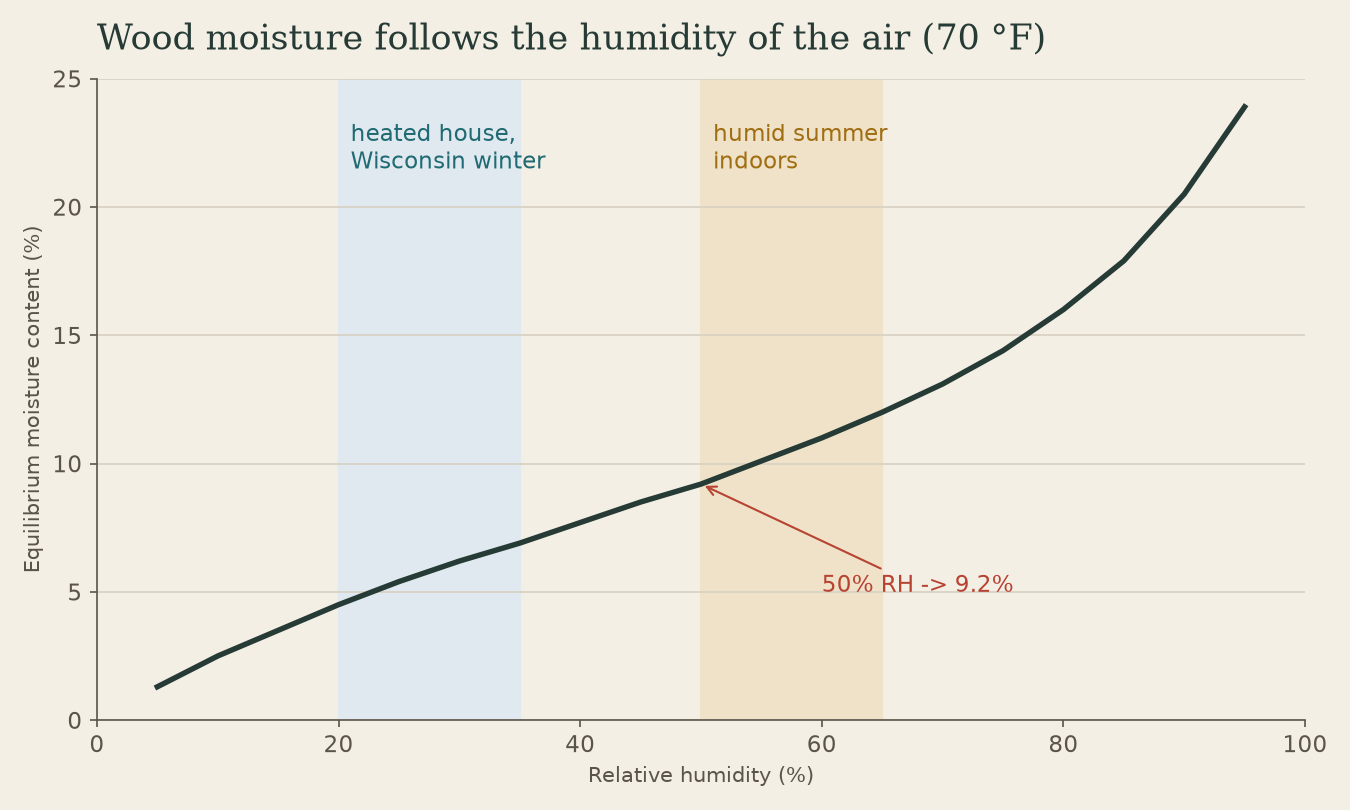
EMC depends on two things: relative humidity (RH) and temperature. Relative humidity matters far more. At 70 °F, the Wood Handbook gives 1:
| Relative humidity | EMC at 70 °F |
|---|---|
| 20% | 4.5% |
| 30% | 6.2% |
| 40% | 7.7% |
| 50% | 9.2% |
| 65% | 12.0% |
| 80% | 16.0% |
| 90% | 20.5% |
Temperature shifts these values only a little at room conditions: at 50 percent RH, wood settles at 9.5 percent at 40 °F and 9.1 percent at 80 °F. Temperature matters much more at kiln temperatures, which is why kilns can push EMC very low.
The handbook is blunt that the decimal place in its table is for showing trends only. Real wood varies by a percentage point or more from these values depending on species, extractives, and history. Wood also lands slightly lower when it is picking up moisture than when it is losing it, an effect called hysteresis. Treat the table as a very good guide, not a law.
Quick check
The Wood Handbook’s table gives 9.2 percent at 70 °F and 50 percent RH. RH, not temperature, does most of the work.
Wisconsin outdoors: 13 to 15 percent
The Forest Products Laboratory, which happens to be in Madison, publishes average outdoor EMC by month for U.S. cities from decades of weather records. For Madison 2:
| Jan | Feb | Mar | Apr | May | Jun | Jul | Aug | Sep | Oct | Nov | Dec |
|---|---|---|---|---|---|---|---|---|---|---|---|
| 14.4 | 14.3 | 13.8 | 12.8 | 12.6 | 12.9 | 13.2 | 14.1 | 14.3 | 13.8 | 14.6 | 15.4 |
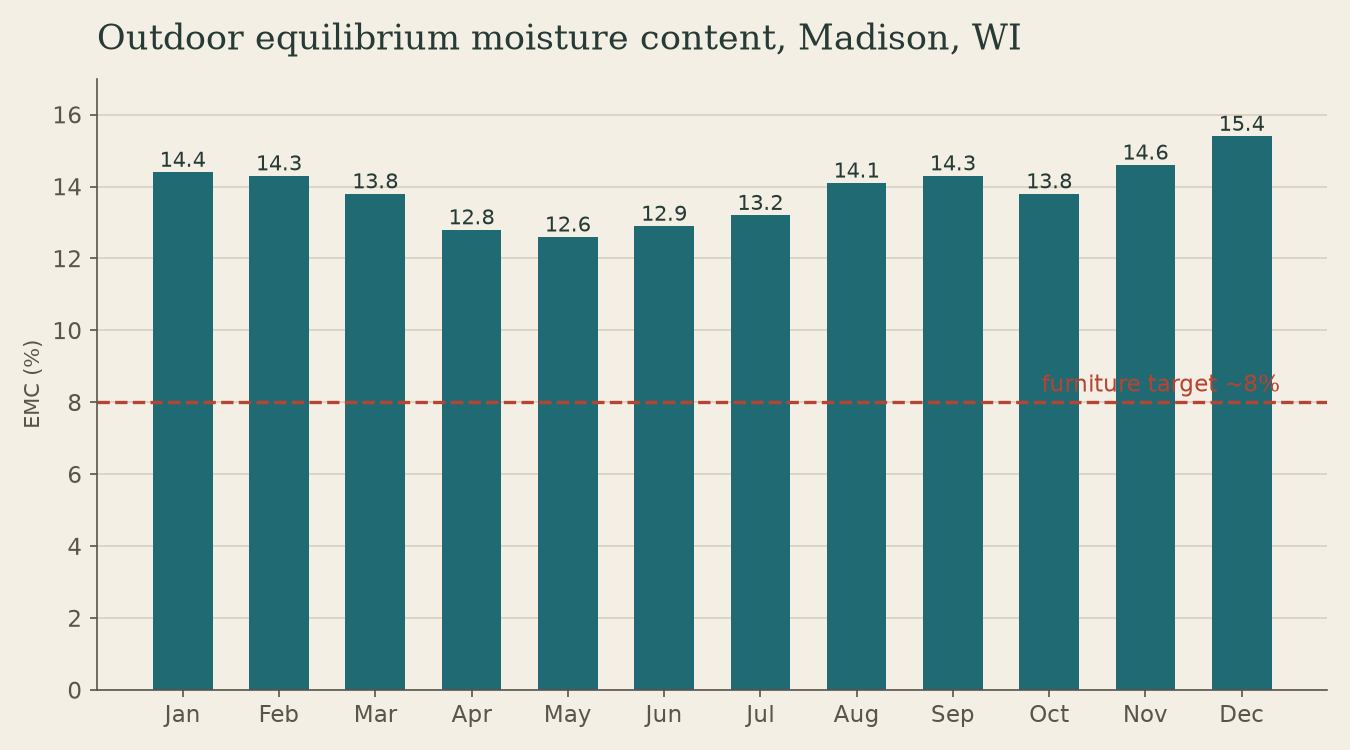
Two consequences follow directly. First, lumber air-drying outdoors in Wisconsin, even under a good roof, bottoms out around 13 to 15 percent; thoroughly air-dried lumber in most of the country reaches 12 to 15 percent and no lower 2. Second, it is driest in late spring, not summer: May and June bring warm, breezy, comparatively dry air, which is also when drying goes fastest.
Wisconsin indoors: winter swings it low
Inside, the story is about heating. Cold winter air holds very little water; heat it to 70 °F and its relative humidity collapses. A heated Wisconsin house without a humidifier often runs 20 to 35 percent RH from December to March, which puts wood at about 4.5 to 7 percent. In a humid July without air conditioning, indoor RH of 55 to 65 percent puts wood at 10 to 12 percent.
That annual swing of around five points is the moisture change you design furniture and floors around. It is also why the Forest Products Laboratory recommends drying interior wood to an average of 8 percent for most of the country: it sits near the middle of the indoor range, so the wood moves both ways around the size you built it at 2.
How fast wood catches up
Wood reaches equilibrium from the outside in. Veneer and thin stock follow the air within days. A 1-inch board takes weeks to settle through its thickness; an 8/4 board, months. Finishes slow the exchange but do not stop it: every practical finish lets some water vapor through, so a finished tabletop still moves with the seasons, just more slowly and with smaller swings from short humid spells. Finishing all faces equally, including the underside, keeps the two faces gaining and losing moisture at the same rate, which prevents cupping.
What to take from this
Wood always drifts toward the equilibrium moisture content of the air around it, and relative humidity sets that equilibrium. Outdoors in Madison it is 12.6 to 15.4 percent depending on the month, so air drying alone can’t produce furniture wood. Indoors, Wisconsin heating seasons pull wood down to about 5 to 7 percent and humid summers push it up to 10 to 12, which is the movement every piece built here has to accommodate.
Practice
Madison’s outdoor EMC runs from 12.6 percent in May to 15.4 percent in December. To reach 6 to 9 percent, wood has to finish drying in heated indoor air or a kiln.
Practice
No practical finish is a perfect vapor barrier. It slows the swings, which reduces how far the wood moves over a short humid spell, but seasonal movement still happens.
Lesson complete
Nice work.
Sources for this lesson
- 1Samuel V. Glass, Samuel L. Zelinka. Moisture Relations and Physical Properties of Wood (Wood Handbook, Chapter 4). USDA Forest Service, Forest Products Laboratory, FPL-GTR-282. 2021. verifiedFree and bound water, fiber saturation (~30%), EMC table (Table 4-2), green moisture by species (Table 4-1), shrinkage by species (Table 4-3), and the shrinkage equation. Cited at: Moisture Relations; Table 4-2.
- 2Richard Bergman. Drying and Control of Moisture Content and Dimensional Changes (Wood Handbook, Chapter 13). USDA Forest Service, Forest Products Laboratory, FPL-GTR-282. 2021. verifiedOven-dry and meter methods, outdoor EMC by city incl. Madison (Table 13-1), recommended MC (Table 13-2), kiln schedules (Table 13-3), drying defects, and dimensional change coefficients (Table 13-5). Cited at: Table 13-1; Air Dry; Table 13-2.
Further reading
- Forest Products Laboratory. Air Drying of Lumber. USDA Forest Service, Forest Products Laboratory, FPL-GTR-117. 1999. verifiedRevision of Rietz and Page (1971). Yard layout, piling and stickering, air-drying times by species and region, and days to dry 1-in. red oak at Madison, WI by stacking month (Table 9).