Cookies, Slabs, and Timbers
Why tree cookies almost always crack, why big slabs take years and still move, and why timber frames are cut green on purpose.
- 5 min
- 4 steps
- 3 questions
- Lesson 22 of 160
In this lesson
- Why cookies crack
- Slabs
- Timbers: framed green
- What to take from this
Picking up where you left off.
Why cookies crack
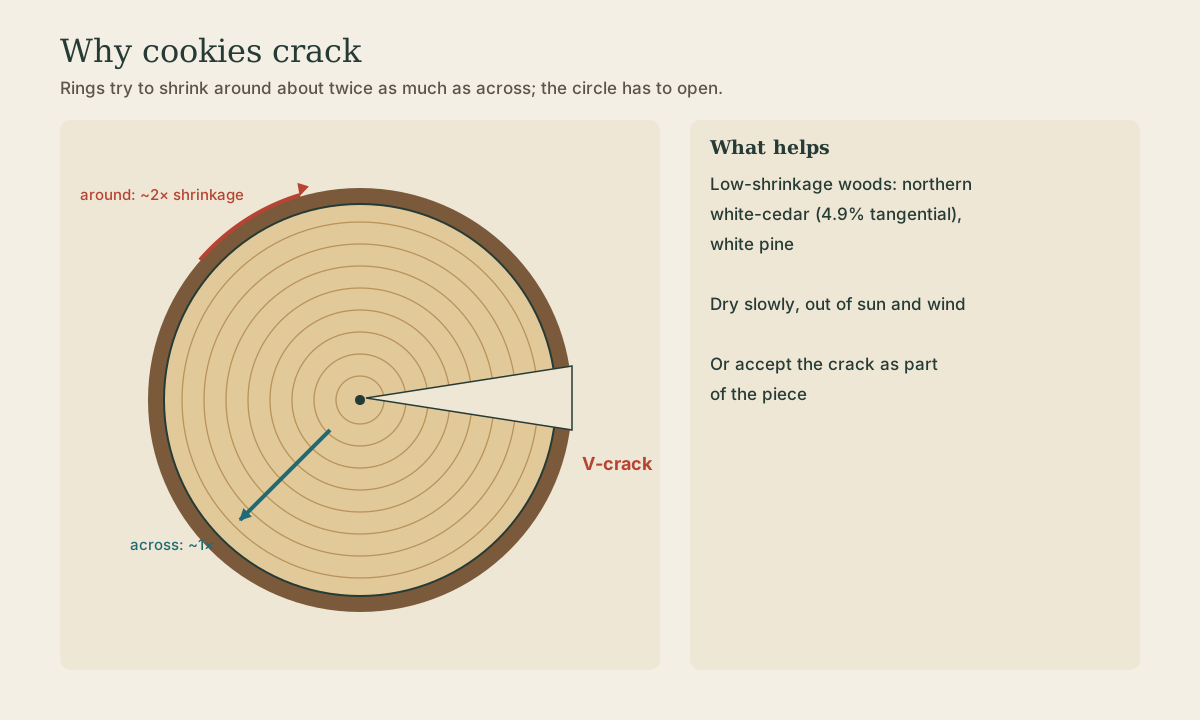
A cookie is a crosscut slice of a log, with the pith in the middle and the bark around the edge. Almost every cookie cracks as it dries, and the reason is pure geometry. As the wood dries, every growth ring wants to shrink around its circumference by the tangential amount, while the cookie’s radius shrinks only by the smaller radial amount. Using white oak’s numbers, a ring tries to shorten by 10.5 percent but the radius only allows 5.6 percent 1. A circle whose circumference shrinks twice as much as its radius can’t stay a closed circle: something has to open, and it does, as a V-shaped radial crack from the bark toward the pith.
End grain also loses water fast, so a thin cookie dries quickly and violently, which makes the cracking worse.
What works, more or less:
- Accept the crack. Many cookies are dried deliberately to one large check, then filled or left as a feature.
- Choose low-shrinkage, low-ratio woods. Northern white-cedar (4.9 percent tangential) and white pine crack less than oak or maple.
- Keep them thin and dry them slowly, wrapped or in a cool, humid space, so stress builds gradually.
- Stabilize with polyethylene glycol (PEG), which replaces water in the cell walls and bulks them so they don’t shrink. It works but changes the feel and finish of the wood.
The same geometry is why a log or post with the pith in it develops a long radial check, and why round wooden things like turned legs and tool handles dry oval.
Quick check
As it dries, the ring around the cookie wants to shorten more than the radius does. The only way to fit is to open a radial crack.
Slabs
Live-edge slabs, long boards sawn through and through, often 2 to 4 inches thick, are big, heavy pieces of mixed grain: flatsawn in the middle, near-quartersawn at the edges, often with the pith running down the center. They dry slowly and move a lot.
- Saw them thick. A 2 1/2- to 3-inch green slab flattens to perhaps 2 inches after drying and machining.
- Plan for time. Drying time rises much faster than thickness; 8/4 already takes about three times as long as 4/4 2. Thick slabs typically need a year or more of careful air drying, often followed by kiln time, and the commercial practice of kiln-drying slabs to 6 to 8 percent is the reliable way to get them dry through.
- Deal with the pith. A slab with the pith in it will usually check down the center. Many slab sawyers rip the center slab along the pith and book-match the halves later.
- Sticker and weight heavily, with stickers every 12 to 16 inches, end coat immediately, and keep slabs out of sun and wind.
- Expect movement after drying. A 36-inch flatsawn-center slab moves several tenths of an inch across its width over a Wisconsin year, which the earlier movement lesson can quantify. Attach slab tops with fasteners that allow movement.
Quick check
Drying time rises faster than thickness; thick slabs often need a year or more.
Timbers: framed green
Timber frames are usually built from green timbers. A large oak beam takes many years to dry through, and its outside would check and twist long before the core reached equilibrium. So framers cut joinery in green wood, which is easier to work, and let the frame dry in place.
North House Folk School’s frames use mostly locally milled eastern white pine, which they note is easy to work and excellent to use green because it stays fairly stable as it dries 3. Its low tangential shrinkage (6.1 percent) and very low radial shrinkage (2.1 percent) help. Green framing depends on:
- Boxed-heart timbers (with the pith near the center), which check but remain straight and strong.
- Joinery designed for shrinkage: pegged mortise and tenons, often drawbored, that tighten as the timbers dry; housings that hide gaps.
- Accepting checks. Seasoning checks in big timbers are normal and generally don’t affect strength in properly graded timber.
- Moisture content of the green timbers well above 30 percent at framing time, settling toward the building’s EMC over years.
The Timber Framing course goes into the joinery in detail.
What to take from this
Cookies crack because each ring shrinks around its circumference about twice as much as along the radius; accept, minimize with low-shrinkage woods and slow drying, or stabilize. Slabs are thick, mixed-grain pieces that take a year or more to dry, usually with kiln finishing, and keep moving afterward. Timbers are framed green, using species like white pine that stay stable and joinery that tightens as the frame dries.
Practice
North House notes white pine is easy to work and excellent green because it stays fairly stable as it dries. Big timbers would take years to dry first.
Lesson complete
Nice work.
Sources for this lesson
- 1Samuel V. Glass, Samuel L. Zelinka. Moisture Relations and Physical Properties of Wood (Wood Handbook, Chapter 4). USDA Forest Service, Forest Products Laboratory, FPL-GTR-282. 2021. verifiedFree and bound water, fiber saturation (~30%), EMC table (Table 4-2), green moisture by species (Table 4-1), shrinkage by species (Table 4-3), and the shrinkage equation. Cited at: Table 4-3.
- 2Forest Products Laboratory. Air Drying of Lumber. USDA Forest Service, Forest Products Laboratory, FPL-GTR-117. 1999. verifiedRevision of Rietz and Page (1971). Yard layout, piling and stickering, air-drying times by species and region, and days to dry 1-in. red oak at Madison, WI by stacking month (Table 9). Cited at: Thickness.
- 3Timber Frame: Build Your Own, Larger Frames FAQ. North House Folk School. verifiedMost frames use locally milled eastern white pine, worked green because it stays fairly stable as it dries; a 24×28 frame weighs about 15,000 pounds.
Further reading
- Richard Bergman. Drying and Control of Moisture Content and Dimensional Changes (Wood Handbook, Chapter 13). USDA Forest Service, Forest Products Laboratory, FPL-GTR-282. 2021. verifiedOven-dry and meter methods, outdoor EMC by city incl. Madison (Table 13-1), recommended MC (Table 13-2), kiln schedules (Table 13-3), drying defects, and dimensional change coefficients (Table 13-5).