Shellac from Flakes
Shellac is an insect resin dissolved in alcohol; mixed fresh by the 'pound cut,' it seals knots, stops resin and odors, builds a warm, repairable film, and is the base of French polishing.
- 5 min
- 6 steps
- 3 questions
- Lesson 105 of 160
In this lesson
- What shellac is
- Grades and colors
- Mixing by the cut
- What shellac is good for
- Brushing it
- What to take from this
Picking up where you left off.
What shellac is
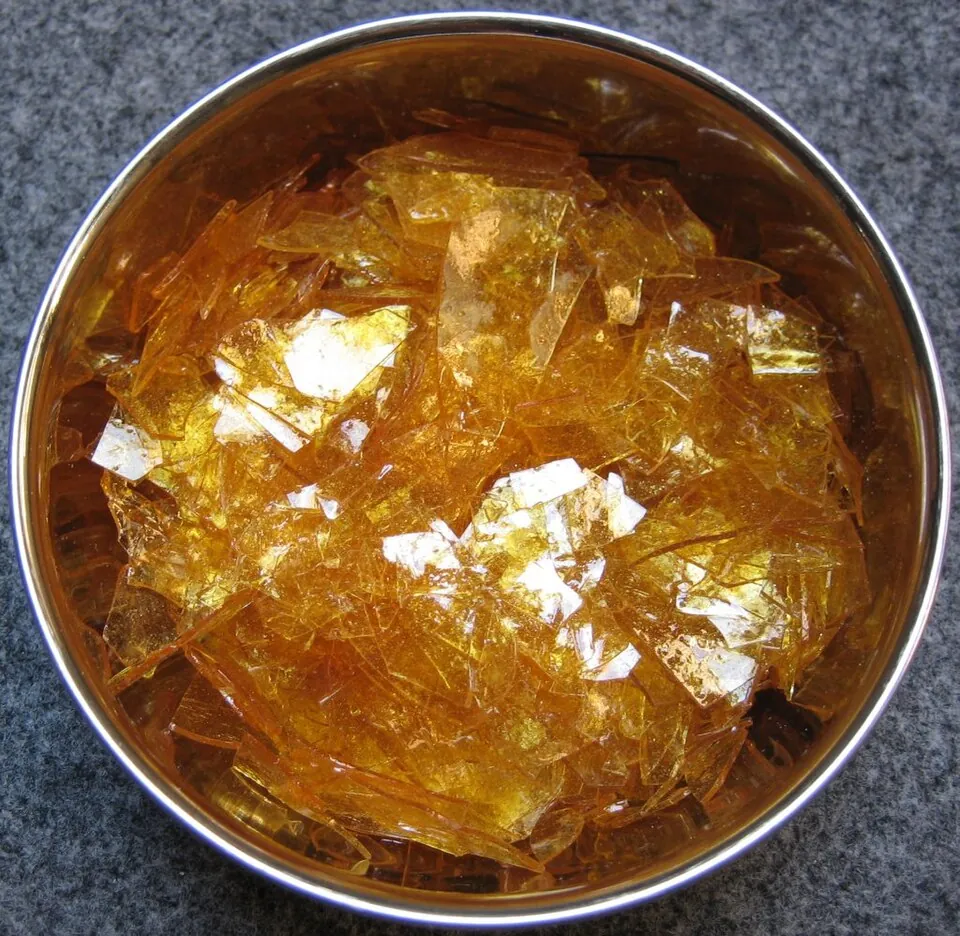
Shellac is a natural resin secreted by the lac insect (Kerria lacca) on trees in India and Thailand. The resin is scraped from branches, refined, and sold as thin, brittle flakes or “buttons” in colors from pale blond to deep garnet. Dissolved in alcohol, it makes a fast-drying, warm-toned finish that was the main furniture finish in America and Europe through the 1800s and into the 1920s, before lacquer replaced it in factories 1.

Shellac dries by evaporation, not by chemical curing: the alcohol leaves and the resin remains. That makes it quick, easy to repair (new shellac partly dissolves old), and reversible with alcohol.
Grades and colors
- Color: blond or “super blond” (nearly clear), orange (amber, the classic warm color), and garnet or button lac (darker, reddish-brown). Choose by the warmth you want.
- Waxed vs. dewaxed: natural shellac contains a few percent wax, which makes it slightly cloudy and can prevent some topcoats, especially polyurethanes, from bonding. Dewaxed shellac is clearer and bonds to and under nearly any finish, so it’s the choice as a sealer or barrier coat.
Mixing by the cut
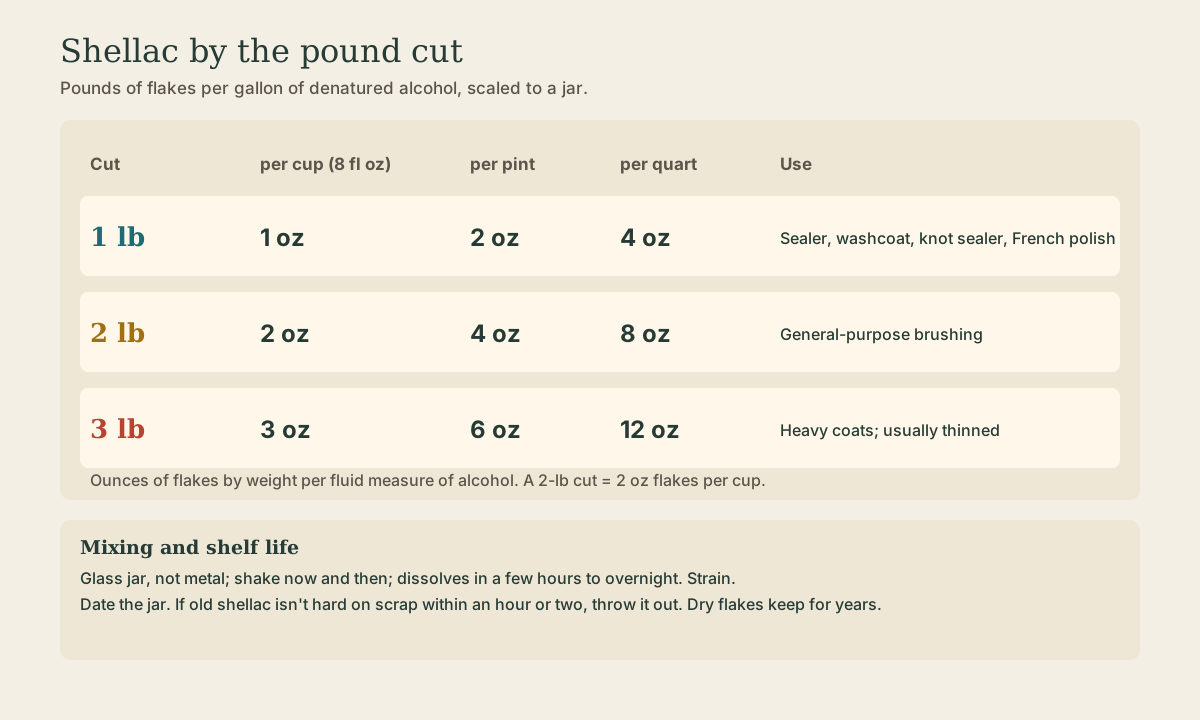
Shellac strength is described by the pound cut: pounds of flakes per gallon of denatured alcohol 1.
| Cut | Use |
|---|---|
| 1 lb | Thin sealer, washcoat before stain, knot sealer, French polishing |
| 2 lb | General-purpose brushing finish |
| 3 lb | Heavy coats; usually thinned before use |
For small batches: a 2-pound cut is about 2 ounces of flakes per 8 fluid ounces of alcohol (a cup), or 1 ounce per half cup.
To mix: put flakes in a clean glass jar, add alcohol, and shake or stir every so often. It dissolves in a few hours to overnight; grinding the flakes first speeds it up. Strain out debris. Use denatured alcohol (ethanol with denaturants) or shellac thinner; never use a metal container that can react with the shellac.
Shelf life: dissolved shellac slowly breaks down; old shellac may never fully harden and stays soft or tacky. Date your jars and mix fresh batches every several months. Test old shellac on a scrap: if it isn’t dry and hard within an hour or two, discard it. Dry flakes keep for years if stored cool.
Quick check
The cut is pounds of flakes per gallon of alcohol. A 2-pound cut is the common all-purpose strength; 1-pound is a thin sealer.
Quick check
2 lb per gallon is 32 oz per 16 cups, or 2 oz per cup.
What shellac is good for
- Sealing knots and resin. The Wood Handbook recommends shellac or a special knot sealer over knots before painting, to keep resin from bleeding through 2.
- A barrier coat. Dewaxed shellac seals in odors (smoke, animal), old wax or silicone contamination, and bleeding stains before refinishing.
- A washcoat before stain on blotch-prone woods like pine, cherry, and maple: a 1-pound cut partly seals the surface so stain goes on evenly.
- A finish in its own right: brushed or padded on in several coats, it gives a warm, low-to-medium sheen that shows off figure. It’s moderately resistant to water but marks with alcohol and heat.
- French polishing: shellac applied with a cloth pad lubricated with a drop of oil, in many very thin layers, building a deep, glassy finish. It’s the traditional finish on fine furniture and instruments.
- Under wax or over milk paint, for a harder layer.
Playback is optional. If the player is unavailable, open the video at its source.
Brushing it
- Use a good natural-bristle or soft synthetic brush, and a 2-pound cut or thinner.
- Brush quickly in long strokes and don’t go back over shellac that’s starting to set; it dries in minutes.
- Let coats dry an hour or more, then sand lightly with 320 grit or a gray pad between coats.
- Several thin coats beat one thick one.
What to take from this
Shellac is lac-insect resin dissolved in denatured alcohol, mixed by the pound cut (2-pound cut for most brushing, 1-pound for sealing). It dries by evaporation, so it’s fast and easy to repair. Use dewaxed shellac as a sealer and barrier over knots, odors, and contamination, as a washcoat before stain, or as a warm finish and the basis of French polishing. Mix it fresh and test old batches before use.
Practice
Shellac naturally contains some wax, which interferes with adhesion of some topcoats. Dewaxed shellac bonds to almost anything and almost anything bonds to it.
Lesson complete
Nice work.
Sources for this lesson
- 1Bob Flexner. Understanding Wood Finishing: How to Select and Apply the Right Finish. 3rd revised ed. Fox Chapel Publishing. 2021. verifiedThe standard reference on finish chemistry and practice - drying oils and driers, shellac cuts, waxes, and what each finish can and can't do. Cited at: Shellac.
- 2Finishing Wood (Wood Handbook, Chapter 16). USDA Forest Service, Forest Products Laboratory, FPL-GTR-282. 2021. verifiedWeathering and UV damage to lignin, sunburned wood and the tape test, paint versus penetrating finishes, drying and nondrying oils, food-contact finishes, and the spontaneous-combustion warning for oily rags. Cited at: Knots.