How a Kiln Works
A kiln controls temperature, humidity, and airflow so the wood dries as fast as it safely can; dry-bulb and wet-bulb thermometers set the equilibrium moisture content that drives it.
- 5 min
- 7 steps
- 3 questions
- Lesson 13 of 160
In this lesson
- Three dials
- Dry-bulb and wet-bulb
- How RH drives the rate
- Air velocity
- Types of kilns
- Kiln dry, air dry, shipping dry
- What to take from this
Picking up where you left off.
Three dials
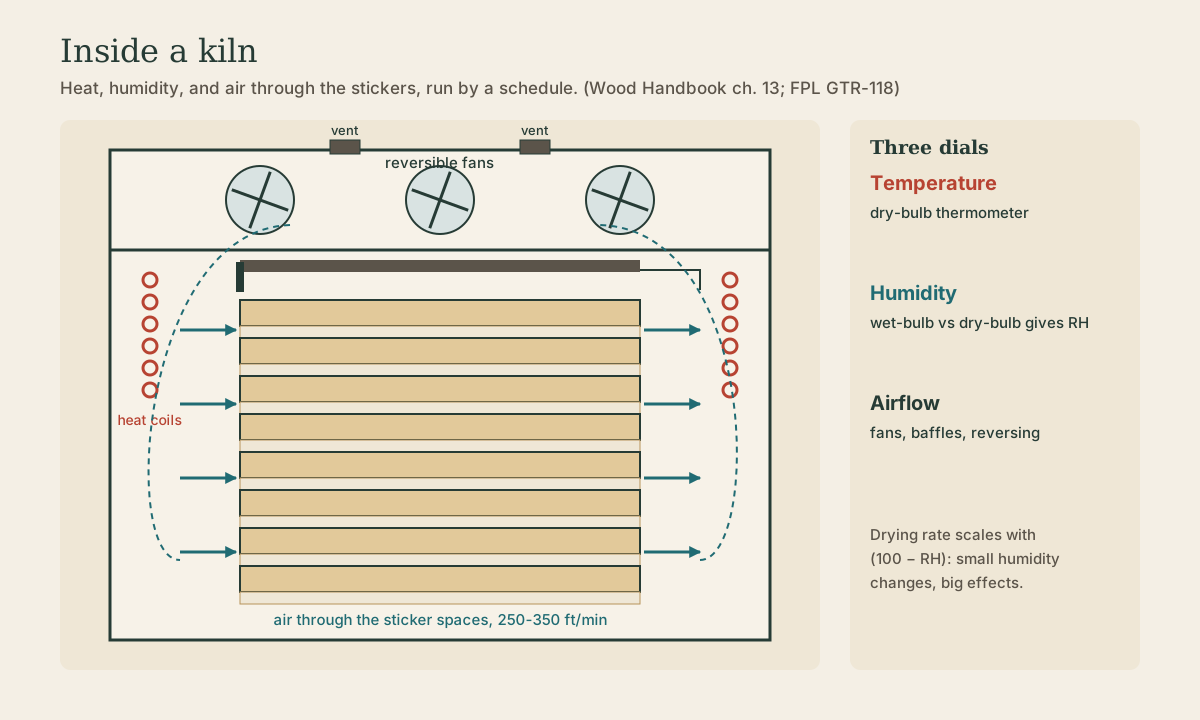
A dry kiln is an insulated chamber that controls three things: temperature, relative humidity, and air velocity. Together they set how fast water leaves the wood. Air drying lets the weather set those dials; a kiln sets them deliberately, changing them as the wood dries according to a schedule 1.
The aim is not just “hot and dry.” It’s to dry each charge as fast as it can go without exceeding the strength of the wood, which changes as the wood dries: wet wood is weak across the grain, especially hot, and dry wood is much stronger. So schedules start mild and get harsher as the lumber dries.
Dry-bulb and wet-bulb
Kilns measure humidity with two thermometers 2:
- The dry bulb reads the air temperature.
- The wet bulb is a thermometer covered with a wet cloth wick in fast-moving air (about 600 ft/min). Evaporation from the wick cools it. The drier the air, the faster the evaporation and the cooler the wet bulb reads.
The difference between them is the wet-bulb depression. Zero depression means 100 percent RH; a large depression means dry air. From the dry-bulb temperature and the depression, tables give the RH and the equilibrium moisture content (EMC) the kiln air is trying to bring the wood to. Operators think in EMC: if the lumber is at 40 percent and the kiln EMC is 12 percent, water leaves the surface; the farther apart they are, the faster.
Newer controls sometimes use a cellulose wafer sensor that directly tracks EMC by its electrical resistance instead of a wet bulb.
Quick check
The wet bulb cools by evaporation. If it reads the same as the dry bulb, no evaporation is happening: the air is saturated.
How RH drives the rate
The FPL hardwood manual gives a simple rule for a given moisture content, temperature, and air velocity 2:
drying rate ∝ (100 − RH)
At 80 percent RH the margin is 20; at 60 percent it’s 40. So lowering the RH from 80 to 60 percent doubles the drying rate. That’s why early hardwood schedules hold RH very high: the danger in early drying is going too fast.
Temperature speeds water movement inside the wood. It also lowers the wood’s strength while wet, and very high temperatures darken many woods. Hot early drying is what causes honeycomb and collapse.
Air velocity
Moving air carries moisture away from the board surfaces and brings heat in. Standard U.S. hardwood schedules assume about 250 to 350 feet per minute through the sticker spaces; white woods like maple are often dried with 500 to 600 ft/min to prevent stain. Faster air at the same RH dries faster, so changing the fans means changing the schedule. In one FPL test with 1,000 ft/min airflow, the RH had to be pushed above 95 percent to keep oak from checking, and it checked anyway 2.
Kiln fans push air across the lumber, parallel to the stickers, and most reverse direction every few hours so both sides of the load dry evenly. Baffles stop air from short-circuiting over or around the stack.
Types of kilns
The Wood Handbook describes five general types 1:
- Track-loaded kilns: lumber on carts rolled in on rails; most U.S. softwood is dried this way.
- Package-loaded kilns: forklift-loaded stacks, common for hardwoods. Both are usually heated by steam coils, with vents to exhaust humid air and steam spray to add humidity.
- Dehumidification kilns: instead of venting, they condense water out of the air on cold coils and reuse the heat. Popular with small hardwood operations.
- Vacuum kilns: dry below atmospheric pressure, so water boils off at lower temperature. Fast, gentle on color, and good for thick stock.
- Progressive (continuous) kilns: lumber moves through zones at different conditions; common in Scandinavia.
Small shops add a sixth: the solar kiln, which uses a glazed roof and fans and is covered later in this module.
Kiln dry, air dry, shipping dry
The trade terms are loose, but the handbook outlines them 1: shipping dry means just the outer 1/8 inch is dried to 25 percent or less to prevent stain in transit; air dry generally means 20 to 25 percent for dense hardwoods and 15 to 20 for softwoods and light hardwoods; kiln dry means dried to a specified average moisture content suited to the use, usually 6 to 8 percent for furniture hardwoods. “KD” on softwood framing often means only 19 percent or less. Always ask for the actual moisture content.
What to take from this
A kiln controls temperature, humidity, and airflow according to a schedule that starts mild while the wood is weak and wet and gets harsher as it dries. Dry-bulb and wet-bulb thermometers give the RH and the EMC the kiln is pulling toward. Drying rate scales with (100 − RH), so small humidity changes have big effects. Hardwood schedules assume about 250 to 350 ft/min of air through the stickers.
Practice
The FPL manual gives drying rate ∝ (100 − RH): 20 at 80 percent, 40 at 60 percent. Halving that margin halves the rate.
Practice
Hardwood schedules are built on roughly 250 to 350 ft/min. Faster air dries faster at the same RH, so the RH would have to be raised to compensate.
Lesson complete
Nice work.
Sources for this lesson
- 1Richard Bergman. Drying and Control of Moisture Content and Dimensional Changes (Wood Handbook, Chapter 13). USDA Forest Service, Forest Products Laboratory, FPL-GTR-282. 2021. verifiedOven-dry and meter methods, outdoor EMC by city incl. Madison (Table 13-1), recommended MC (Table 13-2), kiln schedules (Table 13-3), drying defects, and dimensional change coefficients (Table 13-5). Cited at: Kiln Drying; Dry Kilns; Moisture Content of Dried Lumber.
- 2Joseph Denig, Eugene M. Wengert, William T. Simpson. Drying Hardwood Lumber. USDA Forest Service, Forest Products Laboratory, FPL-GTR-118. 2000. verifiedPredrying, kiln schedules, safe daily drying rates (Table 8.6), stress testing and conditioning, dehumidification kilns, the semi-greenhouse solar kiln, and storage. Cited at: Relative Humidity; Optimal Air Velocity.
Further reading
- William T. Simpson. Dry Kiln Operator's Manual (Agriculture Handbook 188). Revised 1991 ed. USDA Forest Service, Forest Products Laboratory. 1991. verifiedThe standard reference for kiln design, instrumentation, kiln samples, and schedules.