Old Hickory and Park Furniture
Rustic furniture made by the trainload: the Old Hickory company of Martinsville, Indiana, its boiled-and-clamped hickory saplings and woven bark seats, the national park lodges it furnished, and the Park Service's 1930s furniture of split logs, slabs, and peeled poles.
- 4 min
- 5 steps
- 3 questions
- Lesson 80 of 160
In this lesson
- The factory
- Lodges and parks
- What the park builders knew
- Try it
- What to take from this
Picking up where you left off.
The factory
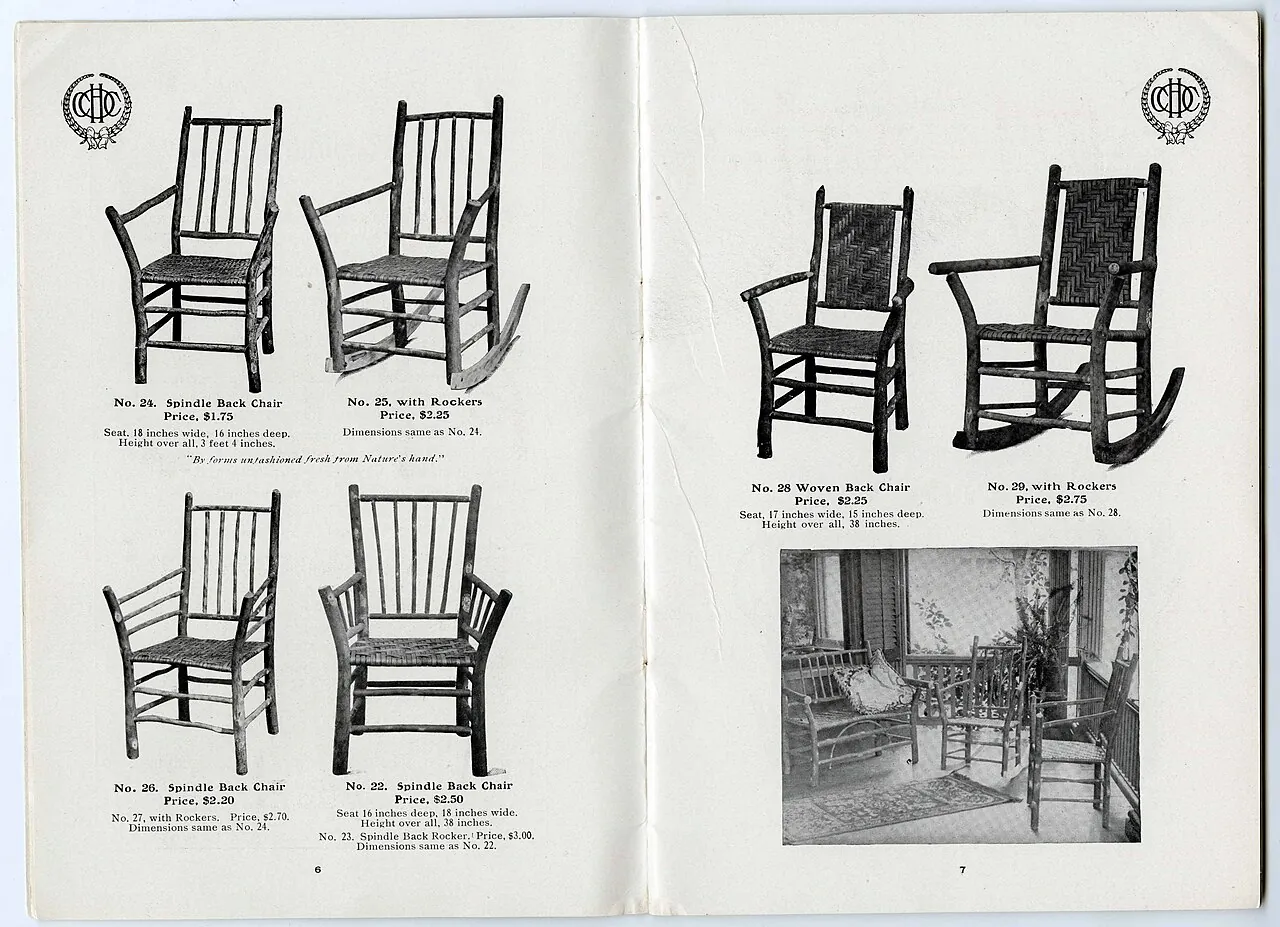
Rustic furniture doesn’t have to be one-off. In the 1890s Billy Richardson, who had come to Martinsville, Indiana, from North Carolina, sold hickory-sapling chairs at the town’s Saturday market 1. In 1892 he and others took over an abandoned church and began making hickory furniture at scale, and in 1898 the Old Hickory Chair Company, named for Andrew Jackson’s nickname, was incorporated 1.
.jpg)
The method was simple and repeatable:
- Saplings, not sawn lumber. Young hickory is tough, springy, and bends without breaking.
- Boil and clamp: the saplings were soaked in boiling water until they softened, then clamped against patterns. When they dried, they kept the shape 1.
- Bark on for legs and frames, so the furniture looked like the woods it came from.
- Woven seats of hickory inner bark, the pale, leathery layer under the outer bark. It’s peeled in May or early June, when it slips easily, then coiled, dried, soaked, and shaved into strips about 3/4 in. wide; one chair seat takes 120 to 180 ft 2.
By 1901 the catalog offered hoop chairs, rockers, settees, tables, garden furniture, and even complete log cabins, shipped anywhere by rail 1. The Patton family bought the company in 1908, it became the Old Hickory Furniture Company in 1921, closed in 1978, and was revived in Shelbyville, Indiana, in 1982 1.
Playback is optional. If the player is unavailable, open the video at its source.
Quick check
Once dry, the hickory held the pattern’s curve.
Quick check
Hickory inner bark is peeled in late spring, when it slips, then soaked and shaved before weaving.
Lodges and parks
Old Hickory’s best-known installation is the Old Faithful Inn in Yellowstone; it also furnished the Grove Park Inn in Asheville 1. Bark-on hickory chairs with woven seats became what a lodge in the woods was supposed to look like.
In the 1930s the National Park Service and the Civilian Conservation Corps built and furnished park buildings and picnic grounds across the country. Albert Good’s Park and Recreation Structures (1938) collected the best of it: tables and benches from split logs and slabs, log seats with branch backs, and massive tables on tree-trunk bases 3. Good wanted furniture simple, sturdy, and suited to its region, with peeled cedar or bark-on hickory as the most rustic finish he’d allow 3.
Quick check
It also went to the Grove Park Inn in Asheville and many resorts and camps.
What the park builders knew
The picnic-table section reads like a checklist from people who maintained thousands of them 4:
- Heights: seat 16 to 18 in. and table top 28 to 30 in. off the ground, with the seat’s front edge 1 to 3 in. from the table edge.
- Open joints about 1/4 in. wide between top boards, so crumbs and food don’t pack into them.
- Smooth, rounded edges that don’t splinter or snag.
- Preservative on any wood set below grade.
- Knock-down designs with few, interchangeable parts.
- Stone lasts, but you can’t move a stone table when the ground around it wears out.
Those numbers return in the picnic table build.
Try it
Look closely at one piece of bark-on hickory or willow furniture, in a lodge, a state park, or an antique shop. Note how the joints are made (nails, round tenons, or both), where the bends are, whether the bark has stayed on, and how the seat is woven or slatted. Sketch one joint.
What to take from this
Old Hickory turned rustic furniture into a product: hickory saplings boiled, clamped to patterns, dried to shape, and fitted with woven inner-bark seats, shipped nationally from Martinsville, Indiana, from the 1890s and furnishing Old Faithful Inn. The Park Service’s 1930s furniture used split logs, slabs, and peeled poles, kept simple and regional. Its practical rules (seat 16-18 in., table 28-30 in., 1/4-in. open joints, rounded edges, protected wood below grade) still work.
Lesson complete
Nice work.
Sources for this lesson
- 1Harry L. Rinker. Rinker on Collectibles, Column 1383: Old Hickory. Rinker Enterprises. 2013. verifiedBilly Richardson sold hickory sapling chairs at the Martinsville, Indiana, Saturday market; in 1892 he and others took over an abandoned church for production; Old Hickory Chair Company, named for Andrew Jackson, incorporated 1898; 1901 catalog of hoop chairs, rockers, settees, tables, and log cabins; saplings boiled and clamped to patterns; Old Faithful Inn and Grove Park Inn; Patton family from 1908; Old Hickory Furniture Company from 1921; closed 1978, revived in Shelbyville 1982.
- 2A.J. Hendershott. Beauty From Bark. Missouri Conservationist (Missouri Department of Conservation). 2026. verifiedHickory inner bark slips in May or early June; trees 6-12 in. diameter; drawknife off outer bark, score, peel, coil, dry; soak overnight and shave to 1/8-1/4 in.; 3/4 in. strips for seats; 120-180 ft per seat.
- 3Albert H. Good. Park and Recreation Structures, Part III: Furniture and Furnishings. National Park Service. 1938. verifiedPublic-domain U.S. government publication with eight plates of rustic furniture precedents. It is a historical design source, not a current accessibility or seating-load standard.
- 4Albert H. Good. Park and Recreation Structures, Part II: Picnic Tables. National Park Service. 1938. verifiedSeat 16 to 18 in. and table 28 to 30 in. off the ground; front edge of the seat 1 to 3 in. from the edge of the table; open joints about 1/4 in. between top boards; smooth, rounded edges; preservative on wood below grade; knock-down tables with few, interchangeable parts; stone tables durable but immovable.