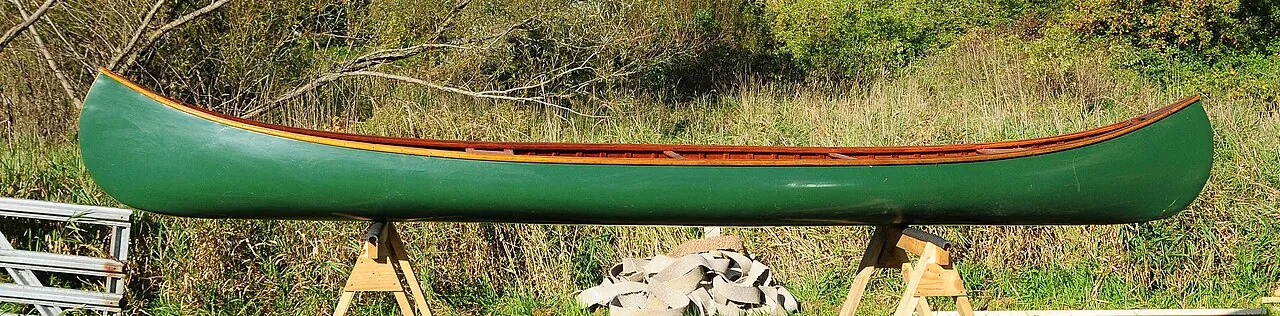
Wood-and-Canvas Canoes
The factory canoe that replaced bark: steam-bent cedar ribs clinched to thin cedar planking over a solid form with metal straps, ash stems and spruce inwales, a canvas skin stretched, tacked, and filled, and where to see the great builders' work in Spooner's Wisconsin Canoe Heritage Museum.
- 4 min
- 6 steps
- 3 questions
- Lesson 90 of 160
In this lesson
- From bark to factory
- Ribs and planking
- The canvas skin
- Where to see them
- Try it
- What to take from this
Picking up where you left off.
From bark to factory
By the late 1800s, builders in Maine and Ontario were copying the bark canoe’s shape and structure in materials a shop could produce in quantity: cedar ribs and planking in place of bark-lined sheathing, and canvas in place of bark 1 2. The construction still works from the outside in, like a bark canoe turned inside out: the shape comes first, then the skin.

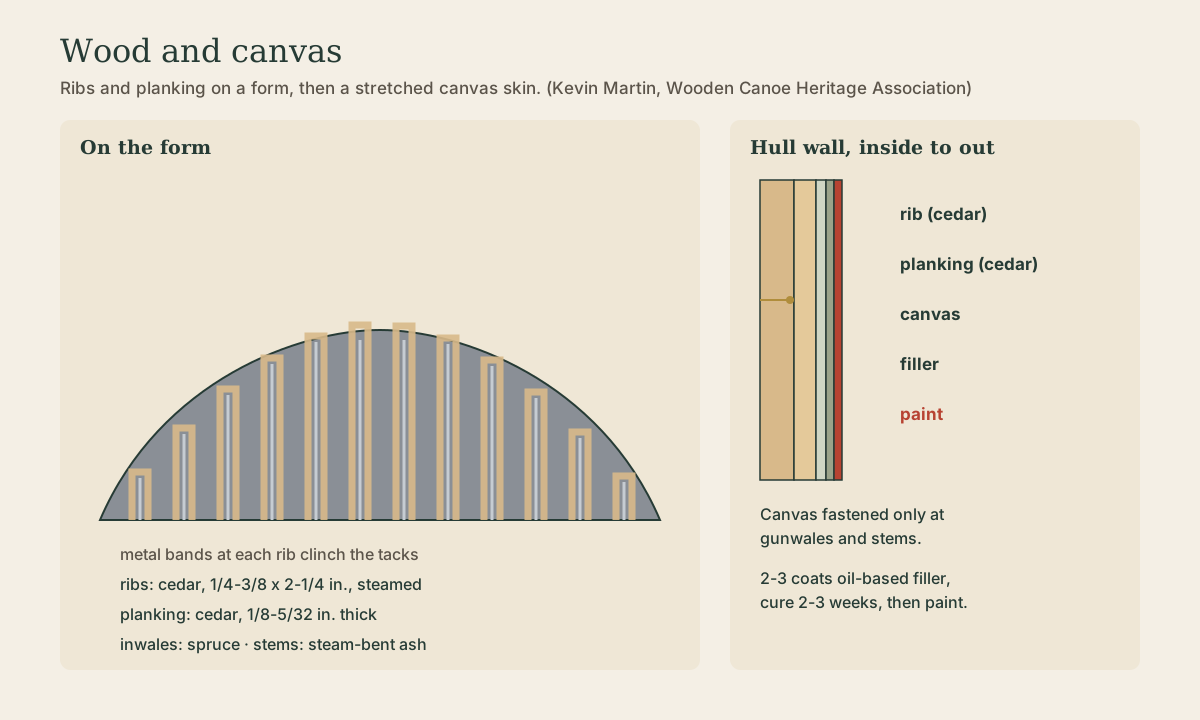
The key difference is the form. A wood-canvas canoe is built over a solid form, a full-size hull shape planked or stripped with wood, with metal straps set into it at every rib station 2. One form could build hundreds of identical canoes.
Ribs and planking
The order 2:
- Stems: steam-bent ash, set at each end of the form.
- Inwales: long spruce strips clamped along the sheer line.
- Ribs: northern white cedar, about 1/4 to 3/8 inch thick and 2-1/4 inches wide, tapered toward the ends. They’re steamed, bent over the form, and nailed to the inwales while hot, one at each strap.
- Planking: thin cedar, 1/8 or 5/32 inch thick and 2-3/4 to 3-3/4 inches wide, laid lengthwise over the ribs and fastened with brass tacks. Each tack goes through plank and rib and hits the steel strap underneath, which clinches (curls) its point back into the rib.
When the planking is done, the hull is lifted off the form: a complete, open-gunwale wooden canoe, light and flexible, but not yet watertight 2.
Quick check
The straps sit at each rib station; the clinched tack locks plank to rib.
The canvas skin
Canvas is laid over the inverted hull, pulled tight end to end (often in a canvas stretcher, with the hull pressed down into it), and tacked along the sheer and at the stems 2. Then:
- Filler: two or three coats of oil-based filler rubbed into the weave, then cured two or three weeks until hard 2.
- Paint: enamel on the outside; varnish inside.
- Trim: outwales over the canvas edge, decks, seats, thwarts, and brass stem bands to protect the ends 2.
The hull flexes when it’s beached or bumps a rock, which is part of why wood-canvas canoes last: the planking gives, the canvas takes the abrasion, and canvas can be replaced when it wears out 2. Restoring an old canoe usually means stripping the canvas, replacing broken ribs and planks, and recanvasing.
Playback is optional. If the player is unavailable, open the video at its source.
Quick check
Two or three coats of oil-based filler cure two or three weeks before painting.
Where to see them
The Wisconsin Canoe Heritage Museum in Spooner opened in 2010 in a former feed mill, built around Jeff and Jill Weber Dean’s collection of antique canoes. It shows canoes by J. Henry Rushton, B.N. Morris, Tom MacKenzie, and bark canoe builder Henri Vaillancourt, among others, and runs a working canoe shop for builders and restorers 3. Compare a Morris’s outside stems and decorated decks with the ash, cedar, and spruce described above, and look at how the planks lap.
Quick check
It opened in 2010 in a former feed mill and runs a working canoe shop.
Try it
Find an old wood-canvas canoe (estate sales and barns in northern Wisconsin still turn them up), turn it over, and read it: count the ribs, look for broken ones, look at how the planks are tacked, and check whether the canvas is sound, cracked, or patched. Inside, find the clinched tack points on the ribs.
What to take from this
A wood-canvas canoe is built on a solid form with a metal strap at each rib station: ash stems, spruce inwales, steam-bent cedar ribs, then thin cedar planking with brass tacks that clinch against the straps. Off the form, canvas is stretched and tacked on, filled and cured for weeks, painted, and trimmed. The hull flexes and can be recanvased. The Wisconsin Canoe Heritage Museum in Spooner shows the great builders’ work.
Lesson complete
Nice work.
Sources for this lesson
- 1Edwin Tappan Adney, Howard I. Chapelle. The Bark Canoes and Skin Boats of North America (U.S. National Museum Bulletin 230). Smithsonian Institution (Project Gutenberg edition). 1964. verifiedPaper birch bark preferred: range reaching through Wisconsin; bark over 1/8 in. thick from straight trunks; peels easily when sap flows; 'winter bark' keeps its inner rind and was prized, 'summer bark' separates into layers; grain runs around the tree so sheets can be sewn end to end; black spruce root for sewing, up to 20 ft long and pencil-thin; northern white cedar for ribs, sheathing, gunwales, headboards; hard maple for thwarts and paddles; spruce gum tempered with fat and powdered charcoal and tested on a bark strip; building bed, building frame, stakes, six stages of construction; ribs pre-bent in pairs; Ojibway long-nose canoes west of Lake Superior, 3-fathom rice-harvesting canoes, all Ojibway canoes built with a building frame.
- 2Kevin Martin. Building Techniques: Wood-Canvas Canoes. Wooden Canoe Heritage Association (member site). verifiedBuilt on solid forms with metal straps at each rib; cedar ribs 1/4-3/8 in. thick and 2-1/4 in. wide, tapered toward the gunwales, steamed and nailed to spruce inwales; steam-bent ash stems; cedar planking 1/8 or 5/32 in. thick and 2-3/4 to 3-3/4 in. wide fastened with brass tacks clinched on the straps; canvas stretched and tacked; two or three coats of oil-based filler cured two or three weeks; enamel paint, varnished interior, brass stem bands; hulls flex when beaching.
- 3Wisconsin Canoe Heritage Museum. Wisconsin Canoe Heritage Museum, Spooner. verifiedMuseum in Spooner, Wisconsin, opened in 2010 in a former feed mill, built around Jeff and Jill Weber Dean's antique canoe collection; exhibits canoes by J. Henry Rushton, B.N. Morris, Tom MacKenzie, Henri Vaillancourt, and others, and runs a working canoe shop for builders and restorers.