Designing Your Own Variation
Changing a proven chair safely: green changes that leave the load path alone, amber changes to seat height, width, posture, and leg angles that need calculation and mockups, red changes to joints and braces, a change-impact worksheet, and a go/no-go review.
- 7 min
- 11 steps
- 3 questions
- Lesson 123 of 160
In this lesson
- Green: expression without changing the load path
- Amber: fit and geometry interact
- Red: joints, braces, and cantilevers
- A change-impact worksheet
- One variable per prototype
- Risk budget
- Preserve compensation systems
- Attribution and ethical study
- Release the variation as a repeatable design
- Final go/no-go review
Picking up where you left off.
A proven chair plan stores more knowledge than its dimensions show. Joint sizes may reflect years of repairs. A foot position may be the result of several prototypes. A crest height may balance comfort against leverage. Varying the plan is not forbidden; it requires identifying which stored knowledge the change touches.
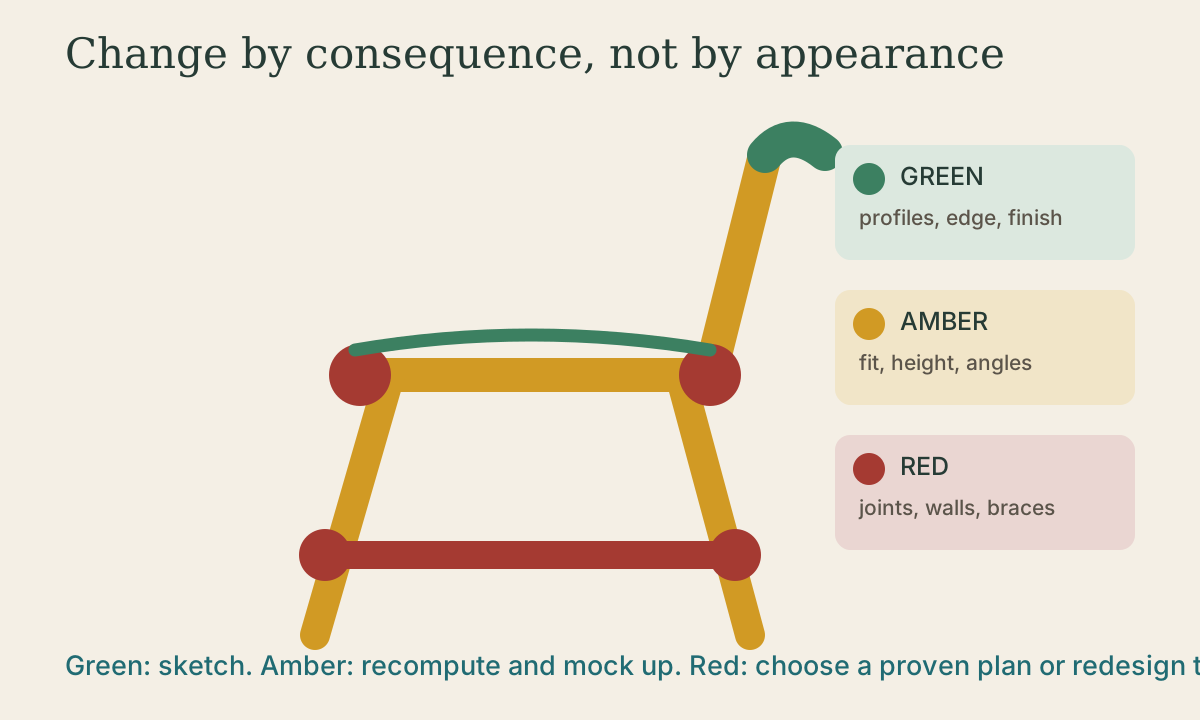
Use a traffic-light system: Green—draw it. Amber—calculate and mock it. Red—redesign or choose another proven plan.
Green: expression without changing the load path
Green changes usually preserve joint centers, structural sections, support polygon, and body-contact geometry:
- chamfers, beads, and edge treatments outside joint zones;
- crest silhouette above its structural depth;
- spindle turning details while preserving minimum diameter and grain;
- color and compatible finish;
- modest decorative relief;
- seat-edge profile that does not reduce socket wall or change usable depth.
Green does not mean thoughtless. A heavy round-over can remove the shoulder a hand uses to rise. Paint can conceal developing joint lines. A carved detail can create short grain. Sketch the change in full size and mark the protected structural envelope before shaping.
Quick check
Green changes preserve joints, sections, support polygon, and body geometry. Amber changes (height, rake, tilt) need calculation and mockups; red changes (joints, braces, cantilevers) need redesign.
Amber: fit and geometry interact
Amber changes include seat height, depth, tilt, back angle, clear width, rake, splay, and spacing of back members. They can be excellent personalizations, but the linked system must be updated.
Changing seat height
If angled legs are shortened by vertical amount \(\Delta h\), their plan projection shrinks. For resultant angle \(R\), the change in radial foot offset is approximately
Shortening a chair 1 inch with 14° resultant lean moves each foot inward by about
That small move is usually manageable, but it should be drawn. Shortening 4 inches would move each foot roughly 1 inch inward and materially change stance and stability.
Keep the leg’s lean direction when trimming at the floor; do not shorten at the tenon end unless the entire joint and stretcher system is being recalculated.
Changing width
Widening the seat changes rail or stretcher lengths, leverage, and sometimes back-stick spacing. Preserve joint dimensions and decide whether the added span needs a deeper rail, another member, or only a longer one. Recompute equal gaps rather than stretching the outside spaces by eye.
Changing posture
Seat depth, tilt, and back angle are one system. Return to the fitting rig. A 2° back change can feel significant; it also changes the direction of load at the crest. Record the original and revised included seat-to-back angle.
Changing rake and splay
Use Lesson 3.3 to recalculate resultant and sightline. Plot all feet in plan, preserve sufficient mortise wall, and drill a scrap block at final seat thickness. Mirroring a line without mirroring its direction arrow is a common expensive error.
Quick check
Δx = Δh × tan R = 1 × tan 14° ≈ 0.25 in. Shortening 4 inches would move each foot about an inch.
Red: joints, braces, and cantilevers
Red changes alter the primary load path or its capacity:
- reducing tenon diameter or mortise depth;
- thinning the wood surrounding clustered sockets;
- deleting or substantially raising stretchers;
- adding major crest height without strengthening the back system;
- converting four supports to three, two, or a cantilever;
- substituting materially weaker stock in slender high-leverage parts;
- cutting across grain to achieve a new curve.
The USDA Wood Handbook supplies species-specific mechanical data, but a single bending-strength number is not enough for substitution 1. Compare stiffness, relevant strength, density, grain quality, moisture behavior, and the actual section. Then make joint samples.
“Red” does not mean impossible. It means the original plan no longer carries the design responsibility. Either find a proven chair that already solves the desired change or treat the project as a new structural design with prototypes and controlled testing.
Quick check
Removing or raising stretchers changes the primary load path. Preserve compensation systems or choose a plan that already omits them.
A change-impact worksheet
For every proposed variation, complete:
| Question | Answer |
|---|---|
| Original dimension or feature | |
| Proposed change | |
| Green / amber / red | |
| Body relationship affected | |
| Load path or moment affected | |
| Joint wall or section affected | |
| Drawing to update | |
| Sample or mockup required | |
| Acceptance test |
If you cannot fill one row, the change is not ready to cut.
One variable per prototype
The free Stick Chair Book presents numerous seat, leg, arm, and crest forms as a vocabulary for continued design 2. Lost Art Press also describes its full-size patterns as starting points for makers’ own versions 3. The way to learn from that freedom is disciplined isolation.
Chair A is the baseline. Chair B changes only the crest. Chair C keeps B’s crest and changes seat tilt. After each:
- record all dimensions and deviations;
- photograph consistent views;
- gather immediate and one-hour sit reports (on the fitting rig until the structure is proven);
- inspect after one month and one year;
- note whether the change should survive into the next chair.
If B changes five things and feels better, you have a result but little knowledge.
Risk budget
Assign each proposed change a simple effort estimate:
- Green: one drawing review.
- Amber: drawing review + calculation + full-size mockup.
- Red: structural prototype + weighted load test, or a proven plan that already solves it.
Suppose a project includes three green changes, two amber changes, and one red change. The red change should dominate the schedule. If the project cannot afford that prototype effort, remove the red change rather than pretending it is amber.
This risk budget keeps visually small structural edits from hiding behind visually large cosmetic ones.
Preserve compensation systems
Some chairs omit a feature because other features compensate. A plank chair without stretchers may use a thick seat, deeply socketed and strongly splayed legs, and appropriate joints. A light frame may depend on low stretchers and continuous rear posts. Do not copy the omission without its compensations.
Use the sentence:
This chair can omit __ because _, , and ___ carry the consequence.
If you cannot complete it from the plan and source, preserve the feature.
Attribution and ethical study
Building from a published plan is legitimate when the plan’s terms allow it. A personal homage can also be a powerful study. Be precise when documenting:
- “Built from Christopher Schwarz’s plan.”
- “After a Hans Wegner type, using independently developed dimensions.”
- “Maloof-inspired sculpted transition from a licensed teaching package.”
- “Personal variation of a Curtis Buchanan chair.”
Do not market a copy as an authentic original or omit the source that made the learning possible. When a living maker or studio sells plans, instruction, or finished work, use their authorized route where available.
Release the variation as a repeatable design
A variation becomes a design only when another build can reproduce it. Update:
- front, side, and seat-plan views;
- patterns and story stick;
- sightlines, arrows, and resultant angles;
- cut list with fit categories;
- joint sections;
- assembly and moisture notes;
- chair log with test results;
- source and attribution note.
Then perform a “cold read” two weeks later. If the drawing requires memory from the prototype, capture that memory in the plan.
Final go/no-go review
Before cutting hardwood, ask:
- Does the intended sitter pass Feet–Knees–Hips–Back?
- Are all amber calculations reflected in every affected view?
- Are red changes removed, proven elsewhere, or prototyped?
- Are joint dimensions and surrounding walls at least as sound as the baseline?
- Does the foot plan remain stable in likely use directions?
- Is only one untested variable being carried into the final chair?
Variation is how a living chair tradition continues. The traffic lights do not protect a famous plan from personality; they protect the maker and sitter from changes whose consequences have not yet been paid for.
Lesson complete
Nice work.
Sources for this lesson
- 1Robert J. Ross. Wood Handbook: Wood as an Engineering Material. Revised 2021 ed. USDA Forest Service, Forest Products Laboratory. 2021. verifiedOfficial chapters on wood structure, moisture, mechanical properties, fastenings, composites, drying, and finishing. Cited at: Chapters 2, 5, and 7.
- 2Christopher Schwarz. The Stick Chair Book. 2nd revised ed. Lost Art Press. verifiedPublisher page with the complete book available as a free PDF. Cited at: patterns and chair plans.
- 3Revised Full-size Patterns from The Stick Chair Book. Lost Art Press. verifiedPublisher description of full-scale shapes, mortise locations, drilling sightlines, and centerlines intended for adaptation. Cited at: pattern description.