Rosemaling and Kurbits
Norway's rosemaling and Sweden's kurbits painting - flowing scrolls and stylized flowers on chests, bowls, and walls - and how rosemaling was revived in Stoughton, Wisconsin.
- 5 min
- 6 steps
- 3 questions
- Lesson 107 of 160
In this lesson
- Rosemaling
- Rosemaling in Wisconsin
- Kurbits
- Materials and method
- Where to see and learn
- What to take from this
Picking up where you left off.
Rosemaling
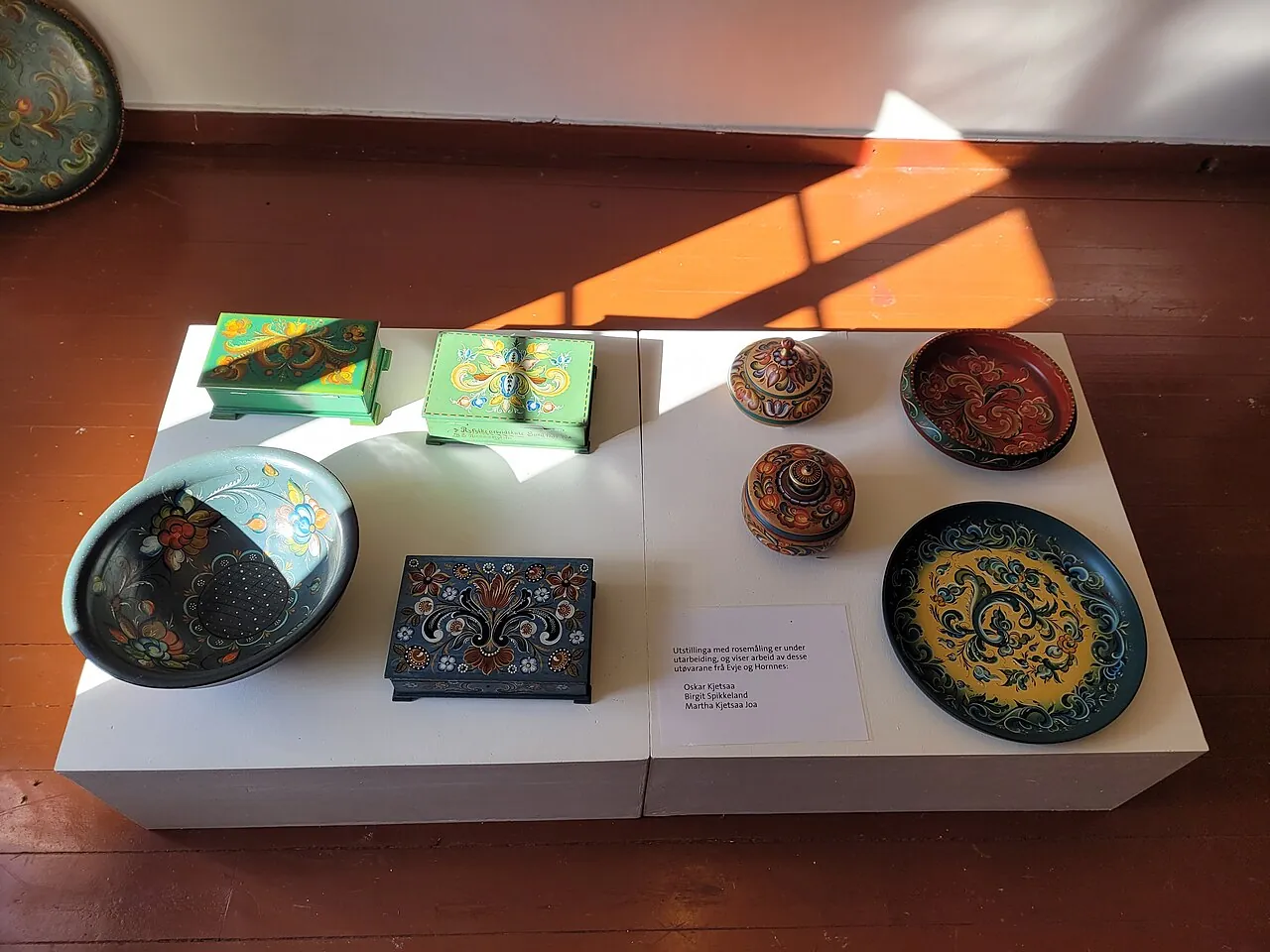
Rosemaling (“rose painting”) is the decorative painting of rural Norway: flowing C- and S-shaped scrolls, stylized flowers and leaves, and bold color on wood. It emerged in the rural communities of eastern Norway in the mid-1700s, drawing on the Baroque and Rococo carving and painting seen in churches and wealthy homes 1. Itinerant painters decorated wall panels, ceilings, chests, cupboards, bowls, ale vessels, and trunks, often in exchange for room and board.

Styles are named for their regions, and there are well over a dozen. The three best known 1:
- Telemark: asymmetrical, free-flowing scrolls growing from a root, with delicate linework.
- Hallingdal: symmetrical, bolder designs with strong flowers.
- Rogaland: symmetrical, with balanced, stylized flowers and scrolls on contrasting backgrounds.
By the 1800s, rosemaling had largely shifted from traveling artists to a cottage industry, and in Norway it faded.
Rosemaling in Wisconsin
The American revival started in Stoughton, Wisconsin. Per Lysne, who had learned rosemaling from his father in late-1800s Norway, settled there and began painting in the 1930s. He expanded the tradition, painting things never rosemaled in Norway, notably round smörgåsbord plates, and his work inspired women in the area to take it up. Masters including Oljanna Venden Cunneen, Ethel Kvalheim, and Vi Thode followed; Kvalheim received a National Endowment for the Arts National Heritage Fellowship in 1989, and Thode’s instruction books shaped an “Americanized” Rogaland style 1.
A second revival came in 1967, when Marion Nelson, director of the Vesterheim Norwegian-American Museum in Decorah, Iowa, launched an annual national rosemaling exhibition. The Wisconsin State Rosemaling Association was founded in Stoughton the same year, and folk schools throughout the Upper Midwest now teach the craft 1.
Playback is optional. If the player is unavailable, open the video at its source.
Quick check
Per Lysne, who had learned rosemaling from his father in Norway, started painting in Stoughton and inspired a generation of Wisconsin rosemalers.
Kurbits
Sweden’s counterpart grew up in Dalarna, the same province as the Falun mine. In the 1700s, Dalarna painters made large painted linen wall hangings to tell biblical stories in homes, including to people who couldn’t read. Painting the story of Jonah, they faced the gourd that grew up to shelter him, kurbits in Swedish, and rendered it as a fantastic, swelling flowering plant 2. The motif spread to furniture, clocks, and household objects, and kurbits became the name of the style. Typical kurbits painting surrounds figures, animals, trees, and buildings with lush stylized flowers and leaves, framed by borders and sometimes lettering. By 1800 Dalarna painters were in demand across neighboring provinces.
Swedish immigrants carried the tradition to the Midwest too; the Gammelgården Museum in Scandia, Minnesota, exhibits Swedish folk painting and contemporary work in the tradition 2.
Materials and method
Traditional folk painters used the paints in this course: linseed oil paint for backgrounds on chests and furniture, and decorative work in oil paint or in water-based distemper and egg tempera on walls and hangings. Colors were the earth palette plus the occasional costly blue or green 3. Today most rosemalers use artist’s oil paints or acrylics over a prepared background.
The core skills are brushstrokes: loading a round brush and laying down the teardrop, C-stroke, and S-stroke in one confident motion, then building scrolls and flowers from them, finishing with fine linework (“outlining”). Students practice strokes for a long time before designing. A typical project sequence is a bread board or plate, then a bowl, then a box or chest.
Quick check
Scrolls and flowers are built from those strokes, finished with outlining.
Where to see and learn
In the Upper Midwest:
- Vesterheim Norwegian-American Museum, Decorah, Iowa, with its folk art school and annual exhibition.
- Stoughton, Wisconsin, home of the Wisconsin State Rosemaling Association and Syttende Mai.
- Folk schools and rosemaling associations across the region, which run classes for every level.
What to take from this
Rosemaling is 18th-century rural Norwegian decorative painting of scrolls and stylized flowers, in regional styles such as Telemark, Hallingdal, and Rogaland. Its American revival began with Per Lysne in Stoughton, Wisconsin, in the 1930s and grew with Vesterheim’s exhibition and the Wisconsin State Rosemaling Association from 1967. Kurbits is Dalarna’s Swedish counterpart, named for Jonah’s gourd. Both rest on practiced brushstrokes over oil-paint grounds in the earth palette.
Practice
Painting the biblical story of Jonah, Dalarna painters rendered the sheltering gourd as a fantastic flowering plant, and kurbits became the name of the motif and style.
Lesson complete
Nice work.
Sources for this lesson
- 1Revived and Redesigned: Rosemaling in the Upper Midwest. University of Wisconsin-Madison, Center for the Study of Upper Midwestern Cultures. verifiedRosemaling's origins in 18th-century rural Norway, Per Lysne's revival in Stoughton in the 1930s, Vesterheim's exhibition from 1967, and the Wisconsin State Rosemaling Association.
- 2Swedish Folk Painting - Tradition and Innovation (2023 exhibit). Gammelgården Museum, Scandia, Minnesota. verifiedKurbits painting from 18th-century Dalarna, its origin in the gourd of the Jonah story, and its use on wall hangings and furniture.
- 3Kulturkulör: Traditional Swedish Colours. Swedish National Heritage Board (Riksantikvarieämbetet). verifiedLinseed oil paint on Scandinavian wooden buildings since the 17th century, and the traditional pigment palette - ochres, siennas, umbers, iron oxide reds, ultramarine, chromium oxide green.