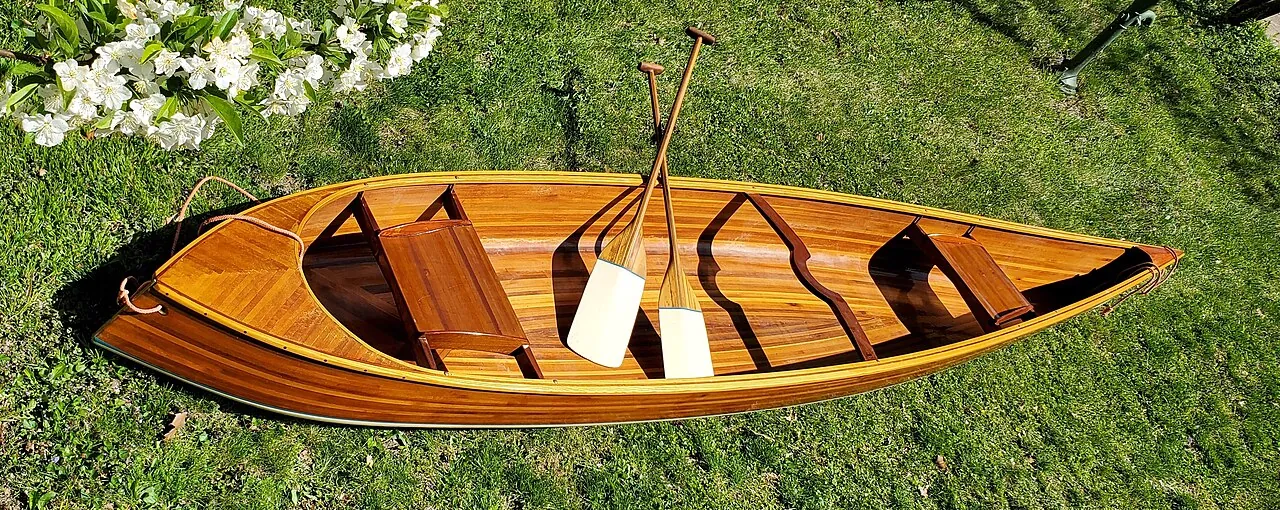
Building a Cedar-Strip Canoe
The home builder's canoe: plans and a strongback, plywood forms at stations, laminated stems, cedar strips milled with bead-and-cove edges and glued edge to edge, fairing, fiberglass set in epoxy inside and out, then gunwales, seats, and varnish.
- 4 min
- 8 steps
- 3 questions
- Lesson 91 of 160
In this lesson
- Plans first
- Strongback and forms
- Strips
- Fairing
- Glass and epoxy
- Finishing
- Try it
- What to take from this
Picking up where you left off.
Plans first
A strip canoe starts with a design and full-size plans or station drawings; Jim Clem’s step-by-step build starts there and points to Ted Moores’s Canoecraft as the standard reference 1. The plans give the shape of the hull at each station, a cross-section at a fixed spacing along its length.

Strongback and forms
- Strongback: a long, straight, level box beam that holds everything 1.
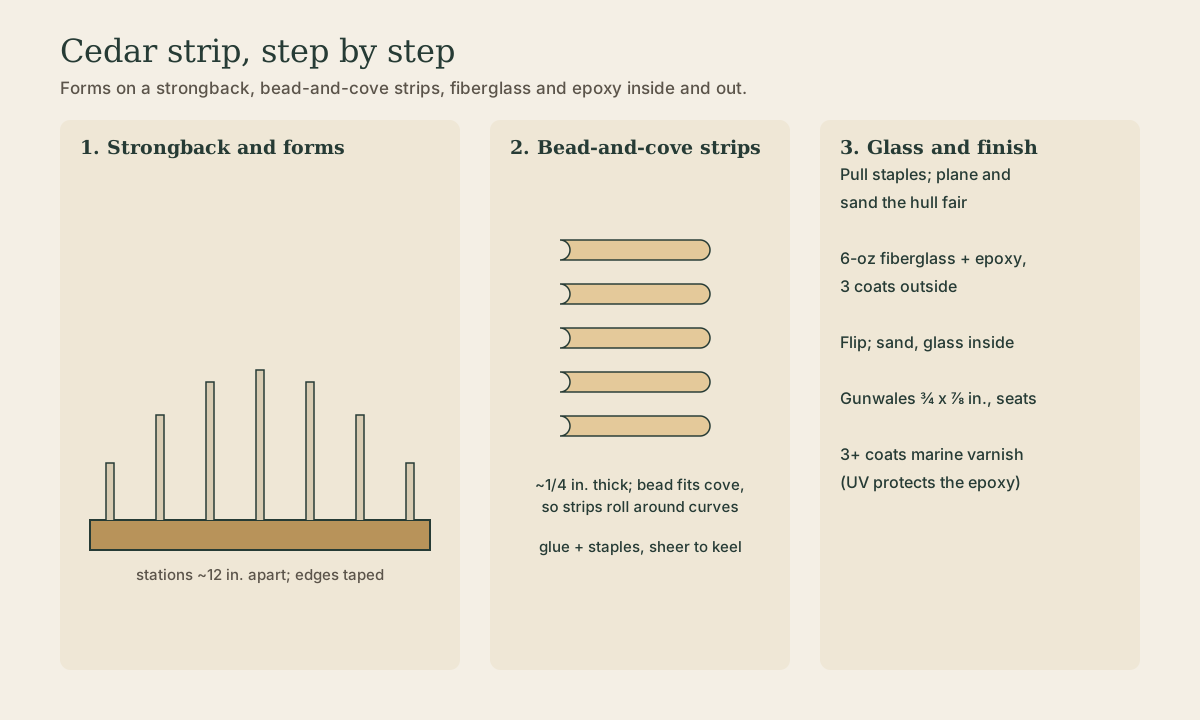
- Forms: plywood cross-sections cut from the plans, typically one every 12 inches, screwed to the strongback and lined up with a string down the center 1 2.
- Tape the form edges so glue squeeze-out doesn’t bond the hull to them 1.
- Stems: inner stems at each end, laminated from thin strips glued over a bending form 1.
Quick check
The hull has to lift off the forms once it’s glassed outside.
Strips
Strips are ripped from clear cedar boards, about 1/4 inch thick, then milled with a bead-and-cove router bit set: a rounded bead on one edge, a matching hollow cove on the other 1 2. Each strip nests into the one below and the joint stays tight as the hull curves.
Stripping starts at the sheer and works toward the keel line. Each strip is glued to its neighbor and stapled to the forms (or held with clamps) until the glue sets 1. Wash off squeezed-out wood glue while it’s wet: dried glue won’t take epoxy 2.
Quick check
A 1/4-in. bead-and-cove router bit set makes the matching edges.
Fairing
With the hull stripped and the staples pulled, the outside is faired: planed and sanded until the strips form one smooth surface with no flats or ridges 1. Fairing is where the canoe’s lines show. Feel for highs and lows with a flat palm, not your eyes.
Glass and epoxy
The outside gets 6-ounce fiberglass cloth laid dry and wet out with epoxy; it turns clear, so the cedar shows through 1 2. More coats of epoxy fill the weave. Then the hull comes off the forms, the inside is faired, and it’s glassed the same way 1. The result is a sandwich: fiberglass, cedar core, fiberglass, light and stiff. (On a strip kayak, Alan Bergen used 6-ounce cloth on the hull and lighter 4-ounce on the deck 2.)
Quick check
Glass cloth wets out clear, so the cedar shows through; varnish adds UV protection.
Finishing
- Gunwales: about 3/4 by 7/8 inch, glued and screwed on 1.
- Seats hung from the gunwales, thwarts, and decks.
- Varnish: at least three coats of marine varnish 1. Epoxy breaks down in sunlight, so the varnish (with UV inhibitors) protects it; Bergen used nine coats of spar varnish 2.
Playback is optional. If the player is unavailable, open the video at its source.
Try it
Before committing to a canoe, make a strip-built test panel: mill a dozen strips of cedar with a bead-and-cove bit, glue them edge to edge over two curved plywood forms, fair the panel, and glass one side with 6-ounce cloth and epoxy. It teaches every step at bench scale, and you’ll know how your router, glue, and epoxy behave before the real thing.
What to take from this
A strip canoe is built from plans: plywood forms at about 12-inch stations on a strongback, edges taped, with laminated stems. Cedar strips about 1/4 in. thick are milled bead-and-cove, glued edge to edge, and stapled to the forms. The hull is faired, glassed outside with 6-oz cloth in epoxy, lifted off, and glassed inside. Gunwales, seats, and several coats of UV-blocking varnish finish it.
Lesson complete
Nice work.
Sources for this lesson
- 1Jim Clem. This Is How to Build a DIY Cedar Strip Canoe. Bangor Daily News. 2016. verifiedTwenty-three steps from research and plans through strongback, plywood forms typically at 12-in. stations, taped form edges, milled strips with a 1/4-in. bead-and-cove bit, laminated stems, gluing and stapling, fairing, 6-oz fiberglass in epoxy outside and in, 3/4 x 7/8 in. gunwales, hung seats, and at least three coats of marine varnish; cites Ted Moores's Canoecraft.
- 2Alan Bergen. Building a Strip Kayak. Epoxyworks (WEST SYSTEM). 2022. verifiedCedar boards ripped into 1/4-in. strips with bead and cove edges; forms from full-size plans aligned with a string; wash off squeezed-out wood glue so epoxy bonds; 6-oz fiberglass on the hull and 4-oz on the deck in epoxy; nine coats of spar varnish with UV inhibitors.