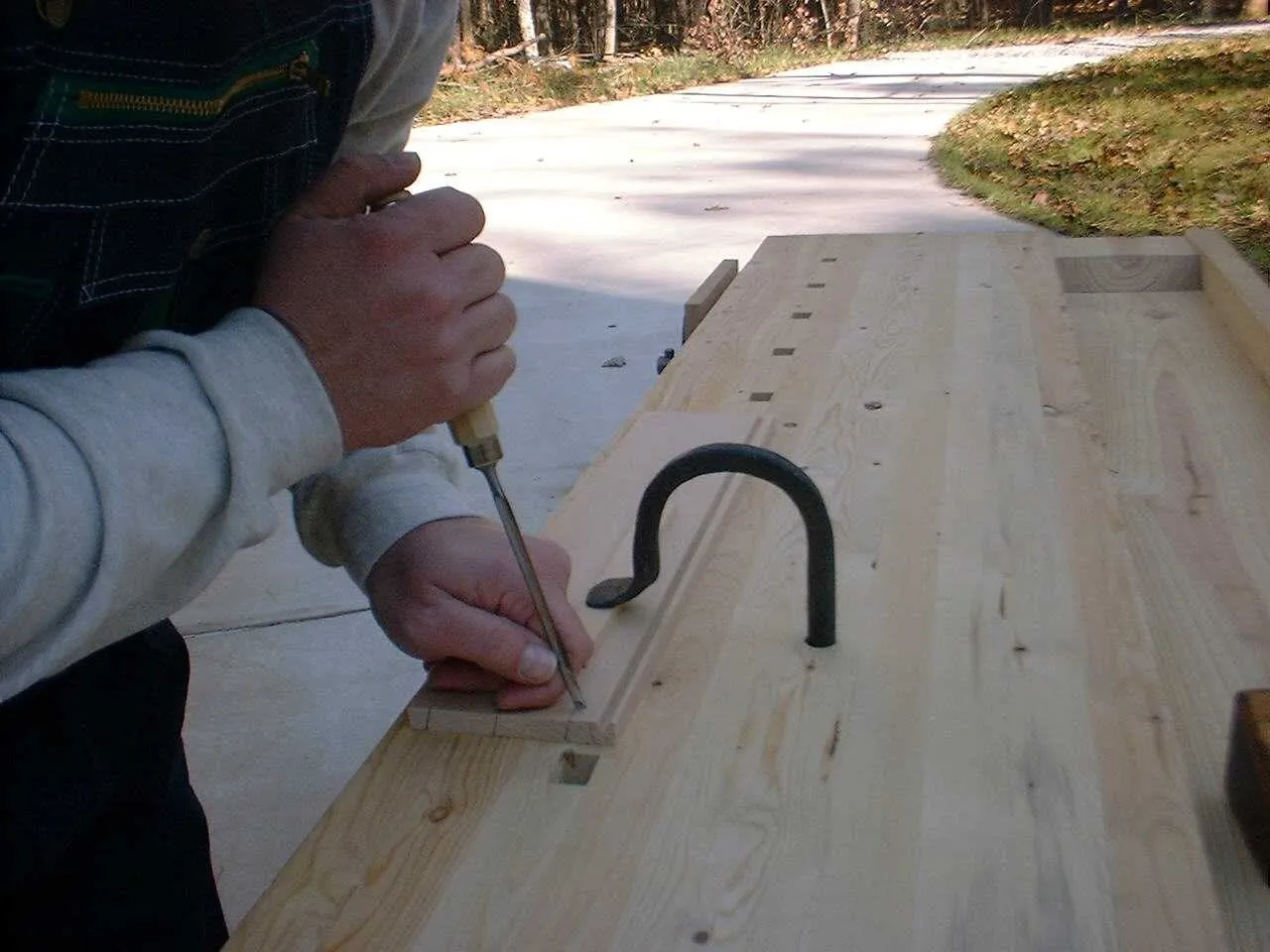
Holdfasts, Planing Stops, and Simple Workholding
How a 17th-century bench held work with almost no hardware: the holdfast and why it grips, the planing stop, the bench screw with pegs in the leg, the double screw, and setting them up on a modern bench.
- 4 min
- 6 steps
- 3 questions
- Lesson 50 of 160
In this lesson
- A bench that holds work with almost nothing
- The holdfast
- The planing stop
- The bench screw and pegs
- On a modern bench
- What to take from this
Picking up where you left off.
A bench that holds work with almost nothing
Moxon’s workbench (Plate 4 of Mechanick Exercises) is a heavy slab on legs with a few simple devices: a holdfast, an iron planing stop, a bench screw, and holes in the legs for pegs 1. The picture appears to be borrowed from André Félibien’s French book of 1676, but the text is clear about how each device works 1.

The holdfast
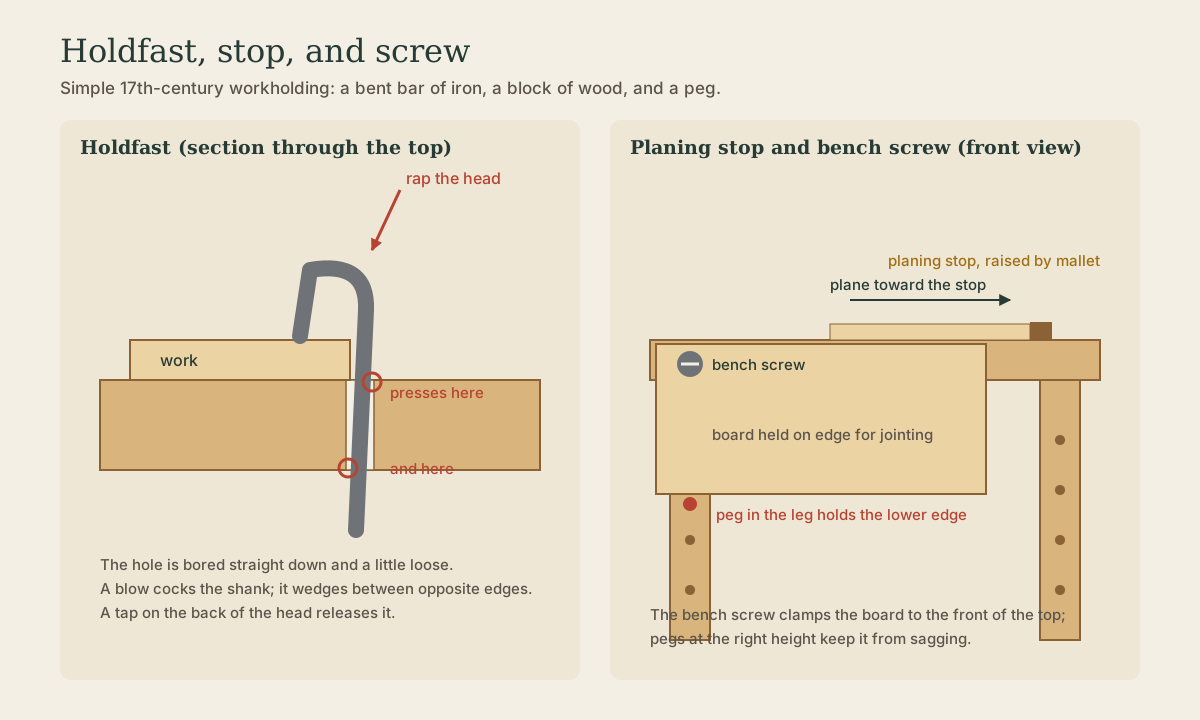
Moxon describes it precisely 1: a bent iron with a beak, dropped loosely into a round hole bored straight down through the top. Knock the head with a mallet and the beak presses the work, which cocks the shank in the hole: it presses hard against the hole’s upper edge on one side and the opposite lower edge on the other, and wedges there. Its job is to hold work while you saw, cut tenons, mortise, or sometimes plane.
- Release: rap the back of the head and it pops loose.
- Hole size: drilled to the shank’s diameter (often 3/4 in.) with a little play; a top 2-4 in. thick grips best.
- Age: the earliest image Schwarz knows is in a painting by Annibale Carracci (1560-1609); the tool is probably older 1.
- Probate inventories list them too: the 1633 estate of John Thorp, a Plymouth carpenter, included “An holdfast 1s6d” 2.
A pair of holdfasts and a scattering of holes across the top and down the front legs replace most vises.
Quick check
The hole is bored straight and a little loose; the bent beak levers the shank sideways.
The planing stop
Moxon calls it the bench hook: an iron hook with teeth, set in a mortise in the top and knocked up or down with a mallet 1. You plane a board against it. Schwarz notes the drawbacks: an iron stop can nick a plane iron and marks the end grain. That’s fine on 17th-century work, where the marks remain, or 18th-century work, where mouldings hide them. A wooden stop, or one with nails driven through at an angle so only their tips bite, works too. Metal stops hold narrow stock (under about 6 in.) better than wide 1.
Quick check
Today ‘bench hook’ means a wooden sawing aid; Moxon’s was a toothed iron stop in the benchtop.
The bench screw and pegs
To joint a long board’s edge, Moxon clamps it to the front of the top with a single bench screw and rests the lower edge on a peg in one of the holes bored down the leg, moved up or down to suit the board’s width 1. If the board shakes under the jointer, he warns, the joint will hardly come out straight 1.
The double screw, a two-screw vise, can sit on the bench secured by holdfasts. Jennie Alexander and Peter Follansbee use one like a big handscrew for holding work to be tenoned or moulded, and Schwarz uses it for dovetailing 1.
Playback is optional. If the player is unavailable, open the video at its source.
Quick check
If the board shakes under the plane, Moxon warns, the joint will hardly come out straight.
On a modern bench
- Bore 3/4-in. holes for holdfasts in a pattern that reaches anywhere on the top, and a column down a front leg for a peg.
- Add a planing stop: a hardwood block in a snug mortise near the left end, tapped up for use.
- A batten screwed to the top makes a quick doe’s-foot or crochet-style stop for planing.
- A two-screw vise that clamps to the bench with holdfasts handles dovetails and tenons.
What to take from this
A holdfast grips because a blow cocks its shank to wedge in a loose, straight hole. Moxon’s “bench hook” is a toothed planing stop. A bench screw and a peg in the leg hold a long board on edge for jointing, and a double screw secured with holdfasts handles tenons and dovetails. A thick top with holes and these few devices holds nearly anything.
Lesson complete
Nice work.
Sources for this lesson
- 1Joseph Moxon, Christopher Schwarz. The Art of Joinery (2nd ed.). Lost Art Press. 2013. verifiedMoxon's 1678/1703 Mechanick Exercises joinery section with commentary. Fore plane with cambered iron set rank (shilling-thick shavings, about 0.04 in.), jointer set to a hair, smoothing plane set very fine; traversing; holdfast and planing stop; use the coarsest tool as long as possible.
- 2Peter Follansbee. Joiner's Work. Lost Art Press. 2019. verifiedNew England oak joinery from about 1620-1630 to the late 17th century, when joiners' riven oak work gave way to cabinetmakers' sawn maple, pine, and later mahogany; frame-and-panel, carving, carved boxes, joined chests; 1633 Plymouth probate inventories of tools.